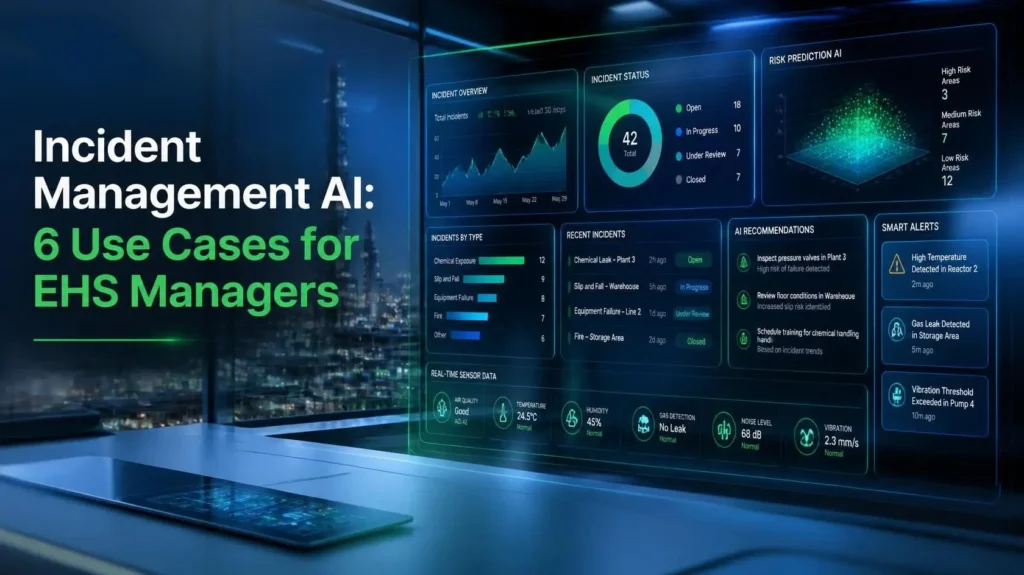
Incident management AI is now standard equipment in the EHS function — and two numbers from 2026 sit uncomfortably beside each other. In its 2026 EHS Benchmarking Report, Benchmark Gensuite found that 90% of incidents, hazards and near misses go unreported — worse than the 79% recorded the previous year. In the same research, 92% of EHS leaders said they now use generative AI, and its single most common application, cited by half of them, is summarising incident and near-miss reports.
Read those together and the picture is awkward. The profession has deployed its most powerful new tool at the analytical end of a pipeline whose intake is collapsing. We are getting much better at describing the tenth of reality that reaches us. This guide maps where incident management AI genuinely earns its place across the lifecycle, where it quietly makes things worse, and what an EHS manager should ask a vendor before signing anything.
Who should read this
- EHS and HSE managers
- Safety directors and site leads
- Operational risk managers
- Quality and CAPA owners
- Teams evaluating EHS software
- Internal audit reviewing safety data
🔑 Key takeaways
- Under-reporting is the binding constraint, not analysis quality. At 90% unreported and rising, most AI investment is applied to a shrinking sample of what actually happened.
- Only one use case changes the denominator: removing friction from capture. Everything else improves what you do with reports you already have.
- Adoption is broad but shallow. A 2026 survey of 864 EHS professionals ranked AI second for effectiveness and last for popularity — interest has not converted into routine use.
- Surveillance backfires. Camera-based monitoring that workers read as scrutiny rather than protection reduces reporting, which attacks the constraint from the wrong side.
- Accountability cannot be delegated to a model. ISO 45001 clause 10.2 requires a named person to determine causes and evaluate corrective action effectiveness.
On this page
- The number that reframes everything
- Where incident management AI sits
- Six incident management AI use cases
- The surveillance trap
- Why AI inherits your reporting culture
- Who signs the investigation
- A sensible implementation sequence
- Six questions for a vendor demo
- Common incident management AI mistakes
- The bottom line
- Frequently asked questions
The Number That Reframes Everything
Safety programmes are measured on what gets recorded. That is a convenient fiction as long as recording is roughly proportional to reality — and in 2026 it is not. The Benchmark Gensuite research puts under-reporting at 90% and, more troubling, shows it moving in the wrong direction year over year. Independent studies of near-miss reporting have long placed the gap between 50% and 90%, so the direction of travel matters more than the precise figure.
The deterioration has visible causes. The same report identifies increased operational demand (44%) and workforce shortages (42%) as the leading contributors to incidents, followed by time pressure (33%) and insufficient training (32%). A workforce under those conditions does not file optional paperwork. Meanwhile injury frequency rose for 45% of respondents, up from 18% the year before, and severity rose for 39%, up from 13%.
So the operating picture is: more incidents, fewer of them recorded, and a profession investing in tools that read the record. The diagram below shows where that investment actually lands.
The amber box is the only intervention that widens the intake. Every other use case in this guide operates downstream of it — valuable, but on a sample you have already lost most of.
Where Incident Management AI Sits in the Lifecycle
An incident passes through six stages between happening and being learned from. Incident management AI capability is uneven across them, and knowing which stage a vendor feature actually touches prevents most disappointment.
| Stage | The work | AI maturity | Effect on the 90% |
|---|---|---|---|
| 1 · Capture | Turning an observation into a record | High | Direct |
| 2 · Triage | Severity, duplicates, routing | High | None |
| 3 · Investigation | Evidence, sequence, precedent | Moderate | None |
| 4 · Root cause | Determining underlying causes | Low | None |
| 5 · Corrective action | Designing and closing CAPAs | Moderate | Indirect |
| 6 · Learning | Patterns across sites and time | High | Indirect |
The final column is the one most evaluations omit. Only capture changes how much of reality enters the system. Stages 5 and 6 affect it indirectly and slowly: when workers see that reports produce visible fixes, reporting rates rise. Stages 2 to 4 do not touch the intake at all — which does not make them worthless, but does mean they should never be sold as a solution to under-reporting.
Six Incident Management AI Use Cases That Earn Their Place
Each of the following is distinct, operates at a different stage, and has a specific question you can put to a vendor. The maturity tag reflects what is demonstrably working in production today rather than what appears on roadmaps.
Voice and photo capture in the field
ProvenA worker in gloves, at height, or mid-shift will not complete a fourteen-field form. Speech-to-text with structured extraction lets them describe what happened in thirty seconds; the model converts free speech into a categorised record with location, equipment, injury status and severity fields populated. Photo capture with automatic scene and object tagging does the same for conditions that are easier to show than describe.
This is the only application on this list that attacks the 90%, because it removes the friction that causes most non-reporting among workers who did notice something. It is also the least glamorous, which is why it is frequently deprioritised in favour of dashboards.
Ask the vendor: how long does a near-miss report take from opening the app to submission, on a phone, with gloves on, in a noisy environment — measured, not estimated?
Severity triage and SIF-potential flagging
ProvenMost reports describe minor events; a few describe events whose potential outcome was catastrophic. Classification models trained on historical records score incoming reports for serious-injury-and-fatality potential rather than actual outcome, pushing the dangerous minority to the front of a queue that would otherwise be processed in arrival order.
Duplicate detection belongs here too — the same event reported by three people across two shifts appears as three investigations until something reconciles them. In the Benchmark Gensuite data, triage workflows that guide next steps are among the most common agentic AI applications, cited by 37% of respondents.
Ask the vendor: show me a report the model escalated that a human reviewer would have filed as routine — and the reasoning it gave.
Precedent retrieval during investigation
ProvenThis is the capability humans genuinely cannot match and it is consistently undersold. When an investigator opens a case, the system surfaces the eleven structurally similar incidents from the past six years across every site — same equipment class, same task type, same failure mode — including what was concluded and whether those actions held.
No investigator remembers an incident from a plant they have never visited, recorded before they joined. Retrieval across the full corpus turns institutional memory from something that leaves with people into something that stays. Note the distinction from use case 6: this is precedent for one open case, not trend analysis across the portfolio.
Ask the vendor: does retrieval span all sites and all years, or only the current site and the current platform’s data?
Root cause challenge — not root cause authoring
Use with careGenerative models write plausible causal narratives, and plausibility is precisely the hazard. A model that produces a fluent Five Whys chain invites an investigator to accept it, and the most common investigation failure — stopping at operator error rather than reaching the system condition that made the error likely — is exactly the failure a fluent narrative reinforces.
The defensible configuration inverts the role. The investigator writes the causal chain; the model interrogates it. Does this cause explain all the evidence? What contradicts it? Which control was assumed effective without verification? Used this way, AI raises investigation quality. Used as an author, it industrialises shallow analysis.
Ask the vendor: can the tool be configured to critique a human-authored root cause rather than generate one?
Corrective action design and closure prediction
EmergingTwo separate jobs sit here. The first is nudging actions up the hierarchy of controls: when a proposed CAPA is “retrain the operator” for a hazard that engineering could eliminate, the system flags that the chosen control sits at the weak end and offers precedents where a higher-order control was used for the same failure mode.
The second is predicting which actions will slip. Models trained on closure history — owner workload, action type, historical slippage by department, elapsed days since assignment — identify at-risk CAPAs while intervention is still cheap. Since corrective action closure rate is one of the leading indicators most strongly associated with lower injury rates, this is a direct lever on outcomes rather than a reporting convenience.
Ask the vendor: does the platform track effectiveness verification after closure, or only closure itself?
Cross-site leading indicator correlation
ProvenSerious incidents are preceded by drift that is visible only in combination: near-miss reports rising on one line while inspection completion falls, corrective actions ageing past target, training certifications lapsing. Each signal individually looks tolerable. Together they describe a site moving toward an event.
Correlating these continuously across sites is straightforward for a model and effectively impossible for a person reviewing dashboards monthly. The output that matters is not a risk score but a ranked list of sites with the specific combination of signals driving each ranking — a score without its drivers cannot be acted on.
Ask the vendor: when the model flags a site, does it name the contributing signals or only produce a number?
The Surveillance Trap
Of all incident management AI capabilities, computer vision for safety has matured most visibly — PPE detection, exclusion-zone monitoring and hazardous-condition identification from camera feeds are all in production in 2026. The technology works. The organisational consequence is where programmes come undone.
When a lens is felt as judgement of the worker instead of a safeguard around them, reporting contracts. That reaction is rational: if the camera that spots a missing hard hat also documents who was wearing it, the safest individual behaviour is to avoid being recorded at all. A deployment that improves PPE compliance statistics while suppressing near-miss reporting has traded a visible metric for an invisible one, and the invisible one was the leading indicator.
The test to apply before deploying vision: can you state, in one sentence a supervisor would repeat accurately, what the system does and does not do with footage — and does that sentence survive contact with the workforce? If the honest answer involves individual attribution or disciplinary use, expect reporting rates to fall, and plan for that cost explicitly rather than discovering it in the following year’s data.
Why AI Inherits Your Reporting Culture
Every incident management AI model learns from your historical records. If those records were shaped by a culture where reporting attracted blame, the patterns the model finds are patterns of reporting behaviour, not patterns of risk.
The practical distortion is specific. Suppose Site A has an open reporting culture and files four times as many near misses as Site B, which has similar operations and a punitive supervisor. A model correlating report volume with risk will rank Site A as the higher concern. It is measuring willingness to speak, and the site that stays quiet — the genuinely dangerous one — is rewarded with a clean profile.
This is why fast, well-formatted output from weak underlying data is not a safety improvement. It is faster documentation of an incomplete picture, delivered with a confidence the underlying data does not support. Before trusting any cross-site ranking, check whether reporting rates per hours worked differ materially between sites; if they do, that difference is your first finding, not a variable to control for.
Who Signs the Investigation
ISO 45001 clause 10.2 requires an organisation to react to nonconformities, evaluate the need for action to eliminate root causes, implement action, and review the effectiveness of what was done. Every verb in that sequence attaches to the organisation — not to a system it operates.
The practical consequence for an EHS manager is that incident management AI output is an input to a judgement, never the judgement itself. A named investigator determines the causes. A named owner accepts the corrective action. A named person verifies effectiveness. When an inspector or an assurance provider asks how a conclusion was reached, “the platform classified it” is not a defensible answer; “the investigator considered the platform’s analysis alongside witness evidence and equipment records, and documented why they concluded X” is.
This has a documentation implication worth building in from the start: record where AI contributed, so the human contribution is visible by contrast. Our ISO 45001 implementation guide covers the wider management-system requirements this sits inside.
A Sensible Implementation Sequence
The order below sequences incident management AI by dependency rather than ambition — each step produces the data or the trust the next one needs.
- Measure your actual reporting rate first. Near misses per 100,000 hours worked, by site. Without this baseline you cannot tell whether anything you deploy later helped or simply looked busy.
- Remove capture friction before adding analysis. Voice and photo reporting on mobile, no login barriers at the point of observation, and a visible response to every report filed.
- Turn on triage once volume justifies it. Severity classification and duplicate detection pay off when a queue exists; deployed too early they add configuration overhead with nothing to sort.
- Add precedent retrieval when the corpus is large enough — typically a few years of structured records across multiple sites. Retrieval over a thin corpus returns weak matches and erodes investigator trust quickly.
- Introduce root cause support in challenge mode only, with investigators trained on why the model is not writing the analysis.
- Enable predictive leading indicators last, after you have confirmed that reporting rates are comparable across sites — otherwise the model ranks candour, not risk.
Six Questions for a Vendor Demo
The gap between marketing claims and functioning features remains wide across the incident management AI category. These six questions separate the two quickly, and each maps to a distinct failure mode rather than repeating the same probe.
| Question | What a poor answer tells you |
|---|---|
| Can you show this in a live environment, not a recorded demo? | The feature may be roadmap rather than product |
| What does the model do when it is uncertain? | No confidence handling means silent errors |
| How is AI-assisted content marked in the record? | Audit trail will not distinguish machine from human |
| Can it run on our historical data before purchase? | Performance claims are not testable on your reality |
| Which of your customers has published a reporting-rate change? | Outcome evidence is anecdotal |
| What happens to accuracy at a site with 200 records? | Small-site performance was never assessed |
Common Incident Management AI Mistakes
Programme mistakes
- Buying analytics before fixing capture, then measuring success by dashboard richness.
- Treating rising near-miss counts as deterioration rather than the intended result.
- Deploying camera monitoring without a stated, credible position on individual attribution.
- Comparing sites on incident volume without normalising for reporting rate.
Investigation mistakes
- Accepting a generated root cause because it reads well and arrives quickly.
- Letting AI-suggested corrective actions cluster at training and PPE.
- Closing CAPAs on completion rather than verified effectiveness.
- Leaving no record of where the model contributed to a conclusion.
The Bottom Line
Incident management AI has become genuinely useful — in triage, in precedent retrieval, in spotting the combinations of drift that precede serious events. Those capabilities are real, available now, and worth deploying in the order set out above.
But the profession should be honest about the shape of its own problem. With 92% of leaders using generative AI and its most common application being to summarise reports, the dominant use case improves how we describe what already reached us. Meanwhile the intake is narrowing.
AI has made us articulate about the tenth of reality that gets reported. The safety problem lives in the other nine-tenths — and that is a trust problem, not a technology problem. The most valuable thing an EHS manager can do with AI is spend it on making reporting effortless, then prove to the workforce that reports produce visible change. No model substitutes for that, and every model gets better once it is done.
Frequently Asked Questions
What is the single most valuable AI use case in incident management?
Of all incident management AI options, frictionless capture — voice and photo reporting that turns a brief spoken account into a structured record. It is the only application that widens the intake itself. Given that roughly nine out of ten events never reach the system at all, widening that intake is worth more than refining the analysis of what does arrive. Every other capability on this list, however sophisticated, works downstream of a sample already lost.
Can AI perform root cause analysis?
It can draft a causal narrative, which is not the same thing as analysing the event — and treating the two as equivalent carries a specific danger. Because generated explanations read convincingly, reviewers tend to sign them off, and the shallow conclusion that blames the individual rather than the conditions surrounding them is exactly the kind that survives such a review. Flip the roles instead: your investigator authors the causal chain, and the model interrogates it — probing for contradicting evidence and for barriers that were presumed to work but never checked.
Does AI-driven incident management satisfy ISO 45001?
A platform can support the requirement; it cannot carry it. Clause 10.2 places the duty on the organisation itself, and in practice that means identifiable individuals: someone determines the cause, someone owns the remedy, someone confirms it worked. What the model produces feeds those decisions rather than replacing them. Mark AI-assisted content in the record, so that under scrutiny the human reasoning behind each decision is easy to point to.
Will computer vision improve our safety performance?
It can, and it carries a specific risk that is often discovered late. PPE detection and exclusion-zone monitoring are technically mature in 2026, but a workforce that reads the lens as oversight of them rather than cover for them files fewer near misses. A deployment that raises PPE compliance while suppressing reporting has improved a visible metric at the expense of a leading indicator. Before deploying, be able to state plainly what the system does with footage — and whether that statement survives contact with the workforce.
Our incident data is patchy. Should we wait before adopting AI?
Not entirely — but sequence matters. Capture and triage tools work on thin data because they process each report as it arrives. Predictive leading indicators and cross-site ranking do not: they learn from history, and if that history reflects uneven reporting culture, the model will rank sites by candour rather than risk. Begin with capture, establish a normalised reporting rate for each location, and switch on predictive analytics only once those rates sit in a comparable range.
How do we know whether an AI feature is real or roadmap?
Ask to see the incident management AI feature in a live product environment rather than a recorded demo or slide, then run it on a sample of your own historical incidents before purchase. Two follow-ups are revealing: what the model does when it is uncertain, and how AI-assisted content is marked in the audit trail. Vendors with production features answer both immediately; vendors selling a roadmap tend to redirect to capability slides.
Where to Go Next
Compare the platforms delivering incident management AI in the incident management and wider EHS software categories — including SafetyCulture and Evotix for mobile-first frontline capture, Cority and Intelex for enterprise investigation and CAPA workflows, and VelocityEHS and SmartQHSE for predictive safety analytics. For the management-system context, see our ISO 45001 implementation guide, and use the free CAPA Tracker to keep corrective actions visible through to effectiveness verification. Every platform is scored using the AiGreenTools Evaluation Framework™. Standards context: ISO 45001 and OSHA recordkeeping requirements.