Reviewed by the AiGreenTools Editorial Team · Last Updated: June 2026
| Founded | 2004, Townsville / Sydney, Australia |
| Best for | Multi-site operations teams needing mobile-first digital inspections and frontline EHS workflow adoption |
| Industries | Construction, Manufacturing, Facilities, Hospitality, Logistics, Retail, Aviation |
| Pricing | Freemium — from $24/user/month (Premium); Enterprise custom |
| AI Classification | AI Enhanced |
| Key Standards | ISO 45001 (inspections and audits only), OSHA (incident reporting), RIDDOR (UK) |
| Maturity Stage | Stage 2–3 |
| Valuation | AUD 2.5 billion (September 2024) |
A Paper Inspection Is Not a Safety Process
The paper checklist on a clipboard is not an EHS failure. It is the symptom of one. The failure is that nobody knows whether the inspector read each question carefully, whether they actually checked the item, or whether they simply ticked every box to finish the round and return to their primary job. The paper goes into a filing cabinet. The filing cabinet is evidence of compliance. The compliance is evidence of safety. Except that it is not — and the next incident will prove it.
SafetyCulture was founded on this observation. Luke Anear, a former workers’ compensation investigator, spent years arriving at workplace accident scenes where the paperwork was in order and people had been hurt anyway. The connection between the documented process and the actual behavior had broken down invisibly. Paper records the intention. They do not record the action.
What SafetyCulture built — initially as iAuditor, a mobile inspection app launched after the smartphone revolution in 2011 — was a system that made the inspection itself digital: timestamped, photo-annotated, GPS-located, immediately reportable, and impossible to complete without engaging with each item. Not a management system. Not a regulatory filing platform. An inspection tool that frontline workers actually use — which turns out to be the problem no amount of enterprise EHSQ software had solved before it.
The Adoption Problem That Enterprise EHS Software Never Solved
The most expensive EHSQ platform in an organization is the one that frontline workers bypass. Enterprise EHS software is frequently purchased by safety directors, configured by IT departments, and resisted by the workers it was purchased to help. The system becomes a compliance record maintained by administrators rather than a safety tool used by the people doing the work.
SafetyCulture’s architecture inverts this dynamic. The product-led growth model — where individual workers can download and use the free tier before any corporate purchase is made — means adoption often precedes the procurement decision rather than following it. By the time an EHS manager evaluates the platform formally, workers on three sites are already completing weekly inspections in the app and sending digital reports to supervisors. The adoption problem has already been solved by the time the contract discussion begins.
By 2026, SafetyCulture is used by over 85,000 organizations across 180 countries, with 2 million workers using the platform daily and more than 50 million inspections completed through the system. For context: Intelex, one of the most established enterprise EHSQ platforms globally, serves approximately 1,400 customers after 30+ years of operation. SafetyCulture has achieved that scale not through enterprise procurement cycles but through product adoption.
What the Platform Actually Does — and How
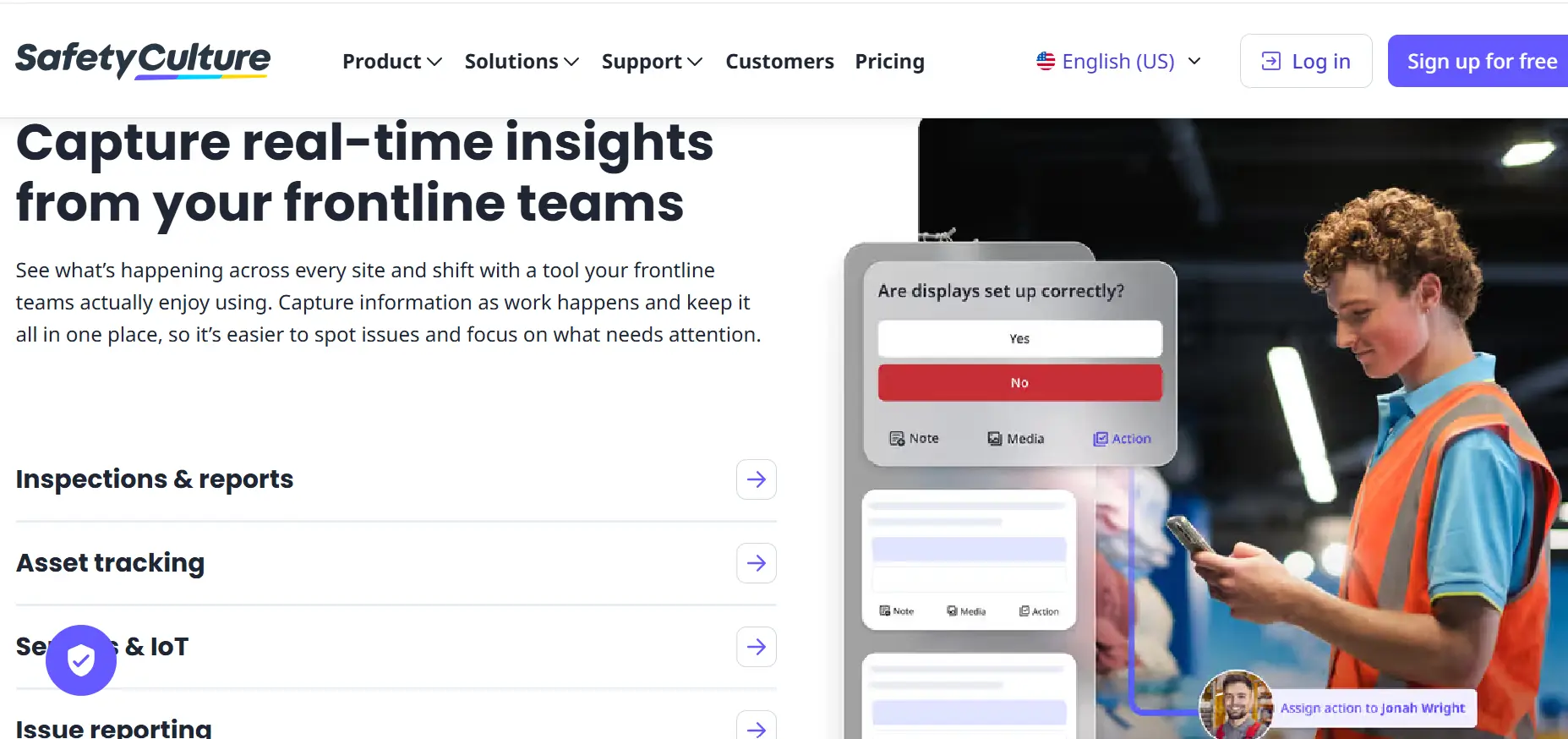
At its core, SafetyCulture is a mobile inspection engine. Workers conduct audits, safety walkthroughs, quality checks, equipment inspections, and toolbox talks through the app, completing structured checklists that were either built from the platform’s template library or created using the AI generation tool introduced in 2025. Every completed inspection is timestamped, signed, and immediately available for review — with photos and annotations attached at the point where an issue was found.
The AI template generation capability deserves attention as an operational tool rather than a marketing feature. An EHS manager who previously spent a week converting a paper inspection form into a digital format — working with IT to build forms, test workflows, and deploy to devices — can now describe the inspection they need in natural language and receive a complete, structured checklist in seconds. This capability has a specific operational impact: it removes the primary barrier that prevents organizations from digitizing inspection processes they know should be digital but have never prioritized because the effort required was disproportionate to the perceived benefit.
The Actions workflow closes the loop that most inspection tools leave open. When an inspector identifies a defective fire extinguisher, a damaged walkway, or an improperly stored chemical, the app immediately creates an Action: assigned to a named owner, with a priority level and due date. That action appears in the owner’s dashboard and in the EHS manager’s reporting view. It cannot be forgotten in a filing cabinet. The resolution requires a close-out action — often with a photo of the corrected condition — that creates a documented record of the remediation. For organizations that can demonstrate to an insurer or an HSE inspector that identified hazards are systematically tracked to resolution, this capability has direct financial value.
The Near-Miss Data That Changes Safety Culture
Lagging safety indicators — Total Recordable Incident Rate (TRIR), Lost Time Injury Frequency Rate (LTIFR), severity rate — measure outcomes that have already occurred. They are essential for regulatory compliance and benchmarking, but they cannot tell an EHS manager which hazard is going to hurt someone next week. Leading indicators — near-miss reports, hazard observations, unsafe condition identifications — provide that visibility, but only if the reporting system is frictionless enough that workers actually use it.
The consistent pattern in SafetyCulture deployments is that near-miss reporting increases substantially within the first 90 days. Not because more near-misses are occurring, but because reporting has become easy enough that workers actually report them. A near-miss observed on a production floor can be logged with a photo and a brief description in under 60 seconds on a mobile device, without leaving the workstation, without filling in a paper form, and without the social friction of walking to a supervisor’s office to report something that “might not matter.” This data accumulates into a view of leading safety indicators that most organizations have never had access to — and that ISO 45001 Clause 9.1 requires for a well-functioning management system performance evaluation process.
The Extended Platform — EdApp, Assets, and Sensors
SafetyCulture has expanded beyond inspection software toward what it describes as a “frontline operations platform.” EdApp, its integrated micro-learning module, enables training content to be embedded in inspection workflows — when a worker flags a specific competency gap, a training module can be assigned immediately within the same session. Asset management links physical equipment to inspection records and maintenance history. Sensor integrations extend data collection from manual inspection to continuous environmental monitoring.
This expansion strategy reflects a genuine market opportunity: organizations that have digitized their inspection process often discover that the same frontline teams need training management and asset compliance tools, and the convenience of a single mobile interface is operationally valuable. For organizations in construction, manufacturing, or facilities management where equipment compliance is a significant portion of the EHS program, the integration of asset records with inspection history in a single platform reduces administrative fragmentation.
The acquisition of Twine in April 2026 signals SafetyCulture’s continued expansion toward workforce connectivity and frontline communication tools — consistent with the platform’s trajectory toward becoming the operating system for the frontline workforce rather than a point tool for EHS inspections.
Who Uses SafetyCulture — and What That Signals
SafetyCulture’s customer base includes Krispy Kreme and Marriott — brands that need consistent operational standards across hundreds of locations where frontline workers have no technical background and where the safety process must be fast, simple, and adoptable by a new employee in their first week. This is the profile the platform was designed for. It is also the profile that explains why Fortune 500 EHSQ Directors rarely choose it as their primary enterprise EHS platform.
The industry distribution of SafetyCulture users — construction (12% of reviewers on Capterra), facilities services (5%), utilities (4%), food and beverage, hospitality — reflects a tool designed for operational environments where inspections happen in the field, not at a desk, and where the person conducting the inspection has limited time and no patience for complex software. This is not a limitation. It is the strategic position.
SafetyCulture vs. the Enterprise EHSQ Market
The honest positioning of SafetyCulture relative to the enterprise EHSQ market is this: it occupies a different quadrant. Intelex is a comprehensive EHSQ management system designed for large enterprises pursuing ISO 45001, ISO 14001, and ISO 9001 certification simultaneously, with contractor management, occupational health surveillance, permit-to-work, and management of change workflows. Cority serves industrial organizations where occupational health integration is a core requirement. VelocityEHS specializes in US regulatory compliance — OSHA process safety management, EPA reporting, chemical management.
SafetyCulture serves the organization that has not yet reached the complexity that requires those platforms — or that operates alongside them to solve the frontline adoption problem that enterprise platforms structurally cannot crack. Several organizations run SafetyCulture for field inspections and near-miss reporting and Intelex for management system documentation and regulatory compliance — using each tool for what it does best rather than forcing one to do both.
For an independent evaluation of EHS software standards and how SafetyCulture compares on ISO 45001 capability, see ISO’s official ISO 45001 resource page and Verdantix Green Quadrant: EHS Software 2025.
Who Should Not Buy SafetyCulture
Three profiles belong elsewhere. First: organizations pursuing ISO 45001 certification whose audit scope will include Clause 10.2 corrective action management, Clause 8.1 operational planning and control (including permit-to-work and management of change), and Clause 7.2 competency management. SafetyCulture cannot generate the documented management system evidence that ISO 45001 certification requires across these clauses. An implementation consultant who tells you otherwise is preparing you for a failed certification audit.
Second: large industrial organizations with significant contractor management requirements — where contractors must be prequalified, monitored against safety performance criteria, and linked to site access controls. This is a managed process in platforms like Intelex and Cority. In SafetyCulture, it requires workarounds that create data governance problems at scale.
Third: organizations that need to generate regulatory submissions in specific mandated formats — OSHA 300/300A logs, HSE RIDDOR submissions, or environmental agency reports in prescribed templates. SafetyCulture’s report export capabilities are flexible but are designed for internal communication, not for regulatory filing in legally mandated formats.
The Verdict
SafetyCulture is the right tool for the right problem. If the problem is that frontline workers are completing paper inspections that nobody reads, corrective actions that nobody tracks, and near-miss forms that end up in a drawer — SafetyCulture solves that problem faster and more reliably than any other tool in this directory. The adoption rate is real. The near-miss data is real. The time-to-value is genuinely measured in hours.
If the problem is that the organization needs a certified ISO 45001 management system, contractor management, occupational health surveillance, or enterprise-grade regulatory compliance documentation — SafetyCulture is the wrong tool, and deploying it will create a gap between the safety data the platform produces and the management system evidence the certification auditor requires. Know which problem you are solving before you sign the contract.