Reviewed by the AiGreenTools Editorial Team · Last Updated: June 2026
| Founded | 1985, Toronto, Canada (as occupational health software) |
| Investor | Thoma Bravo (December 2024 investment) |
| Best for | Fortune 500 enterprises with complex occupational health programs alongside EHS — pharmaceutical, mining, chemical, oil & gas, healthcare |
| Pricing | Custom / Enterprise — high six figures annually for global deployments |
| AI Classification | AI Enhanced (Cortex AI — SIF scoring, predictive risk, connected root cause) |
| Key Standards | ISO 45001, ISO 14001, ISO 9001, IATF 16949, OSHA, RIDDOR, GRI, CDP, SASB, CSRD |
| Maturity Stage | Stage 4 |
| Analyst Recognition | Verdantix Green Quadrant Leader — EHS Software 2025 (sixth consecutive year) |
The Financial Consequence of Disconnected Health, Safety, and Quality Data
The occupational disease cluster that OSHA investigates is not the first event in the sequence. It is the last. Before OSHA arrives, there are clinic visits — respiratory complaints, noise-induced hearing loss assessments, elevated biological monitoring results. There are industrial hygiene sampling records — area samples, personal samples, results compared to occupational exposure limits. There are near-misses flagged in the safety system at the relevant process. There is a quality nonconformance record documenting a process change at the same facility.
These data points exist. They sit in four different systems, managed by four different functional teams, with no architecture that connects them into an emerging risk pattern. An occupational health nurse sees the clinic records. An IH professional sees the sampling data. An EHS coordinator sees the safety near-miss. A quality manager sees the process change record. None of them, individually, sees what the data collectively tells.
Cority was founded in 1985 as an occupational health software provider — before it was an EHS platform, before it was a quality management system, before anyone described it as “converged EHS+.” The founding premise was specific: occupational health outcomes are the direct measurable consequence of workplace conditions, and managing those outcomes requires connecting the clinical data to the operational data that caused them. Forty years later, that premise has not changed. It has been extended — through acquisitions, platform investment, and the January 2025 Meddbase integration — into the most clinically capable EHSQ platform in the enterprise market.
CorityOne — What “Converged” Actually Means in Practice
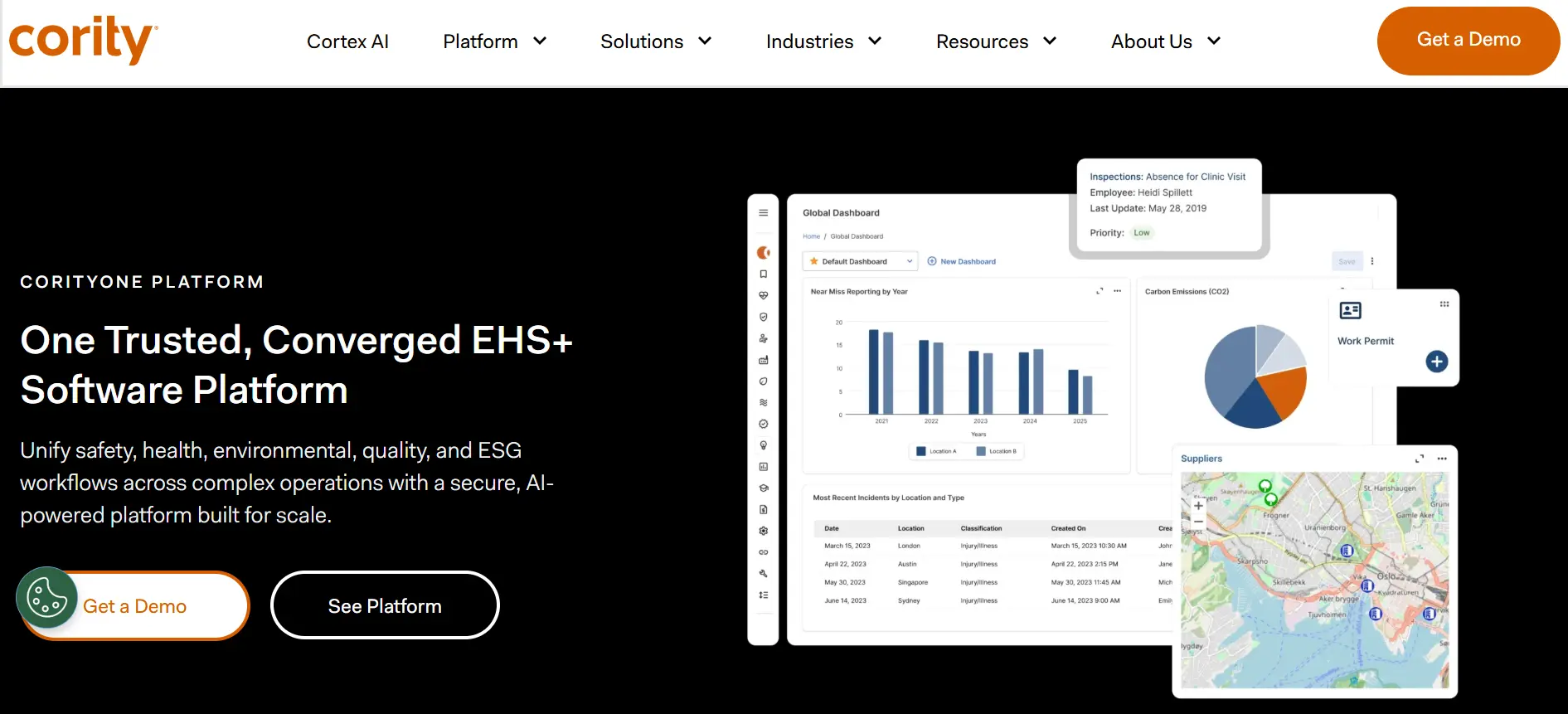
The enterprise EHS software market uses “unified platform” and “single system of record” as marketing descriptions for products that have stitched together previously separate modules. Cority’s CorityOne is architecturally different in a specific way: it shares a single data model across Health, Safety, Environmental, Quality, Sustainability, and Analytics — meaning that data entered in one module is immediately available to every other module without export, API transfer, or manual re-entry.
CorityOne’s six integrated clouds:
- Health: Medical surveillance, case management, clinic operations, biological monitoring, return-to-work — deepened by Meddbase occupational medicine capability
- Safety: Incident management, audits, inspections, observations, corrective actions, contractor management, permit-to-work
- Environmental: Air, water, waste compliance; emissions tracking (Scope 1/2); environmental permit management
- Quality: Nonconformance management, CAPA, document control, audit management — aligned with ISO 9001 and IATF 16949
- Sustainability: ESG data collection and reporting for CDP, GRI, SASB, CSRD
- Analytics: Cortex AI-powered dashboards, SIF scoring, predictive risk intelligence, connected root cause analysis
Aptiv’s implementation — replacing 20 disconnected EHS systems with a single CorityOne platform — illustrates what convergence produces at enterprise scale: consistent data quality across all EHSQ functions, faster access to performance intelligence for operational leaders, and elimination of the reconciliation overhead that consumes EHS teams in multi-system environments. The quantified business case for CorityOne is not primarily about features. It is about the cost of operating the fragmented alternative.
The Occupational Health Depth — Why It Is the Differentiating Capability
No other enterprise EHS platform in the market provides native occupational health clinical management at the depth Cority has built since 1985. The distinction matters most in three types of operational contexts.
Where Cority’s occupational health depth matters most:
- Pharmaceutical and chemical manufacturing: Medical surveillance for regulatory exposures — OSHA-mandated hearing conservation programs (audiometric testing records, audiologist review workflows), respiratory protection medical evaluations, chemical exposure biological monitoring (blood lead, urinary manganese, cholinesterase) — requires longitudinal clinical data management that general EHS platforms do not provide natively
- Mining operations: Silica exposure surveillance, noise-induced hearing loss programs, musculoskeletal case management for physically demanding roles, and return-to-work coordination for underground operations all require clinical depth alongside safety management
- Organizations with on-site occupational health clinics: Clinic appointment scheduling, nursing visit records, physician review workflows, clinical note management, and integration with laboratory results — the operational workflow of an occupational health clinic — is managed within CorityOne rather than requiring a separate clinical records system
The January 2025 acquisition of Meddbase extended this capability into outpatient occupational medicine practice management — bringing clinical workflow tools designed for occupational medicine practitioners into the CorityOne architecture. For organizations managing occupational health clinic operations alongside enterprise EHSQ programs, this integration creates a single clinical and operational record for each employee rather than parallel records in disconnected systems.
Cortex AI — Intelligence From Converged Data
Cortex AI — Cority’s AI layer — is architecturally distinctive because it operates on converged health, safety, environmental, and quality data rather than on a single domain. This matters because the most valuable EHS risk intelligence does not live within any single domain. It lives in the connections between them.
A SIF (Serious Injury and Fatality) potential score applied only to safety incident records misses the IH exposure trend in health records that is preceding the incident pattern. An AI root cause analysis that cannot access quality nonconformance records misses the process change that preceded the safety near-miss. Cortex AI’s access to the full CorityOne data model means its pattern detection operates across the boundaries that siloed systems enforce — producing the early warning signals that organizations consistently report finding too late in multi-system environments.
Cortex AI operates within governance controls appropriate to a regulatory compliance environment: AI recommendations are presented as decision support inputs to human EHS professionals, with clear indication of the data sources underlying each recommendation and with approval workflows that maintain the human accountability chain that ISO 45001 and OSHA regulatory compliance requires.
Cority vs. Intelex and VelocityEHS — Where Each Belongs
The enterprise EHS market has three primary platforms that serve different organizational profiles at similar scale. Understanding the differentiation helps buyers avoid evaluation errors that emerge from comparing feature lists rather than organizational fit.
Intelex is the strongest choice when multi-standard ISO certification management — ISO 45001, ISO 14001, ISO 9001 simultaneously, across multi-country operations — is the primary driver, and when the EHS program’s complexity is in its multi-country regulatory scope rather than its occupational health clinical requirements. Intelex’s 28-language support and multi-country regulatory library are advantages Cority does not match at equivalent depth.
VelocityEHS is the strongest choice for US operations where OSHA regulatory depth — specifically Process Safety Management, HazCom/GHS chemical management, and industrial hygiene program management — defines the compliance challenge. VelocityEHS’s US regulatory precision and SDS library depth exceed Cority’s for organizations whose primary compliance jurisdiction is OSHA.
Cority is the strongest choice for organizations where occupational health clinical management is a first-class operational function — where medical surveillance programs, case management from injury through return-to-work, and biological monitoring longitudinal records must be connected to safety incidents and quality data in a single analytical environment. This is the profile that pharmaceutical organizations, mining operations, and organizations with significant occupational exposure programs consistently represent.
For reference on occupational health surveillance requirements and ISO 45001 management system context, see our ISO 45001 implementation guide and the EHS KPI dashboard.
Who Should Not Buy Cority
Three profiles are better served elsewhere. Mid-market organizations with fewer than 2,500 employees, without dedicated occupational health functions, and without the implementation budget and internal project management capacity to absorb a multi-year enterprise rollout should evaluate EHS Insight, Evotix, or mid-market-appropriate EHS platforms first. The implementation complexity and total cost of CorityOne is calibrated for Fortune 500 enterprises, not for organizations without dedicated EHSQ IT resources.
Organizations whose primary EHS technology need is frontline inspection adoption — getting field workers to complete digital checklists, report near-misses, and receive safety communications on mobile devices — will find that CorityOne requires significantly more training and change management to achieve the frontline adoption that SafetyCulture achieves as a product-led baseline. For organizations where frontline adoption is the bottleneck, solving it first with SafetyCulture before deploying an enterprise management system is architecturally sound and financially rational.
Organizations whose sustainability program is their primary technology investment priority — CSRD disclosure governance, carbon accounting depth, Scope 3 supplier engagement — will find that Cority’s sustainability module addresses sustainability within the EHSQ program context rather than as a primary ESG platform. Combining Cority for EHSQ with Workiva or Novisto for formal CSRD disclosure is the correct architecture; expecting Cority’s sustainability module to replace a dedicated ESG disclosure platform will produce a gap at the first assurance engagement.
The Verdict
Cority is the right platform for Fortune 500 enterprises where occupational health outcomes and EHS performance are recognized as the same organizational risk — where the cost of not connecting clinical health records to safety incidents to quality nonconformances has already been demonstrated, in regulatory actions, disease cluster investigations, or workers’ compensation patterns that should have been visible months earlier from existing data. The CorityOne convergence architecture, the Meddbase clinical depth, and the Cortex AI risk intelligence that operates across connected data are purpose-built for that recognition. For organizations that have made it, the platform has no equivalent. For organizations still evaluating whether occupational health convergence is their problem — the evaluation itself is the answer.