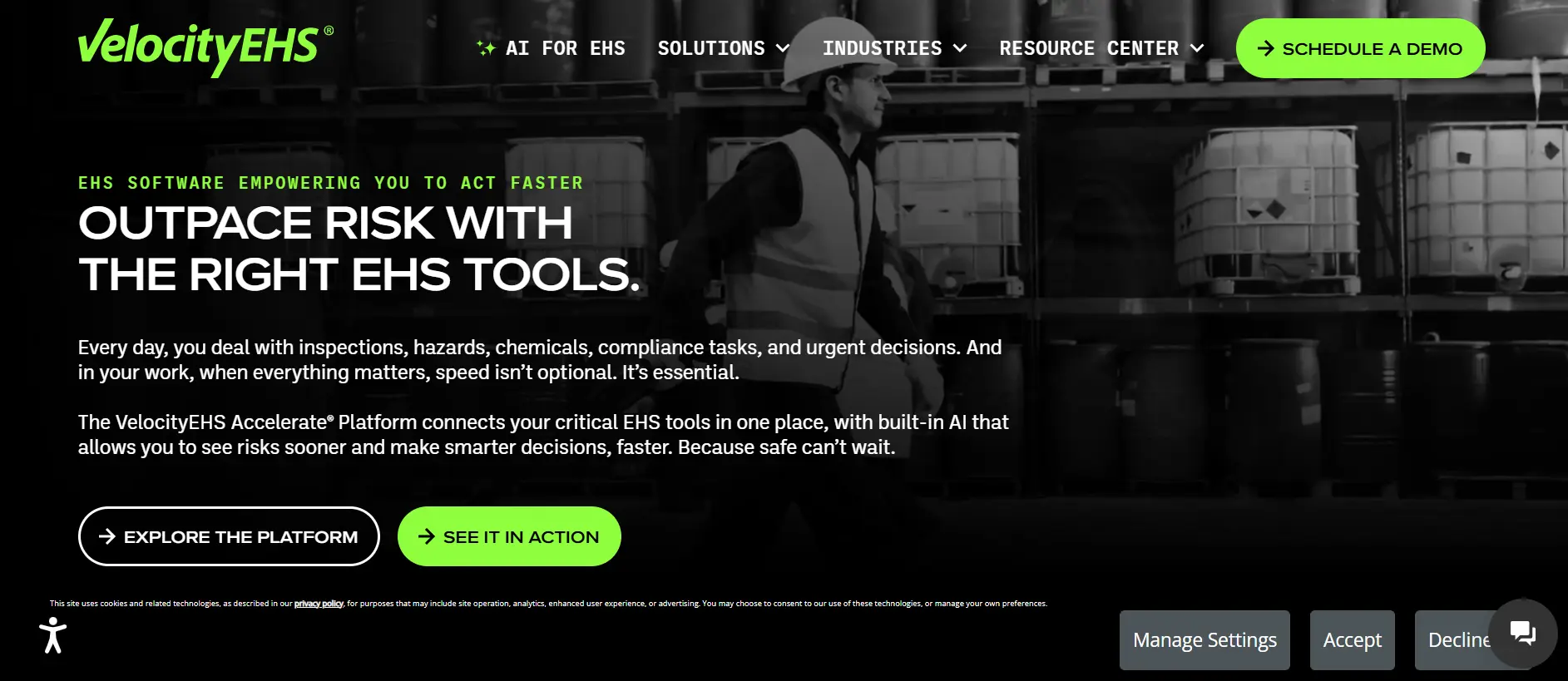
Reviewed by the AiGreenTools Editorial Team · Last Updated: June 2026
| Founded | 1996 (MSDSonline origins) / VelocityEHS brand 2016 |
| Best for | US manufacturing, chemical, pharmaceutical, food & beverage — OSHA PSM, chemical management, industrial hygiene |
| Industries | Chemical, Manufacturing, Pharmaceutical, Food & Beverage, Utilities, Oil & Gas, Retail |
| Pricing | Custom enterprise — module-based per user |
| AI Classification | AI Enhanced (VelocityAI — SIF scoring, ergonomics, contractor review) |
| Key Standards | OSHA 29 CFR 1910.119 (PSM), OSHA 1910.1200 (HazCom/GHS), EPA 40 CFR Part 68 (RMP), ISO 45001, REACH |
| Maturity Stage | Stage 3–4 |
| Analyst Recognition | Verdantix Green Quadrant Leader — EHS Software 2025 |
Most EHS Software Evaluations Start With the Wrong Question
The standard enterprise EHS software evaluation begins with: “Which platform has the most features?” The resulting comparison — a feature matrix across ten platforms — produces a shortlist calibrated to breadth rather than regulatory depth. For organizations whose EHS obligations are defined by specific US regulatory frameworks — OSHA Process Safety Management, EPA Risk Management Program, OSHA Hazard Communication Standard — breadth is not the evaluation criterion that matters. What matters is whether the platform was built by people who understand what an OSHA PSM inspector is looking for when they walk into a covered facility.
VelocityEHS’s answer to that question is specific. The platform grew from MSDSonline — a chemical SDS management service launched in the 1990s specifically to help organizations comply with OSHA HazCom requirements — and from Humantech, a firm staffed by board-certified professional ergonomists. These are not general technology acquisitions. They are domain expertise acquisitions that embed specialist knowledge into the platform architecture. The result is an EHS platform where chemical management, SDS authoring, GHS labeling, ergonomics, and industrial hygiene are first-class capabilities — not modules added to a general incident management core.
The question every US industrial EHS buyer should ask before evaluating VelocityEHS is not “does it have chemical management?” Every enterprise EHS platform has a chemical management module. The question is: “Was chemical management what this platform was designed from the beginning to solve?” For VelocityEHS, the answer is yes. For most of its competitors, the answer is not.
OSHA Process Safety Management — What Compliance Actually Requires
OSHA’s Process Safety Management standard (29 CFR 1910.119) covers operations handling highly hazardous chemicals above threshold quantities — refineries, petrochemical facilities, large chemical manufacturing, and other process industries where a release of covered chemicals could cause a catastrophic event. PSM requires 14 program elements, each with specific documentation and procedural requirements that an OSHA inspector will systematically examine during a process safety inspection.
The 14 PSM program elements VelocityEHS manages:
- Process Hazard Analysis (PHA): Documentation of HAZOP or What-If studies for covered processes — who participated, what hazards were identified, what recommendations resulted, and disposition status of every recommendation
- Management of Change (MoC): Authorization workflow for any change to process chemicals, technology, equipment, or procedures — with approved signatures and pre-startup safety review before restart
- Mechanical Integrity: Inspection and maintenance records for pressure vessels, piping systems, relief devices, and other PSM-critical equipment — with inspection intervals, findings, and repair documentation
- Pre-Startup Safety Review (PSSR): Documented review confirming that new or modified processes meet design specifications before startup
- Incident Investigation: Root cause investigation for incidents and near-misses that could reasonably have resulted in catastrophic release — within 48 hours per OSHA requirement
- Employee Participation, Operating Procedures, Training, Contractors, Emergency Response, Compliance Audits: Additional elements with specific documentation requirements managed within the platform
For an organization managing PSM compliance in a spreadsheet environment, the risk is not that the program doesn’t exist — it is that the documentation cannot be produced on demand when the inspector arrives. VelocityEHS’s PSM-aligned workflow management keeps PHA recommendations tracked to disposition, MoC authorizations timestamped and approved, and mechanical integrity records linked to equipment and inspection history in a system the inspector can navigate directly rather than requiring the EHS team to assemble documentation in real time.
Chemical Management — The SDS Library No Competitor Has Replicated
The SDS (Safety Data Sheet) management capability is where VelocityEHS’s heritage is most visible and most difficult for competitors to replicate. More than 10 million SDSs are indexed in the platform’s database — a library built over nearly three decades of HazCom compliance work that represents a barrier to entry no new entrant can bridge in a reasonable timeframe.
For chemical manufacturers, the SDS authoring tool enables compliant GHS-formatted SDS creation with the 16 required sections, proper hazard classification under OSHA’s adopted GHS framework, and label generation with hazard pictograms, signal words, and precautionary statements. AI-powered chemical data classification in VelocityAI maintains record consistency across large inventories, automatically validating SDS data fields and flagging inconsistencies that manual review would miss at scale.
For users of chemical products — manufacturing operations managing thousands of chemical products across multiple sites — the SDS management module provides centralized access, site-specific inventory tracking, and OSHA Right-to-Know compliance documentation. Employees can access current SDSs from any device at the point of work, which is the specific OSHA HazCom requirement that paper binders in facility hallways historically failed to meet. For multi-site operations, the ability to see which chemicals are present at which sites — and to manage hazardous inventory against OSHA threshold quantities — provides the chemical hazard visibility that PSM program management requires.
Ergonomics and Industrial Hygiene — Specialist Depth at Enterprise Scale
Musculoskeletal disorders (MSDs) — sprains, strains, and cumulative trauma disorders caused by ergonomic hazards — represent the largest category of workplace injury in US manufacturing, food & beverage, and logistics operations. They are also the injury category most frequently underaddressed in EHS programs because identifying and quantifying ergonomic risk at scale requires expertise and methodology that general EHS platforms do not provide.
VelocityEHS’s ergonomics capability reflects Humantech’s board-certified professional ergonomist knowledge base: workers use mobile devices to record video of job tasks, which the platform analyzes to produce MSD risk scores and risk factor breakdowns without requiring an ergonomist to be physically present for every job analysis. Risk prioritization across all jobs in an operation produces a ranked list of which jobs present the highest MSD risk — enabling EHS teams to allocate ergonomics intervention resources to the highest-risk tasks rather than responding reactively to reported injuries. This systematic, data-driven approach to ergonomics risk management is the capability that reduces DART (Days Away, Restricted, or Transferred) rates and workers’ compensation costs — the financial outcomes that make ergonomics investment justifiable to operations leadership.
The Industrial Hygiene module manages exposure assessment programs with a structure that IH professionals recognize: Similar Exposure Groups (SEGs), sampling data management with laboratory result integration, occupational exposure limit comparison against OSHA PELs and ACGIH TLVs, and biological monitoring record management. For organizations with hearing conservation programs, respiratory protection programs, or chemical exposure monitoring under OSHA’s health standards (1910.95, 1910.134, substance-specific standards), the IH module provides the longitudinal data management that programmatic compliance requires.
VelocityAI — Domain-Specific AI for Industrial EHS
VelocityEHS’s AI layer — VelocityAI — is structured around domain-specific EHS applications rather than generic machine learning capabilities. The practical applications in the 2025–2026 platform include:
- Contractor COI and OSHA log review: Automated processing of certificates of insurance and OSHA 300 logs for contractor prequalification, processing documentation 7x faster than manual review
- SIF potential scoring: AI classifies incidents by Serious Injury and Fatality potential — directing investigative depth to events that represent genuine catastrophic risk rather than treating all incident records with equal priority
- Chemical data auto-classification: Validates and maintains consistency of SDS data fields across large chemical inventories
- Ergonomic risk mapping: Video-based job analysis for MSD risk scoring without requiring physical ergonomist presence
- Compliance issue surface detection: Proactively flags potential regulatory compliance gaps before they become inspection findings
These AI applications are built by a team that includes PhD AI/ML scientists alongside certified safety professionals, board-certified ergonomists, and Certified Industrial Hygienists — the domain expertise that makes the AI output trustworthy in an EHS regulatory context where the consequences of incorrect AI guidance are a citable violation or a missed SIF event.
VelocityEHS vs. the Enterprise EHS Field
The EHS software market in 2026 has segmented along two dimensions that define where VelocityEHS sits relative to its primary competitors. Against Intelex: Intelex is the stronger choice for global operations needing ISO 45001/14001/9001 multi-standard certification infrastructure across multiple countries; VelocityEHS is the stronger choice for US operations where OSHA and EPA regulatory depth is the primary compliance requirement. Against Cority: Cority’s CorityOne is deeper on occupational health clinic management and medical surveillance integration; VelocityEHS is deeper on chemical management, GHS compliance, and ergonomics as standalone capabilities. Against SafetyCulture: SafetyCulture solves frontline inspection adoption; VelocityEHS manages the regulatory compliance infrastructure that sits above frontline inspection.
For organizations evaluating EHS software against the specific context of a US OSHA inspection, the question is not which platform has the broadest feature set — it is which platform was built by people who have spent decades navigating the specific technical requirements of HazCom, PSM, RMP, and industrial hygiene programs that OSHA enforcement targets. That is VelocityEHS’s answer to the market.
For EHS regulatory reference, see OSHA’s official Process Safety Management guidance and our ISO 45001 implementation guide for the management system context that complements PSM compliance.
Who Should Not Buy VelocityEHS
Three profiles are better served elsewhere. Global industrial organizations with primarily non-US regulatory obligations — where ISO 45001 certification management, EU EHS directive compliance, or Asia-Pacific regulatory frameworks dominate the EHS program — will find Intelex‘s multi-country regulatory library and 28-language support more precisely matched to their operational context.
Organizations whose primary EHS challenge is occupational health clinic management, medical surveillance at scale, and return-to-work program coordination — particularly healthcare systems, mining operations, and pharmaceutical manufacturers with on-site occupational medicine functions — will find Cority‘s occupational health module, deepened by the 2025 Meddbase acquisition, more comprehensively suited to those requirements.
Organizations without chemical inventories, industrial hygiene programs, or PSM obligations — service organizations, office-based businesses, or logistics operations where the primary EHS risk is slips, trips, and manual handling rather than chemical exposure and process safety — are paying for specialist capability they will not use. SafetyCulture or a purpose-built mid-market EHS tool serves their profile at more appropriate cost.
The Verdict
VelocityEHS is the right platform for US industrial EHS professionals who face specific regulatory obligations that generic EHS software was not built to address precisely: OSHA Process Safety Management, HazCom chemical compliance, GHS labeling, industrial hygiene program management, and ergonomic risk assessment at enterprise scale. The specialist heritage — MSDSonline’s SDS library depth, Humantech’s ergonomics expertise, and three decades of OSHA regulatory alignment — is embedded in the platform architecture rather than bolted on as a module. For the industrial organization where those specific capabilities determine the difference between a compliant OSHA inspection and a significant citation, VelocityEHS has no peer in its depth on those specific requirements.