EHS

SmartQHSE

QHSE-managed organizations in construction, infrastructure, industrial and oil & gas — especially ISO triple-certification (9001 + 14001 + 45001) programs and GCC / Middle East operations — that need Quality managed alongside Health, Safety and Environment on one shared data layer, with a regulation-grounded AI copilot for drafting QHSE documents and answering compliance questions.

Try this tool
AiGreenTools Score
73 / 100
Rating G2 / Capterra
4.5
★★★★½
out of 5 · G2 / Capterra
Pricing
freemium

AiGreenTools Score breakdown

How is this score calculated?
Sustainability Impact 13 / 20
Features & Capabilities 16 / 20
Value for Money 16 / 20
Ease of Use 16 / 20
Trust & Maturity 12 / 20

Key Information

Carbon Scopes
Scope 1 (Direct emissions) Scope 2 (Indirect energy)
Year Founded
2013

Reviewed by the AiGreenTools Editorial Team · Last Updated: July 2026

Category Integrated QHSE — Quality + Health + Safety + Environment on one platform
Best for ISO triple-certification programs & GCC/Middle East operations in construction, infrastructure, industrial, oil & gas
Standards ISO 9001 · ISO 45001 · ISO 14001 · OSHA 29 CFR 1926/1910 · CDM 2015 · OSHAD-SF · Dubai Municipality · Saudi MOL · Qatar Labour Law · NEBOSH/IOSH
Pricing Freemium — Free Solo tier · ARIA AI from ~$49/mo · paid team/enterprise plans
AI Classification AI Enhanced — ARIA copilot grounded in 734 regulatory KB chunks across 113 countries
Scale 120+ modules · used in 40+ countries
Maturity Stage Stage 2–3

Jump to:
The missing “Q” in EHS ·
True QHSE integration ·
ARIA — the AI copilot ·
GCC compliance & modules ·
vs. Intelex vs. SafetyCulture ·
Who should not buy

Most “EHS” Platforms Quietly Ignore Quality. That’s a Problem for ISO-Triple-Certified Organizations.

Search the EHS software market and you’ll notice something: almost every platform manages Environment, Health and Safety — and almost none of them manage Quality. Yet a huge share of construction, infrastructure, industrial and oil & gas organizations hold ISO triple certification: ISO 9001 (quality), ISO 14001 (environment) and ISO 45001 (safety). For them, the omission of quality forces an awkward reality — quality runs in one system, safety and environment in another.

The cost of that split is bigger than it looks. The four QHSE disciplines share the same core processes: audit management, corrective action, document control, non-conformance reporting, risk assessment, management review. Running quality separately from safety duplicates every one of them. Worse, it hides connections: a procedure that wasn’t followed can surface as a quality non-conformance in one system and a safety near-miss in another, and because the data lives in separate tools, nobody links the shared root cause.

SmartQHSE was built around closing exactly this gap — putting the “Q” back into EHS by managing all four disciplines on one data layer.

Quick Answer: SmartQHSE is an AI-powered QHSE platform that unifies Quality, Health, Safety and Environment on one shared data layer — adding the ISO 9001 quality management that most EHS/HSE tools omit. It offers 120+ modules, built-in GCC compliance (OSHAD-SF, Dubai Municipality, Saudi MOL, Qatar Labour Law), and ARIA, an AI copilot grounded in 734 regulatory knowledge-base chunks across 113 countries that drafts risk assessments and answers compliance questions with citations. A free Solo tier makes it accessible to individual HSE officers.

True QHSE Integration — One Data Layer, Four Disciplines

The integration is the product. When Quality, Health, Safety and Environment share one data layer, the duplication and blind spots of separate systems disappear.

Discipline Standard SmartQHSE coverage
Quality ISO 9001:2015 Non-conformances, supplier quality, quality audits, corrective actions
Health & Safety ISO 45001 / OSHA Incidents, near-misses, risk assessment, permits, training
Environment ISO 14001 Aspects/impacts register, waste records, emissions, monitoring
Unified All four One incident record, one audit trail, one CAPA process, one dashboard

💡 Why one data layer beats four systems

A single root cause — say, a procedure that wasn’t followed — can surface as a quality defect AND a safety near-miss. In separate systems, these are two unconnected records investigated by two teams. On SmartQHSE’s shared data layer, they’re linked to one root cause and one corrective action — better analysis, less admin, and a single management-review dashboard showing quality NCRs, safety incidents and environmental metrics together.

ARIA — A Regulation-Grounded AI Copilot

ARIA is SmartQHSE’s built-in AI copilot, and its design choice is what matters: it is grounded, not generic. Rather than a general chatbot, ARIA is described as trained on global HSE regulations, ISO standards and best practices, and grounded in 734 regulatory knowledge-base chunks across 113 countries — with the vendor emphasizing cited answers over free-form generation.

What ARIA actually does:

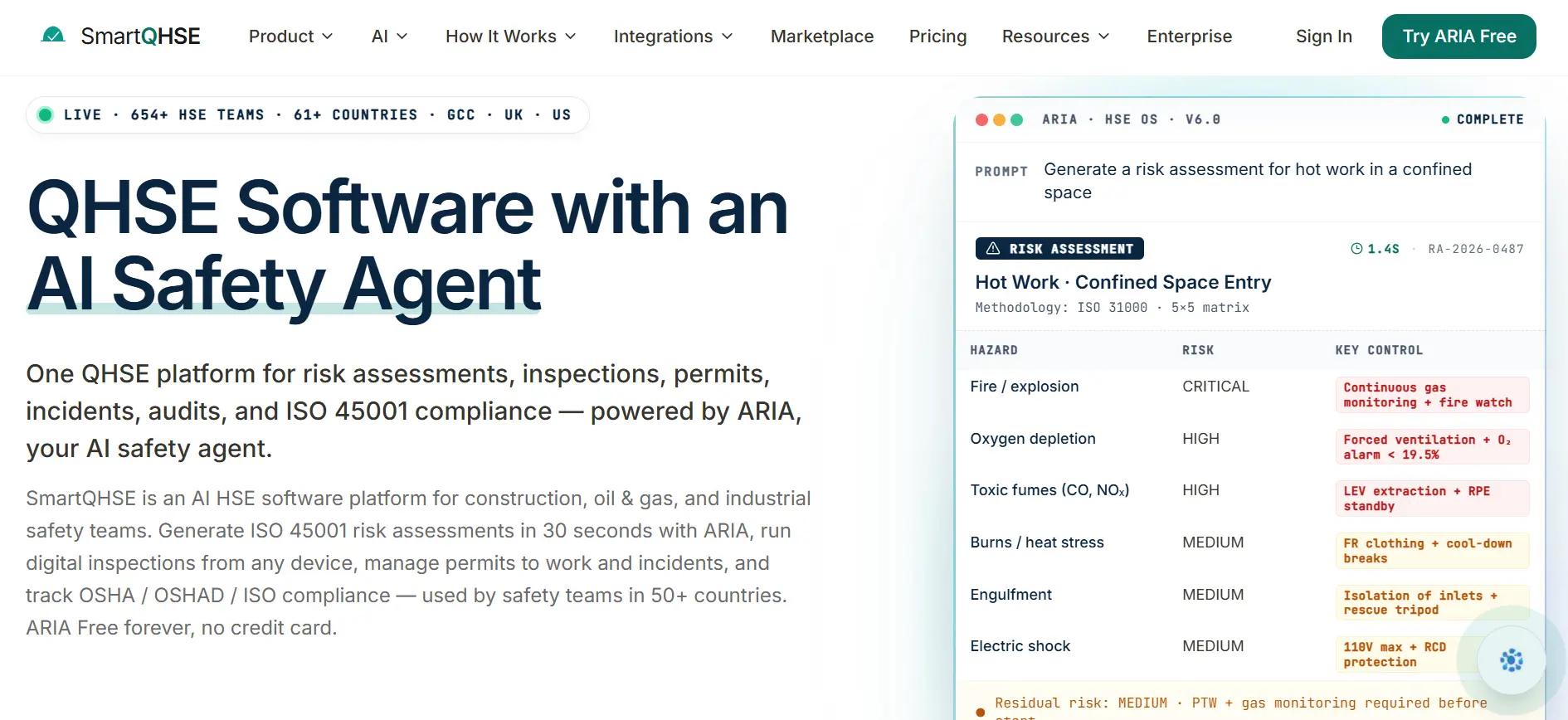
  • Drafts risk assessments — HIRA, JSA, HAZOP with risk matrices and ranked controls, in seconds
  • Generates method statements and emergency response plans tailored to activity, location and workforce
  • Analyzes incident root causes using structured methodologies
  • Checks legal compliance against the relevant jurisdiction’s framework
  • Flags hazards in site photos using image analysis
  • Applies the right framework — referencing ISO 45001 Clause 7.5 and ISO 9001 Clause 7.5 together for document control, or ISO 14001 Clause 6.1.2 for environmental aspects

⚡ On the “zero hallucinations” claim

ARIA’s grounding architecture (a curated regulatory knowledge base with citations) is the right way to reduce AI hallucination — but no generative system is immune to error, and compliance decisions carry real consequences. Test ARIA on your own high-stakes regulatory questions during a trial, verify the citations are accurate and current, and have a competent person review any AI-drafted QHSE document before use.

120+ Modules and Built-In GCC Compliance

SmartQHSE spans the full QHSE lifecycle across 120+ modules, and its most distinctive market position is regulatory: built-in GCC compliance that global platforms typically handle only through costly custom configuration.

Module coverage highlights:

  • Incident & near-miss — OSHA 300 auto-population, 5-Why / Bow-Tie root cause, CAPA to close-out
  • Risk assessment — HIRA, JSA, HAZOP, COSHH with risk matrices and control hierarchies
  • Permit-to-work — hot work, confined space, LOTO, work at height, multi-tier approval, SIMOPS conflict detection
  • Audits & inspections — digital checklists, photo evidence, geo-tagged findings, auto-assigned corrective actions
  • Training & competency — competency matrices, NEBOSH/IOSH alignment, certification expiry alerts
  • Environmental — aspects/impacts register, waste, emissions, regulatory submissions

Regulatory frameworks built in:

  • GCC: OSHAD-SF (Abu Dhabi), Dubai Municipality HSE, Saudi MOL, Qatar Labour Law
  • US/UK: OSHA 29 CFR 1926 & 1910, CDM 2015
  • Competency: NEBOSH, IOSH frameworks

The freemium model is unusually accessible for this category: a free Solo tier for individual HSE officers, ARIA AI from around $49/month, paid team plans, and a free trial with no credit card — opening the platform to solo practitioners and SMEs that enterprise EHS suites price out.

SmartQHSE vs. Intelex vs. SafetyCulture — Three Different Buyers

Dimension SmartQHSE Intelex SafetyCulture
Core strength Integrated QHSE (incl. Quality) + GCC compliance + AI copilot Enterprise multi-standard ISO certification at global scale Frontline mobile inspection adoption
Quality (ISO 9001) Yes — on the same data layer as HSE Yes — enterprise EHSQ depth Limited — inspection-focused
AI approach ARIA — regulation-grounded document drafting & Q&A AI analytics layer AI-assisted inspection
Regional strength GCC / Middle East, UK — built-in frameworks Global — 100+ countries, 28 languages Global — frontline-first
Analyst validation None yet — younger entrant, vendor self-positioning Established analyst recognition Established market presence
Pricing & entry Freemium — free Solo tier, accessible Enterprise — custom Freemium to enterprise tiers
Best for Integrated QHSE + GCC + AI at accessible price Global enterprise ISO certification programs Fast frontline inspection rollout

For embedded AI within a Verdantix-recognized EHS platform, see Evotix. For occupational-health clinical depth, see Cority. For US OSHA PSM and SDS depth, see VelocityEHS. For the corrective-action workflow that every QHSE finding feeds, see our CAPA Tracker, and for the management-system context, our ISO 45001 guide.

Who Should Not Choose SmartQHSE?

Large enterprises that mandate analyst validation (Verdantix Green Quadrant, Gartner) as a procurement standard, or that need evidence of large-scale global multi-site deployments with documented outcomes, should weigh SmartQHSE’s status as a younger entrant carefully and evaluate Intelex, Cority or Evotix alongside it.

US-headquartered industrial organizations whose primary driver is OSHA Process Safety Management, SDS/chemical management depth, and US industrial hygiene should evaluate VelocityEHS, whose US OSHA depth exceeds a GCC-focused platform’s for that specific regulatory context.

Organizations making high-stakes compliance decisions solely on AI output should treat ARIA as a drafting and reference aid, not an authority. Validate citations during a trial and have a competent person review AI-generated QHSE documents before use — the platform’s own workflow implies human review, and compliance consequences make it essential.

The Verdict on SmartQHSE

SmartQHSE is the right platform for organizations that genuinely need integrated QHSE — Quality managed on the same data layer as Health, Safety and Environment — particularly ISO-triple-certified contractors and operators in the GCC and Middle East, and particularly those that value an accessible, AI-forward tool over enterprise scale. Putting the “Q” back into EHS is a real and under-served differentiator, the built-in GCC compliance is a specific advantage global platforms handle poorly, and ARIA’s regulation-grounded document drafting addresses the administrative burden that consumes QHSE teams.

The honest caveats are maturity and validation. SmartQHSE is a younger platform whose “#1 / leading” positioning is vendor self-description rather than independent analyst recognition, and ARIA’s “zero hallucinations” claim warrants hands-on validation on real regulatory questions before reliance. For the integrated-QHSE, GCC-operating, AI-curious buyer who validates carefully during a trial, SmartQHSE fills a genuine market gap. For the enterprise that needs analyst-validated scale and single-discipline depth, the established EHS leaders remain the safer choice.

SmartQHSE screenshot

Key Features

  • True QHSE Integration — The "Q" Most EHS Platforms Omit The defining feature of SmartQHSE is that it manages all four QHSE disciplines — Quality, Health, Safety and Environment — on a single shared data layer, rather than treating quality as an afterthought or omitting it entirely as most EHS and HSE platforms do. This matters because the four disciplines share common processes: audit management, corrective action tracking, document control, non-conformance reporting, risk assessment, and management review. When quality (ISO 9001) runs in one system and safety (ISO 45001) in another, organizations duplicate every one of those processes, produce inconsistent reporting, and — most damagingly — miss the cross-discipline connections that good root-cause analysis depends on, because a quality non-conformance and a safety near-miss with the same underlying cause live in separate tools. SmartQHSE's quality module handles non-conformances, supplier quality, quality audits and corrective actions structured around ISO 9001:2015; the environmental module maintains an aspects/impacts register, waste records and emissions tracking aligned to ISO 14001; and the health and safety modules cover the full occupational safety lifecycle aligned to ISO 45001 and OSHA. Because they share one data layer, a single root cause is managed once across all the disciplines it touches, and one management-review dashboard shows quality NCRs, safety incidents, environmental metrics and compliance posture in a single view.
  • ARIA — A Regulation-Grounded AI Copilot, Not a Generic Chatbot ARIA is SmartQHSE's built-in AI copilot, and its differentiator is grounding. It is described as trained on global HSE regulations, ISO standards and industry best practices, and grounded in 734 regulatory knowledge-base chunks across 113 countries — with the vendor emphasizing real citations rather than generic generative output. Functionally, ARIA goes well beyond answering questions: it drafts risk assessments (HIRA, JSA, HAZOP), generates method statements, produces emergency response plans, analyzes incident root causes, checks legal compliance, and flags hazards in uploaded site photos — tasks that traditionally consume hours of a QHSE professional's time, completed in seconds. Because ARIA understands the integrated QHSE scope, it can apply the right framework to a question: asked about a document-control requirement, it can reference both ISO 45001 Clause 7.5 and ISO 9001 Clause 7.5, noting where they overlap and diverge; asked about an environmental aspect assessment, it applies ISO 14001 Clause 6.1.2 methodology alongside the relevant local environmental regulation. For organizations operating across multiple jurisdictions, the multi-country regulatory grounding is the feature that turns a generic AI assistant into a usable compliance tool — though, as with any generative AI making compliance claims, buyers should validate citation accuracy on their own regulatory questions during a trial.
  • 120+ Modules, GCC Compliance, and an Accessible Freemium Model SmartQHSE provides more than 120 modules spanning the full QHSE lifecycle: incident and near-miss management (with OSHA 300 log auto-population and 5-Why / Bow-Tie root-cause templates), risk assessment (HIRA, JSA, HAZOP, COSHH with risk matrices and control hierarchies), digital permit-to-work (hot work, confined space, electrical isolation / LOTO, work at height, with multi-tier approval and SIMOPS conflict detection), audits and inspections (digital checklists, photo evidence, geo-tagged findings, auto-assigned corrective actions), training and competency matrices (with NEBOSH/IOSH alignment and certification expiry alerts), document control, contractor management, and environmental monitoring. Its most distinctive market position is built-in GCC compliance — OSHAD-SF (Abu Dhabi Occupational Safety and Health framework), Dubai Municipality HSE requirements, Saudi MOL, and Qatar Labour Law — alongside OSHA 29 CFR 1926/1910 and UK CDM 2015. Most global platforms require costly custom configuration to handle Middle East frameworks; SmartQHSE treats them as first-class. The commercial model is unusually accessible: a free Solo tier for individual HSE officers, ARIA AI from around $49/month, paid team plans, and a free trial with no credit card — lowering the barrier for smaller organizations and individual practitioners who are priced out of enterprise EHS suites.

Pros & Cons

Strengths

  • The genuine Quality + HSE integration is SmartQHSE's strongest and most differentiated claim. Most platforms marketed as "EHS" or "HSE" omit quality management entirely, which forces ISO-triple-certified organizations to run ISO 9001 in a separate system from ISO 45001 and ISO 14001 — duplicating audit management, corrective action, document control and management review across tools that never share data. By unifying all four QHSE disciplines on one data layer, SmartQHSE lets a single root cause that surfaces as both a quality non-conformance and a safety near-miss be managed as one problem. For the QHSE manager of an international contractor or oil & gas operator running an integrated management system, that consolidation is a real operational and audit-readiness advantage, not a cosmetic one.
  • The built-in GCC regulatory compliance is a specific, valuable differentiator that larger global platforms genuinely handle poorly. OSHAD-SF (Abu Dhabi), Dubai Municipality HSE requirements, Saudi MOL and Qatar Labour Law each have particular requirements that platforms built for US OSHA or EU frameworks address only through costly custom configuration. For organizations operating in the GCC — a major construction and infrastructure market — a platform that treats these frameworks as first-class rather than as a configuration project is meaningfully easier to deploy and keep compliant. Combined with OSHA, CDM 2015 and NEBOSH/IOSH alignment, the regulatory breadth suits international contractors working across the Middle East, UK and beyond.
  • The AI copilot and accessible pricing lower two barriers at once: capability and cost. ARIA drafting risk assessments, method statements, emergency response plans and root-cause analyses in seconds addresses the administrative burden that genuinely consumes QHSE teams, and the regulation grounded design (described as 734 knowledge-base chunks across 113 countries with citations) is a more credible approach than a generic chatbot for compliance work. The freemium model — a free Solo tier, ARIA from around $49/month, free trial with no credit card — makes the platform accessible to individual HSE officers and smaller organizations that enterprise EHS suites price out entirely, which is a genuine market gap for the solo practitioner and the SME.

Weaknesses

  • SmartQHSE is a younger, AI-forward platform without the independent analyst validation that established EHS leaders carry. It does not appear in the Verdantix Green Quadrant or Gartner assessments that organizations with rigorous procurement standards often require, and its "#1" and "leading QHSE software" positioning is vendor self-description rather than third-party recognition. Buyers in enterprises that mandate analyst validation, or that need evidence of large-scale multi-site deployments with named enterprise references and documented outcomes, should weigh this gap carefully and request detailed, verifiable customer references in their own industry and region before committing.
  • ARIA's "zero hallucinations, real citations" claim is a strong assertion about a generative AI system, and generative AI making regulatory compliance claims warrants careful validation. No generative model is immune to error, and compliance decisions based on an AI-drafted risk assessment or legal-compliance check carry real consequences if the underlying citation is wrong or outdated. The grounding approach (a curated regulatory knowledge base with citations) is the right architecture for reducing hallucination, but buyers should test ARIA on their own specific, high-stakes regulatory questions during a trial — verifying that citations are accurate, current, and correctly applied — rather than relying on the marketing claim. AI-generated QHSE documents should be reviewed by a competent person before use, as the vendor's own workflow implies.
  • The platform's breadth and accessible pricing come with the trade-offs of a younger product: it does not match the enterprise scale, deep single discipline maturity, or extensive integration ecosystems of the established leaders. Organizations needing the deepest occupational-health clinical depth (Cority), the broadest global multi-standard ISO certification management at enterprise scale (Intelex), embedded AI within a Verdantix recognized EHS platform (Evotix), or US OSHA PSM and SDS depth (VelocityEHS) will find those specialists stronger in their respective domains. SmartQHSE's advantage is integrated QHSE breadth, GCC compliance and AI accessibility — not maximal depth or enterprise scale in any single dimension.

Frequently Asked Questions