Reviewed by the AiGreenTools Editorial Team · Last Updated: August 2026
| Product | HSI Donesafe — no-code EHSQ platform |
| Vendor | Health & Safety Institute (HSI) · majority-owned by Waud Capital Partners |
| Origin | Donesafe, founded Sydney 2014 · acquired by HSI (February 2020) |
| Category | Configurability-first EHS platform |
| Best for | Diversified organizations whose divisions genuinely work differently |
| Configuration | Drag-and-drop adaptive forms · conditional logic · 30+ response types · QR capture · no-code multi-level workflow |
| Modules | 60+ switchable — incidents · audits · contractors · chemicals · risk · training |
| Size range | 5 to 500,000 employees |
| Integrations | HR · workforce management · BI · CRM · payroll |
| AI Classification | AI Enhanced — HSI Intelligence, AI Image Hazard Recognition |
| Pricing | Tiered subscription, not published · licensing basis needs verification |
Jump to: The question nobody asks · Configurability as the product · Configuration debt, and who pays it · HSI Intelligence — and a correction · Five employees to 500,000 · What Verdantix actually said · Where it sits in the cluster · Who should not buy
Every Buyer Asks How Configurable It Is. Almost Nobody Asks Who Maintains the Configuration.
The demonstration goes well. Forms are built by dragging fields. Conditional logic appears without anybody writing code. A workflow with four approval levels and two escalation paths takes eleven minutes. The evaluation team is impressed, and rightly — this is genuinely easier than the alternatives.
Then, eighteen months later, a regulation changes. The incident form needs a new mandatory field, the classification list needs two new options, and the escalation rule needs to route differently for one division. On a platform that ships an opinion, the vendor updates a template centrally and it appears. On a configured platform, that work belongs to whoever owns the configuration.
So the question that decides this purchase is not how configurable HSI Donesafe is. It is who does the configuring in year three — and whether that person exists.
Configurability as the Product, Not a Property of It
Every enterprise EHS platform claims to be configurable, and most are — in an administrative back room, by a consultant, during an implementation project. HSI Donesafe makes configuration the primary interface. That is a different design decision, not a stronger version of the same one.
What the configuration surface actually offers
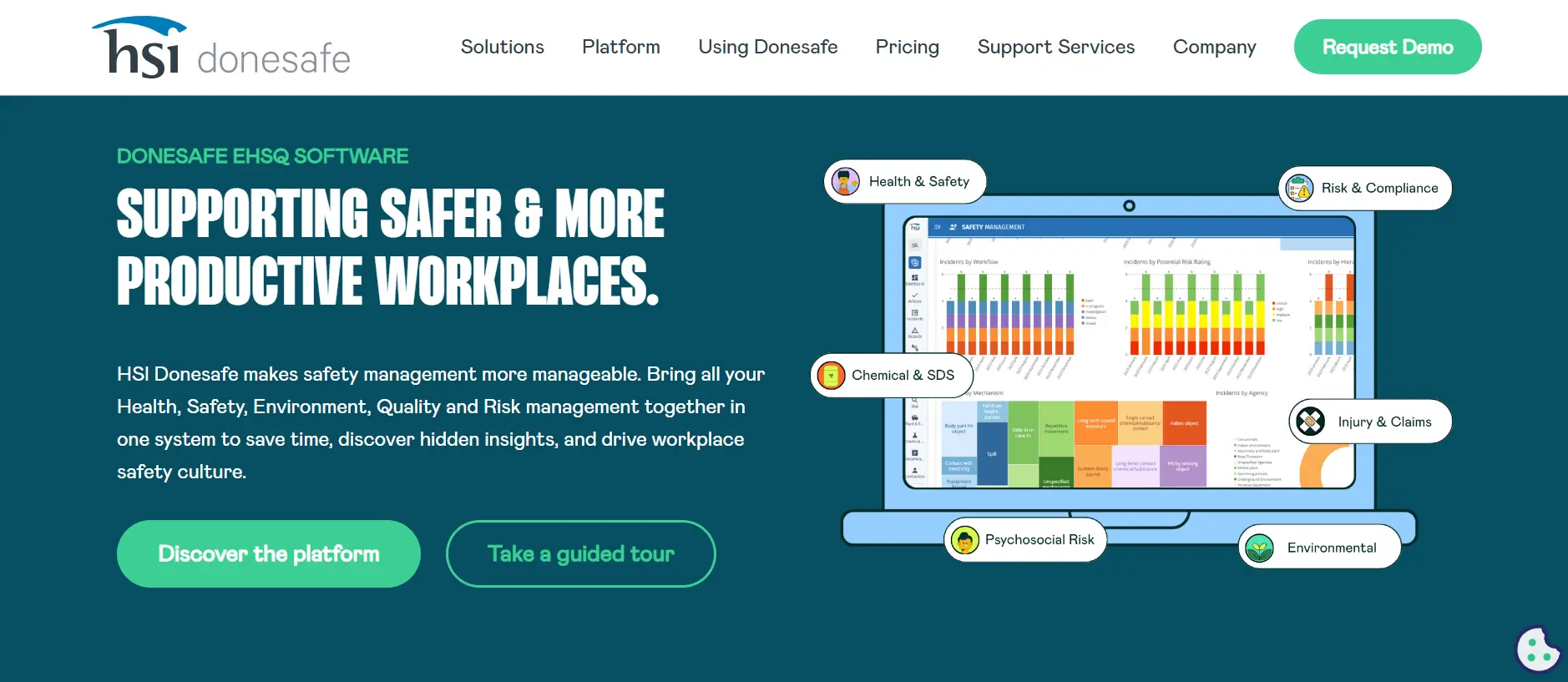
- Smart adaptive forms — drag-and-drop with conditional logic built in, so a form branches on the previous answer rather than showing every field to every user
- 30+ response types — including QR code capture, which matters more than it sounds for frontline and contractor use
- No-code multi-level workflow design — approval chains and escalation paths of real complexity, built by drag-and-drop
- 60+ switchable modules — incidents, audits and inspections, contractor onboarding and compliance, chemical management, risk assessment, training records
- Automation at scale — conditional logic triggers within the same no-code environment
The business consequence of the HSI Donesafe approach is specific rather than general. A diversified group whose manufacturing, logistics and services divisions genuinely work differently can give each a form in its own vocabulary, while corporate reporting draws from one dataset. That is a different proposition from asking three operations to adopt one template — which is the most common reason enterprise EHS rollouts end up covering one division properly and the other two not at all.
Configuration Debt — The Trade Nobody Prices
Flexibility is not free, and with HSI Donesafe the cost is not paid at implementation. It is paid every year afterwards, by whoever owns the system.
| Best-practice suite | Configurable platform | |
|---|---|---|
| Day one | Works, with the vendor’s opinion built in | Requires design decisions before anyone can use it |
| Fit to how you work | You adapt to the template | The template adapts to you |
| Regulation changes | Vendor updates centrally | Your administrator updates it |
| Divisional difference | Handled by exception, often badly | Handled natively |
| Who it suits | Teams without a system owner | Teams with a system owner |
⚠️ The honest test, and it takes one question: Does your organization have someone — named, not hypothetical — who will own platform configuration as part of their job description in three years? If yes, HSI Donesafe’s flexibility is leverage and few platforms bend further at this price. If no, that flexibility is homework, and a pre-built platform will serve you better. This is not a criticism of the product. It is the trade the product is making, and it is the right trade for one kind of organization and the wrong one for another.
There is also a gap between the HSI Donesafe no-code promise and the reported experience worth planning around. Reviewers praise ease of use and customizability, and separately report that getting modules programmed by the HSI team requires lead time and that support responses can take three to four business days. Both are accurate. No-code means an administrator changes a form without a developer; it does not mean every change is self-service. Establish which categories of change you can make yourself and which need the vendor, and ask what the current turnaround is for the second category.
HSI Intelligence — What the AI Does, and a Correction
HSI Intelligence is the AI capability suite, and its most concrete component is proprietary image hazard recognition. A worker photographs a work environment and uploads it. The system detects potential hazards — blocked exits, fire risks, missing personal protective equipment, improperly stored equipment — identifies the related OSHA standard, and generates an observation record with corrective actions and training recommendations attached.
The mechanism is unusually well matched to the HSI Donesafe thesis. If the binding constraint in EHS software is that people do not use it, then a capture method requiring a photograph rather than a form attacks that constraint directly. Mapping the detection to a regulatory standard converts an observation into a compliance record without an administrator translating it in between. Independent reviewers separately describe an in-product AI function that assists users who get stuck.
🔍 A claim in circulation that the evidence contradicts: A comparison page published by a competing vendor in April 2026 states that this platform has “no generative AI” and that its “AI roadmap [is] unclear post-HSI acquisition.” HSI’s own announcement of AI Image Hazard Recognition, published on the product’s blog and dated to late 2025, describes a proprietary AI capability already launched. AiGreenTools does not treat a competitor’s comparison marketing as a source for a rival’s capabilities — the same standard applied earlier in this cluster. Verify AI capability with the vendor directly, on your own images.
Why AiGreenTools classifies HSI Donesafe as AI Enhanced
The platform managed incidents, audits and workflows for years before HSI Intelligence existed, and continues to do so without it. Image hazard recognition accelerates capture and classification inside existing workflows rather than constituting the architecture. That is AI Enhanced by definition. The classification is confirmed by evidence rather than assumed from the category — and it is a genuine capability, newer than the platform, which should be evaluated on your own environments rather than on demonstration imagery.
Five Employees to 500,000 — And Why That Range Is Unusual
Few EHS platforms credibly serve both ends of that spread, and the reviewer base reflects it, splitting fairly evenly across small, midsize and enterprise organizations rather than clustering.
The modular architecture of HSI Donesafe is what makes it possible. An organization begins with incident reporting and adds audits, contractor management, chemicals and training as the programme matures, without a replatform at each stage. For a Stage 2 organization that expects to reach Stage 3 within a few years, avoiding a migration is worth more than most individual features.
Contractor access deserves separate mention because most platforms leave it unsolved, and HSI Donesafe does not. A public portal reachable by QR code lets contractors submit and retrieve what they need without licences, removing the friction that usually keeps contractor populations outside the EHS system entirely. Reviewers single this out. Since contractor incidents are frequently the least well captured data in any organization, closing that gap improves the reliability of the whole picture disproportionately.
Around the platform sits the Health & Safety Institute relationship: a family of EHS brands under Waud Capital ownership combining software with e-learning content, including the SafetySkills acquisition, plus a partner network of EHS consulting firms. For a buyer wanting one vendor across software and training, that is a real simplification. For one evaluating EHS software strictly on its merits, it complicates comparison — price the components separately during negotiation.
What Verdantix Actually Said — And What It Did Not
HSI is a Leader in the Verdantix Green Quadrant: EHS Software 2025. The report credited HSI Donesafe for chemical management, the depth of the EHS training library, the user interface, self-configuration capabilities and AI development momentum, and HSI states the study records one of the highest installed EHS customer bases among evaluated vendors.
🔍 Two findings, one report — read them separately:
(1) Leader placement. HSI holds it, and the credits attached to it are specific rather than generic.
(2) The seven. Verdantix’s own report summary states: “Among the vendors featured in the Leaders’ Quadrant, seven firms — Benchmark Gensuite, Cority, Enablon, Evotix , Intelex, Sphera and VelocityEHS — offered robust all-round EHS management capabilities.” HSI Donesafe is not among them, and the report frames the platform as exceptional for mid-market and lower enterprise customers.
Neither statement contradicts the other. The seven is a breadth designation inside the Leaders’ Quadrant, not a quality tier above it. For a mid-market buyer, the Verdantix framing is a recommendation. For a large multinational needing every EHS domain at depth, it is a signpost toward the seven.
The AI position is stronger than the platform’s marketing suggests
Verdantix records that HSI has built a proprietary AI model trained on its own learning library — and that detail explains the strategic logic behind a company owning both EHS software and safety training content. A model grounded in a curated safety corpus answers EHS questions from a narrower and more defensible base than a general-purpose assistant, which is precisely the argument HSI makes for the confidence customers can place in what the AI returns.
This matters when evaluating HSI Donesafe. Ask which corpus the AI is grounded in and what happens when a question falls outside it. A vendor that can name its training corpus is describing a system; one that cannot is describing an integration.
Where HSI Donesafe Sits in the Cluster
| Dimension | HSI Donesafe | Benchmark Gensuite | SafetyCulture |
|---|---|---|---|
| Core bet | Fit — the platform adapts to you | Breadth on one architecture | Adoption — frontline inspection at scale |
| Day-one readiness | Requires design decisions first | Best-practice templates included | Immediate |
| Ongoing burden | Configuration ownership | Enterprise governance | Low |
| Verdantix position | Leader · not among the seven | Yes | No |
| Deciding question | “Who owns configuration in year three?” | “Is our requirement genuinely wide?” | “Is this an adoption problem?” |
| AiGreenTools Score | 76 | 80 | 79 |
Score totals conceal more than they reveal here, and this cluster contains a useful illustration. HSI Donesafe scores 76 and VelocityEHS also scores 76, but the pillar shapes differ substantially: HSI Donesafe is strongest on ease and value, VelocityEHS on chemical and industrial hygiene depth. Two platforms, one number, entirely different purchases. Read the sub-scores rather than the total.
Within the EHS software category, the honest positioning is that HSI Donesafe competes on fit rather than on depth or breadth. EcoOnline goes deeper in chemicals, Benchmark Gensuite goes wider across domains, SafetyCulture goes further on frontline adoption. Our best EHS software ranking covers the wider field.
What Implementation Actually Requires
The precondition for HSI Donesafe is process design, not data migration. Because the platform adopts your definitions rather than supplying its own, the deployment is only as good as the thinking behind the forms — and that thinking is the customer’s work, not the vendor’s.
Reviewers describe HSI Donesafe as stable and easy to use once configured, with responsive support during implementation and releases, alongside the reporting difficulty and vendor lead time noted above. The sequence that works: agree the minimum common data model across divisions first, configure the divisional variations second, build the reporting layer third and test it against a real leadership question, and add modules progressively rather than switching on 60 at once.
The sequence that works, and the one that fails
Agree the minimum common data model across divisions first — the handful of fields every part of the business must record identically for corporate reporting to mean anything. Configure divisional variations second, on top of that spine. Build the reporting layer third and test it against a real question a leadership team has actually asked. Add modules progressively rather than switching on sixty at once.
The failure sequence is the mirror image: configure each division’s ideal form first, discover afterwards that no two divisions classify a near miss the same way, and end up with a reporting layer that can only aggregate what everyone happened to have in common. HSI Donesafe will build either version faithfully, which is exactly the point — the platform reproduces the quality of the thinking put into it.
Who Should Not Buy HSI Donesafe
Teams without a named configuration owner. This is the decisive exclusion. If your entire EHS function is one manager with a full day job, the flexibility becomes homework and a pre-built platform will serve you better.
Organizations that need a system working on day one. No-code is not no-work. Every form and workflow must be designed before anyone can use it.
Buyers whose binding constraint is single-discipline depth — safety data sheet authoring and ECHA notification, process safety management, industrial hygiene. Breadth of modules is not depth within one.
Large multinationals needing every EHS domain at depth. HSI is a Verdantix Leader, but the report frames the platform as exceptional for mid-market and lower enterprise customers, and it is not among the seven designated for all-round breadth. That framing is guidance rather than criticism — and it points elsewhere for this buyer.
The Verdict on HSI Donesafe
HSI Donesafe is the strongest choice in this cluster for one specific and reasonably common situation: a diversified organization whose divisions genuinely work differently, that has someone able to own configuration, and that has already watched a rigid corporate template fail to achieve adoption. Few platforms bend further at this price, the size range from five to 500,000 employees is genuinely unusual, and the QR-code contractor portal solves a gap most competitors leave open.
The trade is stated plainly rather than hidden: a platform that adapts to you cannot also arrive with a considered view of how the work should be done, and configuration becomes a permanent obligation rather than a project. Reporting is the most consistently criticised area, which matters more here than elsewhere because reporting is where the value of unified divergent data is actually realised. And the analyst position, while genuinely strong — Verdantix Leader with one of the highest installed customer bases in the study — is explicitly framed as mid-market and lower enterprise rather than all-round, which is guidance rather than criticism but points a large multinational elsewhere.
Buy HSI Donesafe for fit. Make sure you know who maintains it.