Reviewed by the AiGreenTools Editorial Team · Last Updated: August 2026
| Product | Benchmark Gensuite — EHS, sustainability and operational risk platform |
| Vendor | Benchmark Gensuite, Cincinnati OH · R. Mukund, founder and chief executive |
| Product lineage | GE PowerSuite (1997) → Gensuite (2000) → Benchmark Digital / Benchmark ESG → Benchmark Gensuite |
| Category | Broad-suite enterprise EHS + ESG on a single architecture |
| Best for | Multinationals whose requirement spans EHS, quality, environmental and ESG disclosure |
| Program coverage | EHS · compliance & enterprise risk · operational safety · quality · environmental (air, water, waste) · sustainability & ESG disclosure · product stewardship & supplier risk |
| AI Classification | AI Enhanced — Genny AI, AI-native platform layer released 5 May 2026 |
| AI commercial model | Included for all enterprise subscribers · no extra cost · no separate setup |
| Analyst | Named among seven firms with robust all-round EHS management capability, Verdantix Green Quadrant EHS Software 2025 |
| Scale (vendor-reported) | 4 million users · 25,000+ sites · 35+ industries |
| Pricing | Sales-led quote — not published, no free tier |
Jump to: The consolidation the market took for granted · One architecture — and how to test it · Genny AI, and why it is included · Lineage, continuity and a brand problem · The Verdantix seven · Where it sits in the cluster · Who should not buy
The EHS Software Market Consolidated. One Vendor Made the Opposite Bet.
Over the past three years, the dominant strategy in EHS software has been acquisition. One European vendor completed nine purchases in 2025 alone and a tenth in July 2026, extending from contractor management into wearable hazard monitoring, fenceline environmental intelligence and airport noise. Another completed twelve acquisitions in four years before buying a competitor’s entire software division outright. Both are now among the broadest suites in the market. Both assembled that breadth in under a decade.
On 5 May 2026, the founder and chief executive of a Cincinnati company that has been building the same product since 1997 described the alternative position bluntly: most platforms, R. Mukund said, have been built by acquiring and patching tools together, and his has taken a different approach — an organically developed, connected suite.
That is a market observation worth sitting with, because it is not merely a marketing contrast. It is a claim about data architecture, and data architecture is what a buyer actually pays for when they buy an enterprise suite. The seams between acquired modules are where reconciliation cost lives. A platform with fewer seams is worth more, and the only question is whether the claim survives inspection.
One Architecture — And the Twenty-Minute Test That Proves It
Breadth on its own is not scarce, and Benchmark Gensuite is not the only vendor that can list it. Several vendors can list EHS management, compliance and enterprise risk, operational safety, quality, environmental management across air, water and waste, sustainability and ESG disclosure, and product stewardship and supplier risk. What differs is whether those domains share one data model or agree by integration.
The distinction is invisible in a feature comparison and decisive in operation. Modules that were designed together share site hierarchy, person records and taxonomy natively. Modules that were acquired agree on those things through mapping tables that someone maintains, and that someone is usually the customer.
💡 The request that settles the architecture question: Ask for a single live query spanning three domains at once — incident data, an environmental permit obligation, and an ESG disclosure datapoint — filtered by one site hierarchy, built in front of you. A genuinely single-version platform returns it as a query. An integrated suite exports to a business intelligence layer and rebuilds the hierarchy there. Twenty minutes, one question, and the answer is not marketable.
Ask the same question of every vendor on the shortlist. It is the fastest way to convert an architectural claim into evidence, and it is more informative than any number of module demonstrations.
What the architecture buys you on an ordinary Tuesday
Architectural arguments are easy to state and hard to feel, so it is worth grounding. Consider a corrective action raised from an environmental permit exceedance at one plant, assigned to an engineer who also owns two safety actions and a quality deviation, at a site that appears in the ESG disclosure boundary but not in the product stewardship scope.
On a single-version platform that person has one task list, one identity and one site record, and the ESG boundary question is a flag on the site rather than a separate mapping. On an integrated suite, that engineer has three logins, the identity reconciliation runs nightly, and the boundary question is answered by a spreadsheet someone updates quarterly. Neither platform will admit to the second arrangement in a demonstration. Both will show you a clean task list.
This is why Benchmark Gensuite’s proposition is worth taking seriously rather than dismissing as positioning — and equally why it must be tested rather than accepted. The claim is checkable in one query, and unverifiable in any amount of conversation.
Where breadth comes from, in this case
Benchmark Gensuite began inside General Electric in 1997 as GE PowerSuite, built to serve many business units simultaneously. That origin explains something a feature list cannot: breadth and configurability were requirements from the first release rather than later additions, because the original customer was itself a federation of very different operations. A platform designed from day one to be configured differently by an aviation business and a healthcare business arrives at multi-industry breadth by a different route than one that acquired its way there.
Genny AI — Embedded Everywhere, Included in Every Subscription
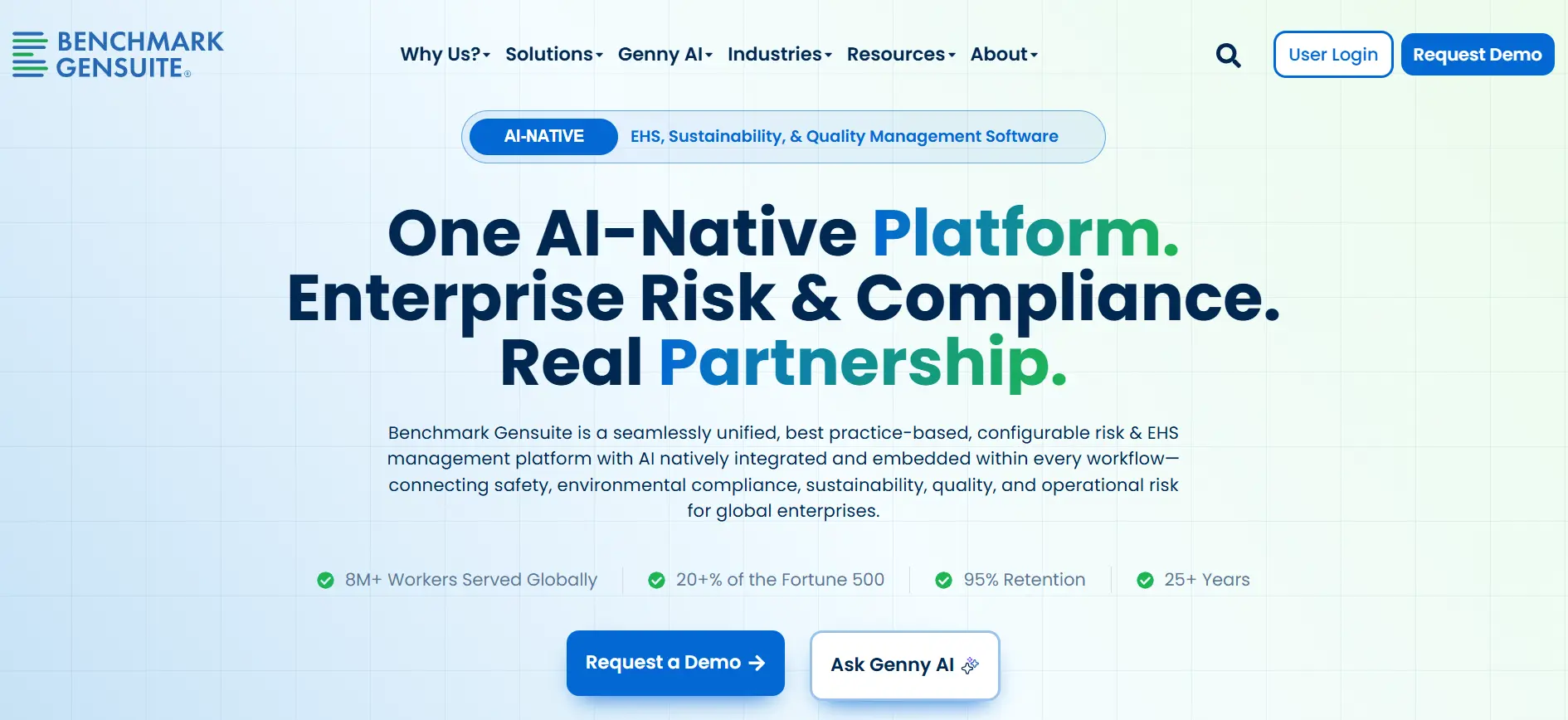
On 5 May 2026 Benchmark Gensuite released an AI-native platform layer unifying chat, prompts and agents into a single experience that retains user context and role as a user moves between applications. Genny AI guides the next action automatically rather than requiring navigation between tools or re-entry of information.
What Genny AI actually does
- Describe-It AI — generates clear, consistent incident descriptions at the point of capture, improving data quality where it is usually worst
- Risk AI Advisor — monitors safety data and surfaces emerging risk before escalation
- Permit Agent AI — automates permit tracking and compliance administration
- PSIF & Ergo Evaluator AI — predicts serious injury and fatality potential and identifies ergonomic risk
- Agentic Hub — the coordination layer across the above
💰 The commercial model is as differentiating as the capability: Genny AI is included for all enterprise subscribers at no additional cost, with no separate setup. In a category where AI increasingly arrives as an uplift, a module or a roadmap commitment, that removes both a negotiation and an adoption barrier — and it means usage figures reflect people choosing to use it rather than people who paid extra and must justify it.
Benchmark Gensuite also publishes deployment rather than only ambition: more than 40,000 productivity hours reported across the first three months of 2026, driven by tens of thousands of interactions each month. Those numbers are vendor-reported and unaudited. They are, however, usage claims rather than outcome claims — harder to fabricate and far easier to test. Ask a reference customer how many of their people open Genny AI in a normal week, and for what task.
Why AiGreenTools classifies this AI Enhanced despite the vendor’s AI-native language
The vendor describes an AI-native platform layer. The AiGreenTools methodology classifies on architecture rather than positioning, and here the vendor’s own documentation settles it: the platform states plainly that AI enhances the platform experience and does not replace EHS expertise. The suite has managed EHS programmes since 1997 and continues to function without Genny AI. That is AI Enhanced by definition.
It is worth being precise about how this differs from a weaker AI Enhanced classification. Genny AI is embedded across every application rather than confined to one workflow, it is included rather than sold separately, and it has published usage volumes. Among the AI layers assessed in this cluster, this is the most extensively deployed. The classification reflects what the AI is architecturally, not how much of it there is.
Lineage, Continuity — and a Brand Problem Worth Knowing About
| Period | Name | Note |
|---|---|---|
| 1997 | GE PowerSuite | Built inside General Electric to serve multiple business units |
| 2000 | Gensuite | Independent product identity |
| 2021 | Benchmark Digital Partners / Benchmark ESG | Corporate and platform rebrand |
| 2022–23 | Benchmark Gensuite | Brands unified under the current name |
R. Mukund, who founded the product, remains chief executive. That continuity is rare enough in enterprise EHS to be a purchase consideration in itself, and it is the substance behind an organic-development claim that would otherwise be unfalsifiable.
⚠️ A false claim you will meet in desk research: A competitor’s comparison article published in June 2026 states that Benchmark Gensuite “is now operated under Sphera, a Blackstone portfolio company, following an acquisition in 2021.” The vendor’s own May 2026 announcements show a founder-led, independently operating Cincinnati company. Four brand names for one product make that error more plausible than it should be. Verify corporate status from the vendor and from filings — not from a competitor’s comparison page. AiGreenTools does not treat competitor content marketing as a source for company facts.
The Verdantix Seven — And Why This Placement Carries Weight
Verdantix’s press release for Green Quadrant: EHS Software 2025 identifies seven firms as offering robust all-round EHS management capabilities: Benchmark Gensuite, Cority, Enablon, Evotix 360, Intelex, Sphera and VelocityEHS.
That list matters more than a Leader badge, and the reason is instructive. Several vendors hold Leader status in the same Green Quadrant without appearing on it — including both European challengers profiled alongside this one in the same publication cluster, Ideagen EHS and EcoOnline. Leader status and all-round breadth are distinct findings inside one report.
For a buyer whose primary criterion is comprehensive EHS management rather than a single specialism, this placement is the most decision-relevant independent evidence available, and it should carry more weight than any vendor’s own summary of the same report.
A separate designation of AI Integration Pacesetter in 2025 is also attributed to Verdantix. That attribution reached this assessment through a competitor’s comparison blog rather than a primary source, and under the AiGreenTools sourcing standard it is reported here as unverified rather than published as fact. Ask the vendor for the citation.
Where Benchmark Gensuite Sits in the Cluster
| Dimension | Benchmark Gensuite | Ideagen EHS | EcoOnline |
|---|---|---|---|
| Architecture | Organic, single-version since 1997 | Assembled — 10 acquisitions in 18 months | Assembled — 12 acquisitions + Alcumus division |
| Core strength | All-round breadth on one data model | EHS + quality governance spine | Chemical authoring and ECHA notification |
| On the Verdantix seven | Yes | No | No |
| AI commercial model | Included, all subscribers | Mazlan, GA ~May 2026 | Smart Extraction, scoped to SDS |
| Deciding question | “Is our requirement genuinely wide?” | “Do quality and safety share a CAPA?” | “Do we author SDSs?” |
| AiGreenTools Score | 78 | 73 | 76 |
The EHS software category rewards honesty about requirement width more than almost any other selection criterion. Benchmark Gensuite is the strongest choice in this cluster for a genuinely wide requirement and the weakest value for a narrow one — the inverse of EcoOnline, whose chemical depth is decisive and whose general breadth is not. Our best EHS software ranking covers the wider field, and the approach to evaluating embedded AI claims is set out in our guide to risk assessment AI for EHS teams.
How the AI Should Be Evaluated, Not Just Demonstrated
Every enterprise EHS vendor now demonstrates AI, and demonstrations are uninformative because they run on prepared data. Four questions separate deployed AI from launched AI, and Benchmark Gensuite is unusually well placed to answer three of them.
- Is it included or charged? Genny AI is available to all enterprise subscribers at no additional cost. A vendor charging an uplift has an incentive to overstate usage; a vendor including it does not.
- How many people used it last week? The vendor publishes interaction volumes rather than only outcomes. Ask a reference customer to confirm the pattern in their own tenant.
- What happens when the AI is wrong? Ask specifically about a rejected Describe-It AI incident description or a false positive from Risk AI Advisor. The answer reveals whether human review is a genuine control or a checkbox.
- Is it in every workflow or one? Benchmark Gensuite claims embedding across every application with context and role retained as users move between them. Test by starting a task in one module and continuing it in another.
These four questions apply to any vendor in the category. They are listed here because Benchmark Gensuite is one of the few that can answer the first two with published figures rather than assurances.
What Implementation Actually Requires
This is enterprise deployment, and the scale Benchmark Gensuite is built for — 25,000-plus sites, 35-plus industries, 18-plus languages — sets the implementation profile. Configuration decisions taken centrally propagate globally, which is the benefit and the risk in the same sentence.
G2 reviewers describe the platform as helping track incidents from origin through to action items and as a foundation for operationalising an ESG programme, while also citing lag in the software and complexity in use. Both readings are accurate and they describe the same architecture from different vantage points. A broadly configurable enterprise platform will be slower to query and denser to navigate than a narrow inspection tool.
⚠️ The most common way this purchase goes wrong: A mid-market organization buys enterprise architecture for a mid-market problem, then experiences the depth as complexity and the configurability as delay. The complexity is not a defect — it is the cost of serving 25,000 sites. If you have eleven sites and a straightforward incident and audit requirement, the reviewers complaining about complexity made the mistake you are about to make.
Who Should Not Buy Benchmark Gensuite
Mid-market organizations with a narrow requirement. The platform’s entire value rests on breadth across many domains. Buy it for incident management alone and you are paying for architecture you will experience only as complexity.
Buyers whose binding constraint is a single specialism. If the problem is safety data sheet authoring and ECHA notification, EcoOnline built a decade of depth there. If it is contractor accreditation, Avetta and Alcumus SafeContractor are the category. Organic development means adjacent specialisms arrive more slowly than in a suite that can buy them.
Organizations that need frontline inspection adoption above all. That is SafetyCulture’s problem and it is a different one — an adoption challenge rather than a governance or architecture challenge.
Any buyer who needs a published price to open an internal business case, since there is no tier and no trial — and where the quote depends particularly heavily on how many modules are scoped, because the architecture argument only pays back when several are.
The Verdict on Benchmark Gensuite
Benchmark Gensuite is the strongest choice in this cluster for a buyer whose requirement is genuinely wide, and the evidence for that is unusually specific: it appears on Verdantix’s own list of seven firms with robust all-round EHS management capability, a list from which several Leaders in the same report — including both European challengers published alongside it here — are absent.
The architectural claim behind the Benchmark Gensuite position is credible because the lineage supports it. A product built continuously since 1997, still led by its founder, is a different proposition from breadth assembled in eighteen months, and the difference shows up as reconciliation cost rather than as a feature gap. Genny AI reinforces the case: embedded across every application, included in every subscription, and published with usage volumes rather than only ambitions.
The honest limits are the mirror image. Organic development is slower into adjacent specialisms, so the suite does not match a specialist at its own game. The depth that serves 25,000 sites reads as complexity to an organization with eleven. And four brand names across one product lineage have made desk research unreliable enough that a competitor’s incorrect ownership claim is currently circulating unchallenged.
Buy Benchmark Gensuite for width. Buy something else for depth in one thing.
Assessment date: 8 August 2026. This assessment would change if the Verdantix AI Integration Pacesetter designation is confirmed from a primary source, which would strengthen the AI position materially; if the reported Genny AI productivity figures are corroborated by independent reference evidence; or if corporate ownership changes, which the current volume of misinformation makes worth re-checking at every drafting cycle.