Reviewed by the AiGreenTools Editorial Team · Last Updated: August 2026
| Product | Ideagen EHS — formerly ProcessMAP, acquired Oct 2022 |
| Vendor | Ideagen, founded 1993, Nottingham UK · Hg-owned since July 2022 |
| Category | Enterprise EHS management on a unified data layer |
| Best for | Multi-site regulated operators consolidating fragmented site-level systems |
| Domains | Incident · risk · audit & inspection · environmental · chemical lifecycle · contractor |
| Standards | ISO 45001 · 45003 · 14001 · 9001 · 13485 · 17025 · 27001 · AS 9100 · OSHA · RIDDOR |
| Pricing | Enterprise quote — not published, no free version, no trial |
| AI Classification | AI Enhanced — Ideagen Mazlan agentic AI, GA ~May 2026 |
| Analyst | Verdantix Leader ×3 (EHS 2025, QMS 2025, PSM 2026) · Gartner Representative Vendor 2026 |
| Scale | 18,000+ companies · ~2M daily users (vendor-reported, July 2026) |
| Maturity Stage | Stage 3–4 |
Jump to: The reconciliation problem · The unified data layer · Ten acquisitions in 18 months · Mazlan AI — and its timing problem · What the evidence actually says · vs. Intelex vs. Cority · Who should not buy
A Mature EHS Programme That Still Cannot See Itself Whole
A speciality chemicals manufacturer runs eleven sites across four countries. Its EHS function is not broken. There is a Head of EHS, site coordinators at every plant, a defined incident taxonomy, an internal audit schedule and a board that reads the safety numbers every quarter. By any reasonable measure, this is a mature programme.
And yet, three weeks before an assurance visit, someone is exporting incident data from one system, audit findings from a second and contractor certifications from a third, in order to answer a question the board considers routine: how many corrective actions raised last quarter are still open, and at which sites.
The answer exists. It is simply distributed across systems that were bought at different times, by different people, to solve different problems. That organization is the buyer Ideagen EHS is built for — not the company that needs to create an EHS programme, but the company that has one and cannot see it whole.
The Unified Data Layer — And How to Test the Claim
The problem Ideagen EHS targets is not data capture. Most organizations at this maturity stage capture a great deal. The problem is that capture happened in systems that never agreed on what a record was, so no single object connects an incident to the corrective action it generated, to the audit that verified closure, to the regulatory obligation the audit satisfied.
What sits on the layer:
- Incident management — mobile and offline capture, investigation and root cause workflow, CAPA tracking
- Risk assessment — registers, matrices, control effectiveness
- Audit & inspection — scheduling, execution, finding-to-closure traceability
- Environmental monitoring — air, water, noise, odour and vibration
- Chemical lifecycle — inventory, radiation, hazardous waste, biosafety
- Contractor compliance — prequalification and ongoing certification
💡 The demonstration test that separates unification from integration: Ask for a live cross-site overdue corrective action report, filtered by the regulatory obligation each action satisfies, built in front of you. If it requires an export into a business intelligence layer, the data layer is less unified than the architecture diagram suggests. Every vendor in this category claims a single source of truth; this question is how you find out.
Ideagen EHS regulatory coverage spans OSHA recordkeeping and RIDDOR reporting alongside the ISO management system standards covered in our ISO 45001 guide — the combination a multinational needs when the same incident must satisfy an American recordkeeping obligation and a British reporting one from a single record.
Why the quality adjacency decides more shortlists than the feature list
Ideagen sells quality management, document control, audit intelligence and enterprise risk management to the same customer, and holds Verdantix Leader placements across EHS, quality management and process safety management. For an organization running both a regulated quality system and an EHS programme, this removes a recurring and genuinely expensive argument: which system owns a corrective action arising from a quality deviation that also has a safety consequence.
The same vendor sells Ideagen Quality Management into that estate. One governance spine. One CAPA process. One audit trail an assessor can follow from a shop-floor observation to a management review minute without changing systems. This is the strongest reason to choose Ideagen EHS over an EHS specialist — and it deserves a blunt corollary: if you do not run a regulated quality system, the single most compelling argument for this platform does not apply to your situation.
What Ten Acquisitions in Eighteen Months Added
This question matters more for Ideagen EHS than for most platforms in the category, because the answer changed substantially in the last eighteen months and continues to change. Ideagen completed nine acquisitions during 2025, the majority landing directly in the EHS portfolio.
| Acquisition | Date | What it added |
|---|---|---|
| Beakon | Feb 2025 | Contractor management |
| ConvergePoint | Jun 2025 | Policy management |
| SafeFood 360 · Authenticate | Jul 2025 | Food and beverage safety, supply chain |
| WorkSafe Guardian | Aug 2025 | Lone worker safety, mobile-first |
| Reactec | Aug 2025 | Wearables — hand-arm vibration, noise, dust, proximity |
| Envirosuite | Aug 2025 | Air, water, noise, odour, vibration · IoT + predictive modelling · ex-ASX |
| Casper | Sep 2025 | Airport environmental and noise monitoring |
| SafetyStratus | Oct 2025 | Chemical, inventory, radiation, hazardous waste, biosafety |
| Work Wallet | Jul 2026 | Mobile-first EHS, UK |
Read together, these Ideagen EHS additions describe a deliberate strategy rather than opportunism. Reactec brings sensing at the worker. Envirosuite brings sensing at the fenceline. SafetyStratus brings the depth in chemical, radiation and biosafety governance that laboratory and life sciences operations require and generalist EHS platforms rarely have. Beakon and WorkSafe Guardian address the two places where enterprise EHS software historically fails: contractors and lone workers.
⚠️ The integration question you must ask in writing: Taken as a capability map, Ideagen EHS is among the broadest EHS portfolios in the market in 2026. Taken as an integration question, it is eight or more distinct engineering lineages joined to a ninth within roughly eighteen months. Do not assume a capability appearing on a solution page shares the unified data layer with the incident module. Ask which modules share that layer today and which are on a roadmap — and get the answer in the contract, not the demo.
Work Wallet, July 2026, and what it reveals about the mobile gap
On 22 July 2026, three weeks before this assessment, Ideagen acquired Work Wallet, a UK developer of mobile-first EHS software. The strategic reasoning is unusually explicit: chief executive Ben Dorks framed the purchase around customers who need rapid deployment and strong mobile capability, and described organizations needing solutions matched to their requirements and readiness rather than one-size-fits-all approaches.
That statement is more useful to a prospective buyer than any feature comparison, because it constitutes a vendor acknowledgement of exactly the gap independent review commentary has raised about the core platform. Mobile capability, particularly completing investigations in the field rather than capturing an initial report, has been a recurring limitation. Ideagen has now bought a company to close it. The practical consequence: if mobile investigation closure matters to your operating model, establish whether you are being sold the core platform, Work Wallet, or a future integration of the two.
Ideagen Mazlan — What the AI Actually Does
Mazlan is the embedded agentic AI layer spanning EHS, quality, audit and compliance workflows. Its described function is concrete rather than aspirational, which is itself a useful signal in a category where AI claims are frequently unfalsifiable.
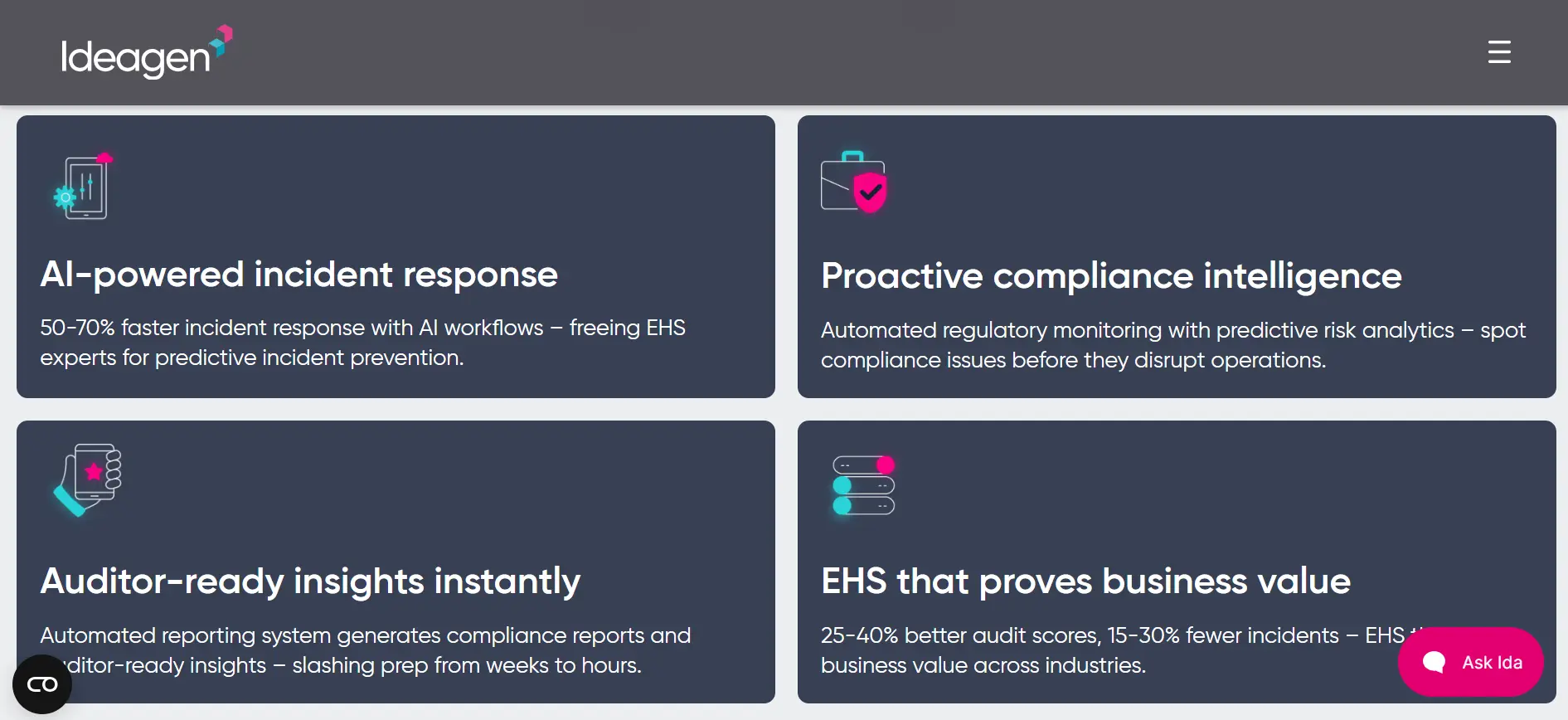
Inside Ideagen EHS, Mazlan drafts root cause investigations, prepares audit evidence, coordinates corrective actions across owners, maps regulatory changes to the operational requirements they affect, and identifies recurring issues across incidents, audits and compliance records. Because it operates inside the system rather than alongside it, it has access to the organization’s own incident history, jurisdictional regulatory requirements and internal policies.
Two design decisions that matter more than any capability claim
- Human approval is mandatory — every AI-generated output requires review and approval before it becomes part of the official record
- Data stays contained — Mazlan operates within the customer’s secure cloud infrastructure, learns only from that customer’s data, and is not used to train models outside the organization
For an auditable EHS record in a regulated environment, both choices are correct, and the second addresses the objection that has most often stalled AI adoption in this category.
Why AiGreenTools classifies this AI Enhanced, not AI Native
The classification turns on architecture, not positioning. Ideagen markets Ideagen EHS as AI-first. That is a marketing statement, and the AiGreenTools methodology requires the classification to follow what the software is rather than how it is sold. The underlying platform has managed incidents, audits and risk registers for more than twenty years and continues to do so without AI. Mazlan is a layer that accelerates work inside existing workflows and cannot complete an action without a human approving the output. Remove Mazlan and Ideagen EHS remains a complete EHS management system. That is the definition of AI Enhanced.
⏱️ The timing problem with the analyst scores: Verdantix awarded Ideagen 2.5/3.0 for AI integration in the EHS Green Quadrant 2025, and 3.0/3.0 for AI Operations in the Quality Management Green Quadrant 2025. Strong scores from a credible assessor — but Verdantix itself noted the analysis was carried out before the Mazlan launch, describing the framework at that point as pilot-phase. Mazlan reached general availability around May 2026. A buyer evaluating in August 2026 is assessing a feature set roughly three months old against recognition awarded partly on its pre-launch state.
The correct response is specificity, not scepticism. Ask for a demonstration on your own incident data. Ask what proportion of the installed base runs Mazlan in production today. Ask what happens to a draft investigation a reviewer rejects, and whether that rejection improves subsequent drafts. Those three questions establish maturity better than any score, and they follow the approach set out in our guide to risk assessment AI for EHS teams.
What the Independent Evidence Actually Says
The Verdantix nuance vendor communication leaves out
Ideagen holds Leader status in the Verdantix Green Quadrant for EHS Software 2025. That is accurate and independently awarded, and Verdantix analyst commentary noted that buyers in medium-to-high-risk verticals are particularly well suited to the platform, with organizations in highly regulated sectors able to draw on the vendor’s quality expertise as well.
🔍 Both of these are true, from the same report: Ideagen is a named Leader in Verdantix Green Quadrant: EHS Software 2025. And the Verdantix press release for that same report identifies seven firms as offering robust all-round EHS management capabilities — Benchmark Gensuite, Cority, Evotix, Intelex, Sphera, VelocityEHS and Wolters Kluwer Enablon — without Ideagen among them. Ideagen appears elsewhere in the release, credited for AI-derived insights embedded within BI tools. The distinction suggests recognition resting more on AI, document management and quality adjacency than on all-round core EHS breadth.
Ideagen also posted the highest scores of any evaluated vendor for document management at 2.5 out of 3.0 and quality management at 2.4 out of 3.0, which is consistent with that reading. If your evaluation weights core EHS depth above everything else, read the full Green Quadrant rather than the summary, and weigh the specialists equally.
What G2 reviewers consistently raise
Aggregated review sentiment for Ideagen EHS identifies incident management and data tracking as the most frequently praised capabilities. The recurring criticisms are more useful for a buyer, because they cluster rather than scatter: system responsiveness during data retrieval and reporting, workflow complexity, limited customization, and support quality.
The pattern is coherent and it matches the platform’s design intent. A broad, deeply configurable enterprise system with a unified data layer will be slower to query and more complex to navigate than a narrow inspection tool. That is a trade-off rather than a defect. It becomes a defect only when the buyer wanted the narrow tool and was sold the enterprise system.
Ideagen EHS vs. Intelex vs. Cority — Governance Spine vs. EHS Depth
| Dimension | Ideagen EHS | Intelex | Cority |
|---|---|---|---|
| Core strength | Governance breadth across EHS + quality on one spine | EHS-discipline depth, long operating record | EHS + occupational health depth |
| Approach | Compliance and quality inward | EHS outward | EHS outward |
| Verdantix all-round list | Not named | Named | Named |
| Best fit | Already an Ideagen quality customer | EHS depth is the primary criterion | Occupational health is material |
| Deciding question | “Do quality and safety keep arguing over the same CAPA?” | “Is this fundamentally an EHS problem?” | “Do we need OH integrated?” |
| AiGreenTools Score | 73 | 78 | 78 |
The EHS software category is well populated and the philosophical differences are far clearer than the feature differences. Almost every serious platform, Ideagen EHS included, will demonstrate incident management, audits and corrective actions competently. Our best EHS software ranking covers the wider field.
VelocityEHS competes hardest on chemical management and industrial hygiene depth, and the SafetyStratus acquisition is Ideagen’s direct answer to that. SafetyCulture solves a genuinely different problem — frontline inspection adoption at scale — and an organization that mistakes an adoption problem for a governance problem will buy the wrong one of these two. Enablon and Sphera compete at the top of the enterprise range where operational risk and process safety dominate, and Ideagen’s Leader placement in the Verdantix process safety report from July 2026 signals an intention to contest that ground.
What Implementation Actually Requires
Ideagen EHS is a vendor-led enterprise deployment measured in months. Capterra data indicates enterprises make up 54% of reviewers, with utilities the single largest sector at 23%, alongside construction, oil and energy, manufacturing, chemicals, transportation and telecommunications. For public sector buyers, Ideagen operates a FedRAMP-authorized government cloud and a national security solutions division, which materially shortens procurement for organizations that would otherwise disqualify a commercial SaaS platform on hosting grounds.
💡 The precondition buyers consistently underestimate: A unified data layer produces unified reporting only if your incident taxonomy, risk matrix and corrective action workflow are already agreed across sites. Ideagen EHS reproduces whatever definitions it is given. If eleven sites classify a near miss in eleven different ways, consolidation produces one database containing eleven inconsistent datasets — and the reporting problem you bought the software to solve survives the implementation intact. That harmonisation is a governance project and it belongs before the software project.
Who Should Not Buy Ideagen EHS?
Single-site operators, for whom the cross-site consolidation argument is worth nothing and who will pay for architecture they cannot use. Organizations below roughly 200 employees, where enterprise EHS licensing is disproportionate to the problem being solved.
Ideagen EHS is also the wrong choice for teams whose primary requirement is frontline inspection capture and field-based investigation closure on mobile. The Work Wallet acquisition indicates Ideagen intends to serve this buyer, but in August 2026 that is a stated direction rather than a delivered integration, and inspection-led competitors have the established record.
Any buyer who needs a published price to secure internal approval before committing to an evaluation, because there is no trial, no free version and no published tier. And any organization that has not yet decided how it wants EHS governed, because configurability is only an asset once you know what you want configured.
The Verdict on Ideagen EHS
Ideagen EHS is a credible enterprise consolidation platform whose strongest argument is not, in the end, an EHS argument. It is that safety and quality governance can share one spine, sold by one vendor holding Leader placements in both categories, with a genuinely broad capability map assembled at considerable speed and expense. For a multi-site regulated operator already running Ideagen quality products, Ideagen EHS is close to a default choice and belongs at the top of the shortlist.
For a buyer evaluating purely on core EHS breadth, the evidence is less settled than the vendor’s communication implies, and the specialists on the Verdantix all-round capability list deserve equal weight. For anyone weighting the decision on AI, the honest position is that Mazlan is a well-designed, human-governed capability roughly three months into general availability, assessed by analysts partly before it shipped. And for anyone whose operating model runs on mobile, the July 2026 Work Wallet acquisition is either reassuring or disqualifying depending entirely on whether you can wait for the integration.
The consolidated capability inside Ideagen EHS is real. The integration timeline is the buyer’s risk, and it should be priced into the contract rather than assumed away.
Assessment date: 8 August 2026. This assessment would change if the full Verdantix Green Quadrant EHS Software 2025 report places Ideagen in the Leaders quadrant on core EHS management capability rather than principally on AI and document management; if independent production-adoption data for Mazlan becomes available; or once Work Wallet’s mobile capability is demonstrably integrated with the core platform data layer rather than sold alongside it.