Reviewed by the AiGreenTools Editorial Team · Last Updated: June 2026
| Founded | 2019, San Francisco |
| Best for | Large enterprises and multinationals with complex global supply chains and an in-house sustainability team |
| Carbon Scopes | Scope 1, Scope 2, Scope 3 (all 15 categories) |
| Pricing | Custom / Enterprise — estimated $50,000–$400,000+ annually |
| AI Classification | AI Enhanced |
| Key Frameworks | GHG Protocol, CSRD/ESRS E1, ISSB, TCFD, CDP, SBTi, California SB 253/261, Australian ASRS |
| Maturity Stage | Stage 4 — Mature program |
| Verdantix 2026 | Leader — Green Quadrant: Enterprise Carbon Management Software |
Carbon Accounting Has a Problem That Most Carbon Software Ignores
Here is the counterintuitive truth about how corporate carbon programs actually fail: the bottleneck is rarely the measurement. Most enterprises that have been running sustainability programs for three or more years can produce a carbon footprint. What they cannot do is answer the question that the footprint is supposed to make answerable: which intervention, with which supplier, in which category, produces the largest reduction per dollar of capital committed?
The carbon accounting market built itself around the disclosure problem. Get the number. File the report. Pass the audit. The consequence — intended or not — is that most platforms optimize for the quality of the output document rather than the quality of the decision the document should inform. Measurement and action became separate problems, handled by separate tools, producing separate datasets that never quite reconcile.
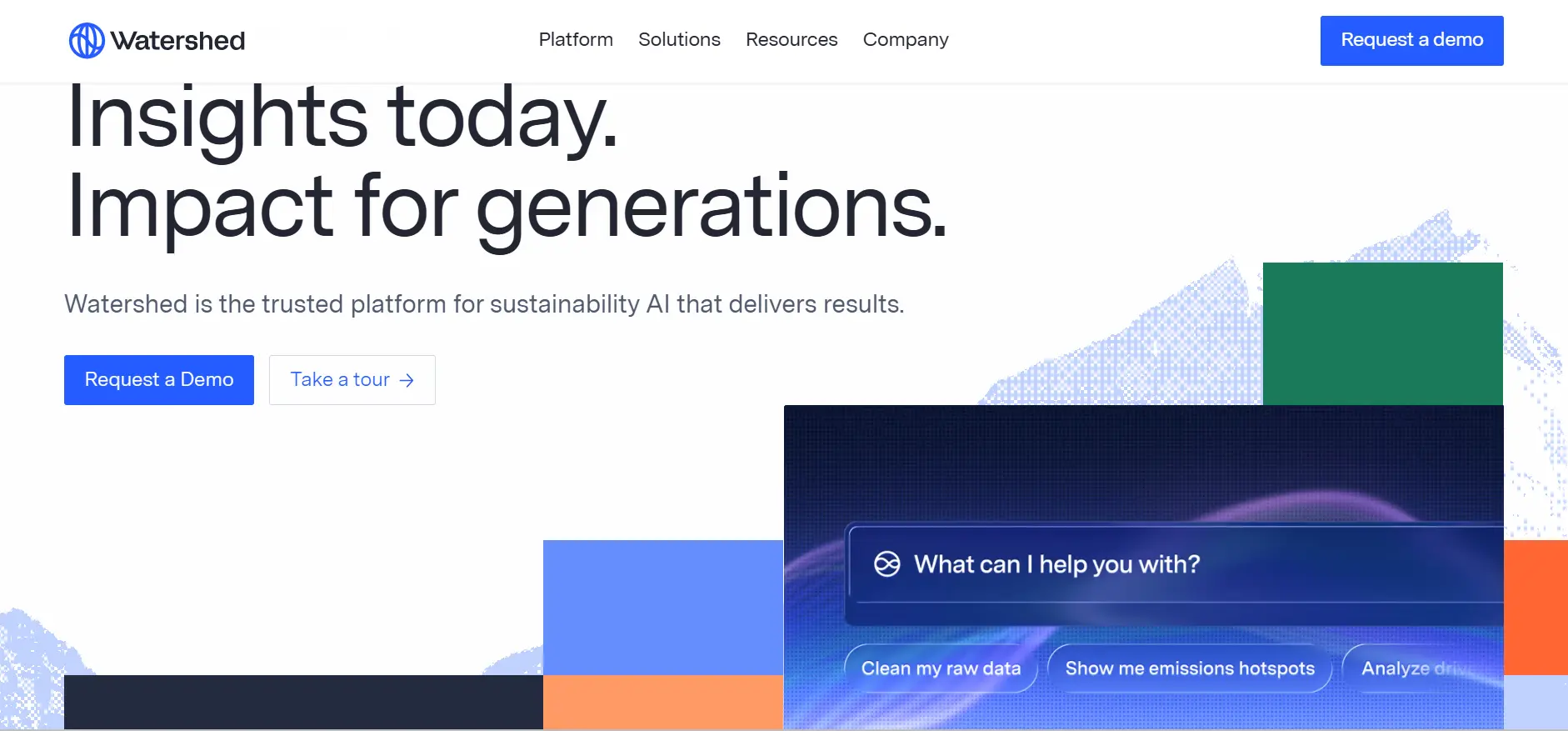
Watershed’s founding premise is that this separation is the problem. The platform is designed so that the data used to calculate the footprint is the same data used to model reduction scenarios, engage suppliers, and procure clean power. Measurement and action run on the same engine. That architectural choice drives almost everything distinctive about how Watershed performs in a mature sustainability program — and almost everything that makes it the wrong choice for organizations that are not yet ready to use carbon data as a decision tool.
What the Platform Actually Does, and Why the Architecture Matters
Watershed’s core is a carbon accounting engine built on a library of more than 500,000 emission factors — including CEDA, the Comprehensive Environmental Data Archive now open-sourced through the Cornerstone Sustainability Data Initiative, a collaboration between Stanford’s Doerr School of Sustainability and Watershed. That database breadth matters most at Scope 3, where the choice of emission factor can move a calculation by a factor of two or more depending on the sector and geography of the supplier.
The Product Footprints capability, introduced in 2025, represents a meaningful step beyond spend-based Scope 3 estimation. The tool uses AI to decompose purchased physical goods into constituent materials and manufacturing processes, allowing an organization to model the carbon intensity of what it buys at a level of granularity that spend-based EEIO methods cannot reach. For a consumer goods company or a manufacturer where Category 1 (purchased goods and services) dominates the Scope 3 inventory, this is the capability that makes supplier-level decarbonization strategy numerically credible.
Supplier engagement is integrated directly into the platform rather than operating as a parallel workflow. Watershed has tools for collecting primary emissions data from suppliers, validating what is submitted, and reflecting supplier-specific figures in the corporate footprint — so that the progress a supplier makes on decarbonization appears in the customer’s Scope 3 inventory as it happens, not twelve months later in the annual report. Sweep approaches the data coordination problem with a similar integration philosophy, though with a stronger emphasis on cross-functional internal data collection rather than supplier engagement depth.
When Measuring Emissions Becomes Reducing Them
The scenario modeling functionality is where Watershed’s architecture pays off most directly. Sustainability leads can model the footprint impact of logistics network changes, energy procurement decisions, supplier switches, or product material redesigns — and see the projected result against the corporate SBTi pathway before any capital is deployed. This is not a reporting feature. It is a capital allocation tool that uses the carbon accounting engine as its input.
The clean power marketplace extends this into execution. Organizations can move from identifying that Scope 2 market-based emissions are a reduction lever to procuring the power purchase agreement or renewable energy certificate portfolio that delivers the reduction — within the same platform. Watershed and Powertrust announced a 150MW clean power RFP in emerging markets in mid-2025, giving customers access to projects outside the conventional offset market.
This design reflects a specific philosophical position: that the value of carbon data is not the number in the disclosure. It is the decision the number enables. Persefoni is built on a different but complementary premise — that the calculation must be treated with the discipline of financial accounting, and that investor-grade documentation of methodology is the primary deliverable. The two platforms address sequential problems. Persefoni builds the defensible baseline. Watershed connects that baseline to what an organization does about it. For organizations choosing between them, the question is which problem is harder: the documentation or the action.
The Regulatory Coverage in Practice
Watershed supports CSRD reporting with pre-built ESRS E1 outputs — covering climate-related disclosures including GHG emissions across all scopes, transition risk, physical risk, and climate targets. The platform also supports ISSB-aligned and TCFD-structured disclosures, CDP reporting (Watershed holds CDP Gold Software Provider status), California’s SB 253 and SB 261 climate disclosure requirements, and Australia’s ASRS framework. For organizations with global reporting obligations across multiple jurisdictions simultaneously, the framework pre-population reduces the manual effort of multi-framework alignment.
The CSRD coverage warrants a precise note. Watershed handles the climate pillar of CSRD with genuine depth. The social and governance pillars — ESRS S1 through S4, ESRS G1 — receive less attention. For organizations whose double materiality assessment produces material topics beyond the environment, Watershed needs to be complemented by a platform with broader ESG data collection capabilities. Workiva or Novisto are better positioned to manage the full CSRD data point inventory across all ESRS topics.
Post-Omnibus CSRD state as of June 2026: Directive (EU) 2026/470 entered into force on 19 March 2026. The revised scope covers organizations exceeding 1,000 employees and €450 million in net turnover. Listed SMEs are fully exempt. For organizations now outside the revised scope, Watershed remains relevant for voluntary disclosure and investor engagement — but the regulatory urgency that drove many 2024 and 2025 evaluation processes has receded for the Wave 2 and Wave 3 cohort.
The Customers Who Use It and What That Signals
Watershed’s customer base reads as a deliberate market position: Airbnb, Spotify, FedEx, Visa, Dr. Martens, General Mills, Carlyle Group, Roche, KKR, four of the top six US banks, six of the top ten private equity firms. These are not early adopters exploring carbon accounting for the first time. They are organizations that have existing sustainability programs, existing disclosure obligations, and the organizational infrastructure to direct what Watershed surfaces.
The CDP partnership is worth noting specifically. CDP — the independent environmental disclosure platform — used Watershed to manage its own emissions reporting. When the organization that operates the world’s largest environmental disclosure framework selects a carbon accounting platform for its own footprint, that is a form of technical endorsement that sits outside the standard analyst quadrant.
By the end of 2024, Watershed’s customers collectively managed 1.9 gigatons of CO2e — more than the combined annual emissions of France, the UK, Germany, and Italy. That scale creates a network effect on the emission factor database: the more complex and diverse the customer base, the more edge cases the methodology must handle correctly, and the more validated the output becomes across industries and geographies.
What the Implementation Actually Requires
Watershed is not a self-service platform. The implementation model assumes a sustainability team capable of mapping the organization’s data sources, directing integration priorities, and making strategic decisions about Scope 3 boundary-setting and supplier engagement sequencing. The 60+ pre-built integrations — covering ERP systems (SAP, Oracle), cloud infrastructure (AWS, Azure, GCP), travel and expense platforms (Concur, Navan), and financial systems — reduce the technical lift, but they do not eliminate the organizational judgment required to configure them correctly.
Implementation timelines depend significantly on data readiness. Organizations with clean, structured Scope 1 and 2 data in ERP systems and a defined Scope 3 boundary can reach a reportable footprint faster. Organizations whose Scope 3 data lives in spreadsheets distributed across business units or procurement teams will need to resolve the data coordination problem before Watershed’s calculation engine can operate at full capability. Sweep is specifically designed to address this upstream coordination challenge; for some organizations, Sweep is the right tool to resolve the data problem before Watershed is the right tool to model the decisions.
Pricing is enterprise-negotiated with no published tiers. Market estimates suggest annual contracts range from $50,000 for simpler single-entity deployments to $400,000 or more for large multinationals with extensive integration requirements. Training, advanced configuration, and additional regulatory modules frequently add to base contract cost. The negotiation process rewards buyers who have completed a structured competitive evaluation — Watershed’s absence of published pricing creates asymmetric information that experienced procurement teams can use to their advantage.
Who Should Not Buy Watershed
Three organizational profiles should look elsewhere. First: organizations at Stage 2 or Stage 3 maturity — running sustainability programs on spreadsheets, without a dedicated sustainability function, or producing a carbon footprint for the first time. Watershed’s depth is proportional to the program it supports. Without the internal capability to direct the data, the scenarios, and the supplier engagement, the platform returns investment more slowly than simpler tools. Greenly or Plan A serve this profile better.
Second: financial institutions whose primary measurement challenge is financed emissions — Scope 3 Category 15 under the PCAF framework. Watershed added PCAF-aligned financed emissions measurement in 2024, but Persefoni was built specifically for this use case and carries the deeper methodology, the financial-institution-specific data model, and the regulatory documentation discipline that asset managers and banks require for investor-grade disclosure.
Third: organizations whose CSRD obligation extends materially into social and governance topics — worker health and safety, supply chain human rights due diligence, or anti-corruption governance disclosures. Watershed’s ESRS coverage is strongest on E1. The full ESRS data point set requires a platform with broader ESG data architecture. Choosing Watershed as the sole CSRD tool for a company with material S and G topics will produce a gap that becomes visible at the first assurance engagement.
The Verdict
Watershed is the right platform for a specific and well-defined organizational profile: a large enterprise or multinational with an established sustainability program, a Scope 3-heavy footprint, an in-house team capable of directing the program, and a genuine intent to use emissions data as an input to operational decisions — not just as the source material for an annual report. For that profile, Watershed offers a depth of Scope 3 measurement, a connection between data and action, and an audit-ready governance model that no peer platform matches at equivalent scale.
It is the wrong platform for organizations still solving for the baseline, for financial institutions whose core challenge is PCAF-aligned financed emissions, and for CSRD filers whose material topics run significantly beyond climate. The platform’s confidence in its positioning is earned — named a Leader in the 2026 Verdantix Green Quadrant for Enterprise Carbon Management, a 100% audit pass rate, customers managing 1.9 gigatons of CO2e. But that confidence belongs to a specific buyer. Knowing whether you are that buyer is the evaluation.