Reviewed by the AiGreenTools Editorial Team · Last Updated: June 2026
| Founded | 2017, Berlin |
| Acquired by | Diginex (NASDAQ: DGNX), January 15, 2026 |
| Best for | European mid-market to large enterprises at Stage 3 — CSRD obligation approaching, SBTi commitment in progress |
| Carbon Scopes | Scope 1, Scope 2, Scope 3 (all 15 categories) |
| Pricing | Custom / Enterprise — not publicly disclosed |
| AI Classification | AI Enhanced |
| Key Frameworks | GHG Protocol, CSRD/ESRS E1, SBTi, CDP, SFDR |
| Maturity Stage | Stage 3 |
| Certifications | TÜV Rheinland (carbon methodology), SOC 2, GDPR |
Picture the Organization Plan A Is Built For
It is a European company. Between 500 and 5,000 employees, with operations in multiple EU countries and a supply chain that extends into Asia or North America. The Head of Sustainability has been in the role for two years. The board has approved a commitment to the Science Based Targets initiative. The CSRD reporting obligation is real — for Wave 2 organizations under the revised Directive (EU) 2026/470, first reporting covers FY2027 data. The carbon footprint is currently produced annually in a spreadsheet that takes three months to compile and cannot be defended at the methodology level if an auditor asks the wrong question.
This organization does not need a platform built for FedEx or Carlyle Group. It needs a platform that can produce a TÜV-certified carbon footprint, connect that footprint to a SBTi-aligned reduction roadmap, structure the ESRS E1 disclosure, and do all of this without requiring the sustainability team to grow from one person to five before the system delivers value. That is the organizational profile Plan A has built its platform to serve since 2017. It is also why Diginex — which acquired Plan A in January 2026 for approximately €55 million — saw in it a strategic asset rather than a commodity point solution.
Understanding Plan A means understanding this positioning precisely: not the platform for the most complex enterprise in the market, not the platform for the SME taking its first steps, but the platform for the European mid-market organization that has arrived at the moment when the regulatory calendar, the investor expectation, and the internal capability have aligned — and now needs a system that can translate that alignment into a credible, certified, externally defensible sustainability program.
The Decarbonization-First Architecture
Most carbon accounting platforms are built around the disclosure problem: get the number, structure the report, pass the audit. Plan A is built around a different sequence: understand the emissions, build the reduction plan, then produce the disclosure that documents the journey. Lubomila Jordanova, Plan A’s founder and CEO — who became CEO of Diginex following the acquisition — has articulated this position consistently since founding: “Carbon accounting is no longer a tick-box compliance exercise. It is a reduction race.”
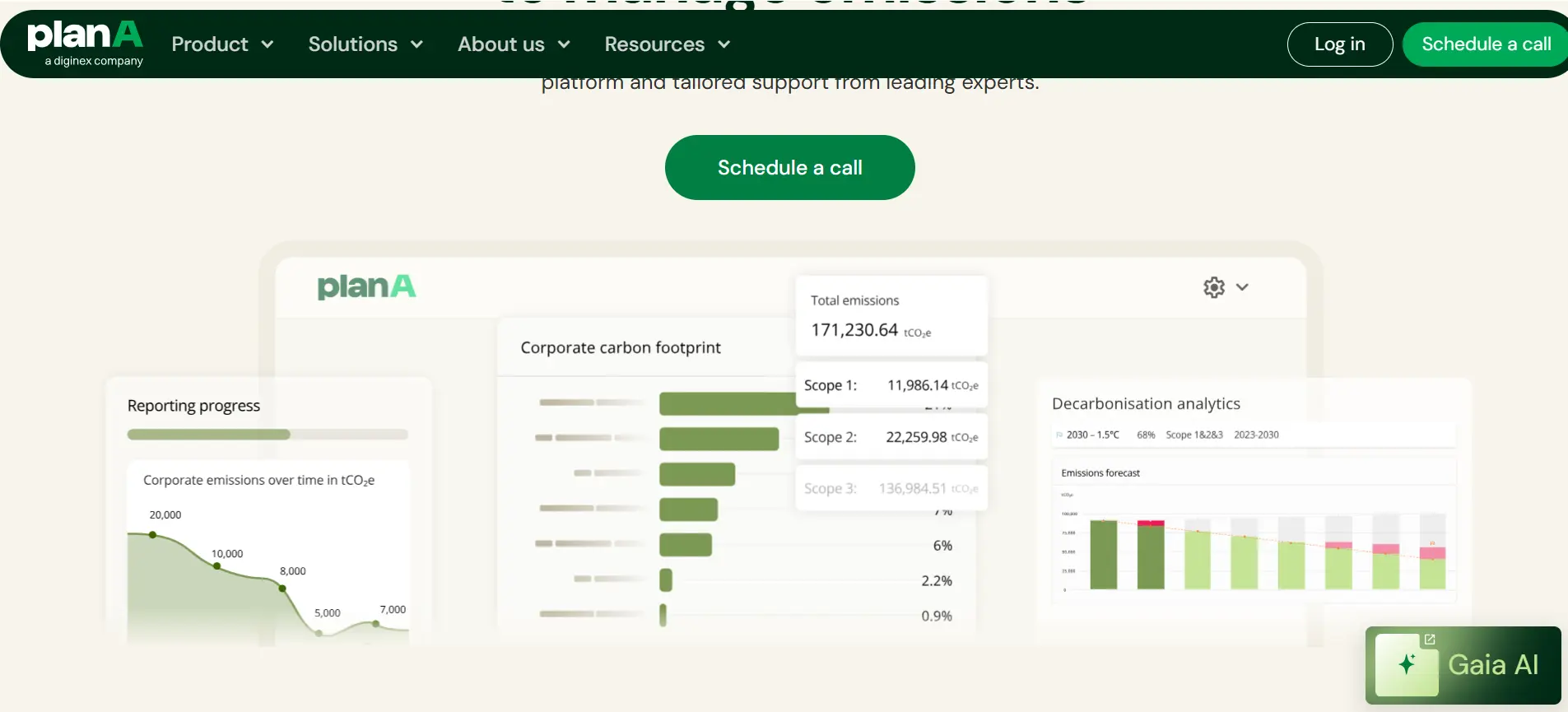
That philosophy shows up in the product architecture. The measurement module and the decarbonization planning module share the same dataset. A sustainability manager who identifies that Scope 3 Category 4 (upstream transportation) is the largest emissions hotspot can immediately model the financial cost and emissions impact of shifting logistics providers — in the same platform, using the same emission figures, with the result expressed in both tCO2e and projected cost savings. The output is not a second report. It is the reduction roadmap that CSRD, SBTi, and CDP all require as a forward-looking counterpart to the historical footprint.
This architecture matters because the organizations Plan A serves are typically at the moment where the baseline has been established — or needs to be — and the board is asking what happens next. A platform that delivers a footprint and stops is useful. A platform that delivers a footprint and immediately frames the question “what should we do about it?” is what a sustainability lead can bring to a board meeting with a credible answer.
TÜV Rheinland Certification and What It Covers
Plan A’s carbon accounting methodology is certified by TÜV Rheinland — a German technical inspection organization with no commercial relationship with the calculation outcome. The certification covers methodology alignment with the GHG Protocol Corporate Standard and SBTi criteria. This means the calculation approach has been externally assessed, not merely self-described as “aligned.”
For European enterprises preparing for CSRD assurance, this certification addresses a specific risk: the question of whether the carbon footprint methodology would survive scrutiny from an assurance provider. Under ISAE 3000 limited assurance — the standard most Wave 2 CSRD organizations will encounter first — the assurance scope includes an assessment of whether the methodology applied is appropriate and consistent. A TÜV Rheinland-certified methodology provides documentary evidence of that appropriateness that the assurance provider can reference rather than reconstruct.
The distinction between Plan A’s TÜV Rheinland certification and Normative‘s TÜV SÜD verification is worth noting for buyers evaluating both. Both are third-party certifications of the carbon accounting methodology — different bodies, similar function. The Normative verification additionally covers ISO/IEC 25051 (software quality), which is a broader technical standard; the Plan A certification focuses specifically on GHG Protocol and SBTi methodology alignment. Neither certification makes one platform universally superior — they address slightly different dimensions of methodology assurance, and both are materially more rigorous than a platform with no third-party certification at all.
The Diginex Acquisition — What It Means for Buyers
Plan A was acquired by Diginex (NASDAQ: DGNX) on January 15, 2026. The acquisition price was approximately €55 million, structured as €3 million in cash and Diginex shares. Lubomila Jordanova was appointed CEO of Diginex following the transaction, maintaining strategic continuity at leadership level. The combined entity intends to integrate Plan A’s carbon accounting capability with Diginex’s ESG reporting infrastructure — which spans 19 global frameworks — and with Diginex’s supply chain transparency tools, including the human rights risk platform The Remedy Project and the ESG analytics engine from Matter DK.
The strategic logic is sound: carbon accounting without ESG context misses the full CSRD disclosure requirement, and ESG reporting without rigorous carbon methodology produces disclosures that fail under assurance. The Diginex-Plan A combination addresses both directions of that gap. The same fragmentation problem that has driven consolidation across the market — identified by Verdantix in September 2025 as the defining structural shift — is precisely what this acquisition is designed to resolve.
The honest buyer’s question is not whether the strategic logic is sound. It is whether the integration is complete enough, at the moment of evaluation, to justify a multi-year platform commitment. As of mid-2026, the integration is in progress. The carbon accounting engine and the decarbonization planning tools operate as they did before the acquisition. The broader ESG framework coverage and supply chain transparency features from Diginex’s portfolio are being integrated on a roadmap that has not been fully published. Buyers should evaluate the current state of the product — what it can do today — and treat the roadmap as directional rather than committed.
Scope 3 Coverage and European Supply Chain Context
Plan A covers all 15 Scope 3 categories with both spend-based and activity-based methodologies. The AI-assisted data processing retains organizational context across reporting cycles — memorizing naming conventions, data mapping decisions, and custom calculation structures — which reduces the annual data preparation burden materially after the first year. Automated anomaly detection flags data quality issues before they propagate into the footprint, reducing the manual review time that teams without a dedicated data analyst typically spend after data collection.
For European companies, the regulatory landscape around supply chain emissions has a dimension that North American-centric platforms often underweight: the EU Corporate Sustainability Due Diligence Directive (CSDDD) requires large companies to conduct due diligence on their value chains, creating a legal obligation that extends the Scope 3 data collection question beyond carbon accounting into human rights and environmental due diligence. The Diginex integration — particularly The Remedy Project acquisition — is positioned to address this combined requirement. For Plan A customers who will face CSDDD obligations alongside CSRD, the acquisition trajectory is directly relevant to how the platform will serve their needs in 2027 and beyond.
The platform’s customer base includes BMW, Deutsche Bank, Visa, Chloé, Trivago, and more than 1,500 clients worldwide. This range confirms the mid-to-large enterprise positioning but also signals that the platform has served complex organizations with demanding requirements — the BMW and Deutsche Bank implementations, in particular, involve supply chains and reporting structures that go well beyond what a lightweight SME tool can support.
Positioning Against the Carbon Cluster
Within the carbon accounting market, Plan A occupies a specific and well-defined position. It is not the scientific-first engine that Normative represents, where the TÜV SÜD verification of the calculation engine itself is the primary trust signal. It is not the action-and-reduction powerhouse that Watershed represents, where Scope 3 product-level decomposition and a clean power marketplace extend measurement into operational strategy. It is not the financial-institution specialist that Persefoni represents, where PCAF alignment and portfolio-level carbon data serve asset managers and banks.
Plan A is the platform that brings TÜV-certified carbon methodology, decarbonization-first architecture, and active CSRD alignment to the European organization that is not yet operating at the complexity level that Watershed or Normative requires — but has outgrown the spreadsheet and needs a system that will grow with it through the regulatory cycle. That is a real and substantial segment of the European market. The CSRD-driven demand from Wave 2 organizations — now reporting under the revised scope of Directive (EU) 2026/470 — creates a large population of exactly this profile through 2027 and 2028.
Who Should Not Buy Plan A
Three profiles are better served elsewhere. Large multinationals with Scope 3 Category 1 inventories spanning thousands of suppliers across global value chains should evaluate Watershed’s Product Footprints capability and supplier engagement infrastructure before committing to Plan A. The depth of Scope 3 primary data collection and scenario modeling at enterprise scale exceeds Plan A’s current capability, particularly for organizations whose supply chain complexity is the primary measurement challenge.
Financial institutions whose core carbon accounting challenge is PCAF-aligned financed emissions — Scope 3 Category 15 for banks, asset managers, and insurers — should evaluate Persefoni first. Plan A covers Category 15 within its Scope 3 framework, but Persefoni’s data model and methodology were built specifically for this use case and carry the institutional documentation depth that financial regulators and investor disclosure requirements demand.
Organizations that require a fully settled, standalone platform with a stable multi-year roadmap and no integration uncertainty should wait until the Diginex integration is further advanced — or evaluate Normative or Watershed in the interim. The Diginex acquisition is strategically sound, but it introduces a period of product evolution whose specifics are not yet fully defined. For organizations where platform stability is the overriding selection criterion, that uncertainty is a genuine constraint.
The Verdict
Plan A is the right platform for the European enterprise that has reached the regulatory and strategic moment where a certified carbon foundation and an active decarbonization roadmap are both required — and where neither the complexity nor the budget of the largest enterprise platforms is appropriate. The TÜV Rheinland certification, the decarbonization-first architecture, and the CSRD alignment make it a credible choice for the Wave 2 CSRD cohort now preparing for FY2027 reporting. The Diginex acquisition adds strategic breadth that will, over time, address the ESG coverage gap that all carbon-first platforms share. The honest buyer evaluates Plan A for what it is today: a certified, science-based carbon and decarbonization platform for the European mid-market, with a roadmap toward integration that is directionally clear and tactically in progress.