Reviewed by the AiGreenTools Editorial Team · Last Updated: June 2026
| Founded | 2019, Montreal, Canada |
| Funding | CAD $27M Series C (May 2025) — Inovia Capital, White Star Capital, SCOR Ventures, Sagard |
| Best for | Mid-to-large enterprises with cross-functional ESG data collection and multi-framework CSRD reporting obligations |
| Pricing | Custom SaaS — from ~CAD $40,000/year |
| AI Classification | AI Enhanced (Mira AI — benchmarking, gap analysis, ESG intelligence) |
| Frameworks | CSRD/ESRS (all topics), GRI, SASB, TCFD, ISSB S1/S2, CDP, EU Taxonomy, SFDR, S&P Global, UN SDGs — 25+ total |
| Maturity Stage | Stage 3–4 |
| Reference Deployment | Sanofi — one of the first 15 CSRD-compliant reports (2025) |
Every Sustainability Team Faces the Same Choice — and Most Choose the Wrong Tool First
There is a choice every Head of Sustainability eventually faces. The ESG reporting obligation has grown beyond what spreadsheets and email coordination can support. The team needs a system. The options are: a financial reporting platform with sustainability modules added (Workiva), a dedicated carbon accounting engine (Normative, Watershed), a portfolio ESG tool for PE firms (KEY ESG), or a purpose-built ESG data management platform designed for the sustainability team’s actual workflow.
The last category is where Novisto sits — and it is the category that buyers most frequently underspecify when they start the evaluation. Organizations that evaluate ESG software primarily on carbon accounting depth miss the governance problem. Organizations that evaluate primarily on financial reporting integration miss the cross-functional coordination problem. The buyer who understands both problems is the one who evaluates Novisto correctly.
The Novisto value proposition is specific: ESG data governance for organizations where metrics flow from 40 contributors across six functions, where five frameworks must be satisfied from one dataset, and where assurance providers need live access to the system of record rather than a clean export. That is not a financial reporting problem. It is not a carbon accounting problem. It is a data governance and workflow coordination problem — and it is the problem Novisto was built to solve.
What Is Novisto and How Does It Work?
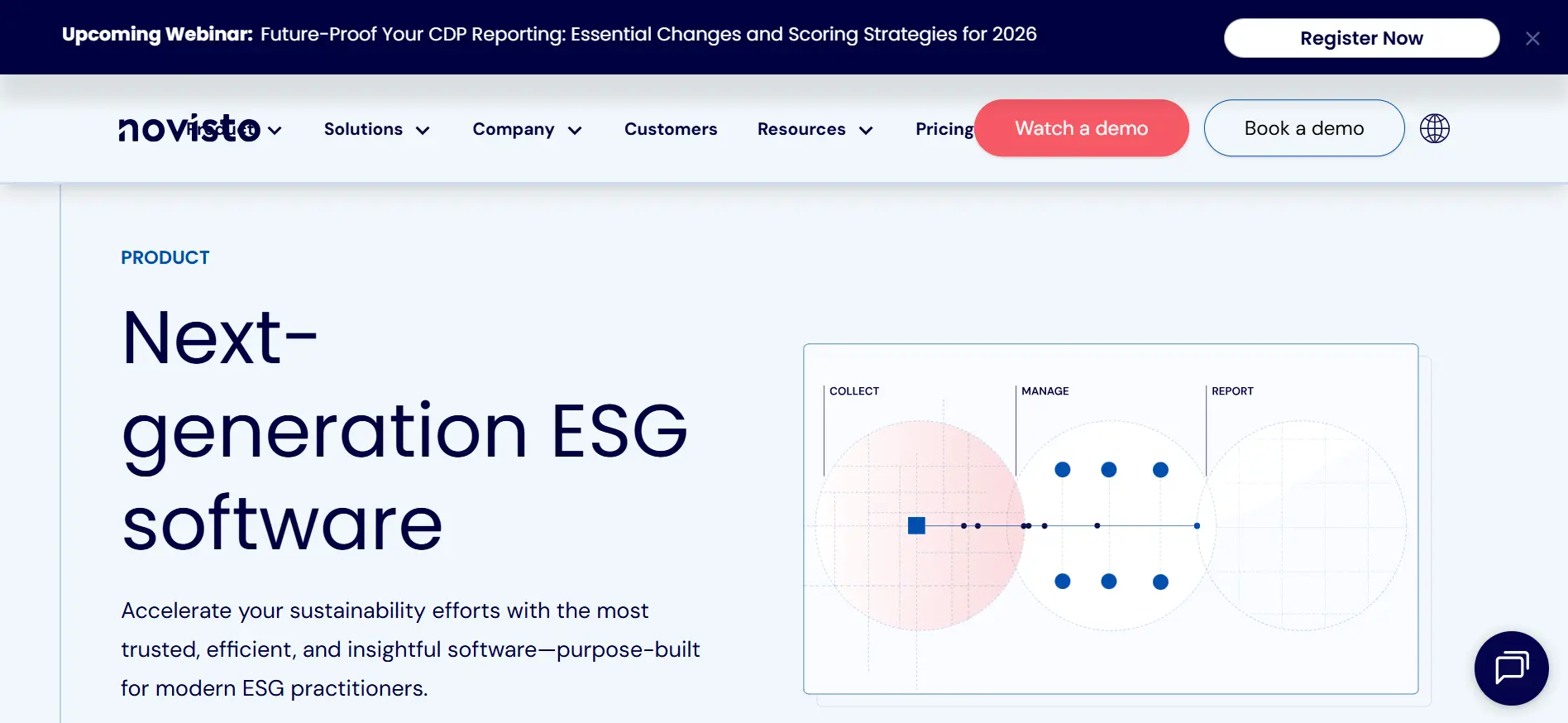
Novisto’s architecture is built around the metric — not the document. Every ESG data point is defined once in the platform’s curated metric library, assigned to a named owner, and connected to every framework where that metric appears. When a contributor submits an energy consumption figure, that figure automatically populates the GHG calculation, the CSRD ESRS E1 data point, the GRI 302 disclosure, and the CDP questionnaire response — without re-entry, without version divergence, without reconciliation.
Core platform capabilities:
- Metric library: 25+ frameworks pre-mapped, including full CSRD/ESRS coverage across E, S, and G topics
- Workflow engine: Automated data requests, reminders, and approval chains for cross-functional contributors
- Audit trail: Complete change history, named owners, supporting documentation, and assurance provider access
- Double materiality assessment: Structured DMA module with GIST Impact integration for monetary impact valuation
- Report builder: Customized disclosure outputs aligned to framework requirements
- XBRL tagging: ESAP-compliant iXBRL tagging for CSRD regulatory filing
- Peer benchmarking: Metric-level comparison against industry peers via Mira AI
- Integrations: REST APIs, SINAI Technologies (carbon modeling), Q4 Inc. (investor relations), Normative (carbon accounting)
How Does Novisto Handle CSRD Reporting — Including Double Materiality?
CSRD compliance under Directive (EU) 2026/470 (in force since 19 March 2026) requires organizations exceeding 1,000 employees AND €450M net turnover to disclose according to European Sustainability Reporting Standards. The process begins with a double materiality assessment — a structured analysis identifying which ESRS topics are material from both an impact materiality and a financial materiality perspective. Only after the DMA is complete can the organization determine which ESRS data points it must disclose.
Novisto provides a DMA module developed in partnership with GIST Impact, which adds monetary impact valuation — quantifying the financial cost of environmental and social impacts — and industry benchmarking against sector peers. The output is a documented materiality matrix that satisfies EFRAG’s double materiality guidance and can be disclosed within the CSRD report alongside the determination of material ESRS topics.
From the DMA output, the platform automatically activates the relevant ESRS data points in the reporting workflow — assigning them to contributors, triggering collection requests, and mapping them to the curated metric library. Organizations that have completed a DMA in Novisto with GIST Impact do not start from a blank framework template. They start from a materiality-filtered metric set that reflects their specific impact profile.
For CSRD regulatory reference, see our post-Omnibus CSRD guide and AI in carbon accounting 2026.
Novisto vs. Workiva for CSRD — What Is the Actual Difference?
This is the comparison that appears most frequently in enterprise ESG software evaluations, and it is most often framed incorrectly as a quality comparison rather than an organizational model comparison.
| Dimension | Novisto | Workiva |
|---|---|---|
| Primary buyer | Head of Sustainability / ESG Director | CFO / Finance Director |
| Core architecture | ESG data governance and workflow | Connected financial and sustainability reporting |
| CSRD social & governance | Full ESRS E, S, G coverage | Full ESRS E, S, G coverage |
| iXBRL / ESAP filing | XBRL tagging + xHTML export | Native iXBRL authoring — deepest in market |
| Financial reporting integration | Limited — sustainability-native platform | Native — financial + sustainability connected |
| DMA module | Yes — with GIST Impact monetary valuation | Yes — documentation and governance focused |
| Peer benchmarking | Metric-level via Mira AI | Framework-level via ESG Explorer |
| Carbon accounting depth | Functional (GHG module) + SINAI partnership | Workiva Carbon (functional) + integrations |
| Pricing entry point | ~CAD $40,000/year | Enterprise ($100,000+ typical) |
The selection rule is organizational: if sustainability reporting is led by the finance function and must be integrated into the same governance infrastructure as the annual report and SEC filings, Workiva is the right architecture. If sustainability reporting is led by the sustainability team and the primary challenge is cross-functional data governance across ESG topics — not financial reporting integration — Novisto is the right architecture. The two platforms are compatible and serve sequential organizational models, not competing ones.
Which Organizations Benefit Most from Novisto?
Novisto is purpose-built for:
- Mid-to-large enterprises (500–50,000 employees) with sustainability teams of 2–10 people managing data from 20+ contributors across functions
- Organizations in their first or second CSRD reporting cycle needing to replace spreadsheet-based data collection with governed workflows
- Companies reporting simultaneously to CSRD, GRI, CDP, and ISSB who need a single-dataset, multi-framework output
- Organizations preparing for ISAE 3000 limited assurance and needing demonstrable data lineage from source to disclosure
- Industries where ESG performance spans multiple dimensions: retail (GHG + labor), pharmaceuticals (GHG + human capital + product safety), financial services (GHG + SFDR PAI + governance)
Novisto’s Reference Deployment — What Sanofi’s CSRD Report Demonstrates
Sanofi used Novisto to produce one of the first fifteen CSRD-compliant reports, setting what the platform describes as “new data governance and quality standards.” This reference is operationally meaningful because Sanofi is a large-cap pharmaceutical company with complex ESG obligations spanning ESRS environmental, social, and governance topics — not a simple climate-only disclosure.
The implications for buyers: a CSRD-compliant report from a regulated pharmaceutical company with a Big Four assurance engagement means the platform’s audit trail, DMA documentation, and XBRL tagging have been tested under real assurance scrutiny. That is not a feature demonstration in a vendor environment. It is a live regulatory deployment at the complexity level that most CSRD-obligated organizations will eventually face.
Emirates Group and Power Corp of Canada are additional enterprise customers across geographically and sector-diverse operations — confirming that the platform scales beyond the single-country, single-sector deployments that characterize earlier-stage ESG software.
Who Should Not Buy Novisto?
Financial institutions and PE fund managers needing portfolio-level ESG aggregation across multiple entities should evaluate KEY ESG, whose dual-portal architecture is purpose-built for the GP-portfolio company data relationship. Novisto is a single-entity ESG platform; it does not aggregate across a fund portfolio natively.
Organizations whose primary ESG challenge is Scope 3 carbon accounting depth — Category 1 supplier engagement, product-level footprinting, SBTi pathway modeling integrated with reduction decisions — should lead with Watershed or Normative for the carbon layer and evaluate Novisto as the upstream ESG governance system. The SINAI integration covers some of this gap but requires a separate platform contract.
Small organizations below 200 employees without dedicated sustainability functions will find Novisto’s workflow governance architecture more infrastructure than their program complexity requires. Greenly or Plan A provide ESG data management at a more appropriate entry point for that profile.
Organizations where the CFO drives the sustainability reporting process and where CSRD disclosure must be integrated into the same governance infrastructure as the annual report and SEC filing should evaluate Workiva first. The connected financial-sustainability reporting architecture is a different product category from Novisto’s ESG governance focus.
The Verdict on Novisto
Novisto is the right ESG platform for the sustainability team that has accepted that the reporting challenge is a data governance problem — not a framework coverage problem — and that solving it requires a system of record with named metric owners, approval workflows, audit trails, and multi-framework output built on a single dataset. The CAD $27M Series C funding (May 2025), the Sanofi CSRD reference deployment, and the partnerships with GIST Impact, SINAI, and Q4 Inc. signal a platform with both the financial stability and the ecosystem depth to serve that buyer through an evolving regulatory landscape. For organizations that need Workiva’s financial reporting integration or Watershed’s carbon accounting depth — those are different products. For organizations that need the sustainability team’s operating system — this is it.