Reviewed by the AiGreenTools Editorial Team · Last Updated: June 2026
| Founded | 2020 |
| Best for | Private equity fund managers and enterprise groups managing multi-entity ESG data collection, SFDR, EDCI, and portfolio-level reporting |
| Carbon Scopes | Scope 1, Scope 2, Scope 3 (all 15 categories — 70,000+ emission factors) |
| Pricing | Custom / SaaS — modular, per entity or portfolio |
| AI Classification | AI Enhanced |
| Key Frameworks | SFDR (Art. 8 / Art. 9 PAI), EDCI, EU Taxonomy, CSRD/ESRS, IFRS S1/S2, TCFD, GRI, SBTi, Invest Europe |
| Maturity Stage | Stage 3 |
| Languages | 13 languages supported |
Picture the Fund Manager KEY ESG Is Built For
A European private equity firm. Twelve portfolio companies across France, Germany, the Netherlands, and the UK. Three in North America. Two in Southeast Asia. The ESG Director has been in the role for eighteen months. LP data requests are multiplying. One large pension fund LP now requires SFDR Article 8 PAI indicator disclosure for all portfolio companies annually. EDCI membership was approved at the last partner meeting. Two portfolio companies will face CSRD reporting obligations for FY2027 data.
The current process: a shared Excel template emailed to each portfolio company in January. Four companies respond by March. Six respond after three follow-up emails. Two require phone calls. The data arrives in different units, different base years, and different scopes. The ESG Director spends February through May reconciling inputs before producing the LP ESG report. The same Scope 1 emission figure appears differently in the SFDR report, the LP deck, and the EDCI submission because they were compiled at different points from different versions of the same spreadsheet.
This is the operational reality that KEY ESG was built to solve — not for the single large corporation filing CSRD independently, but for the fund manager whose ESG program quality depends entirely on its ability to collect consistent, validated data from portfolio companies that have neither the time, the expertise, nor the motivation to make the process easy for themselves.
What Makes KEY ESG Architecturally Different — The Dual Portal
Most enterprise ESG platforms are built for a single organization: one data model, one reporting hierarchy, one set of users with common context and institutional knowledge. Deploying such a platform across a PE portfolio means asking 20 portfolio companies with different sizes, sectors, and ESG maturity levels to adopt the same enterprise software — and then hoping the data they submit is consistent enough to aggregate.
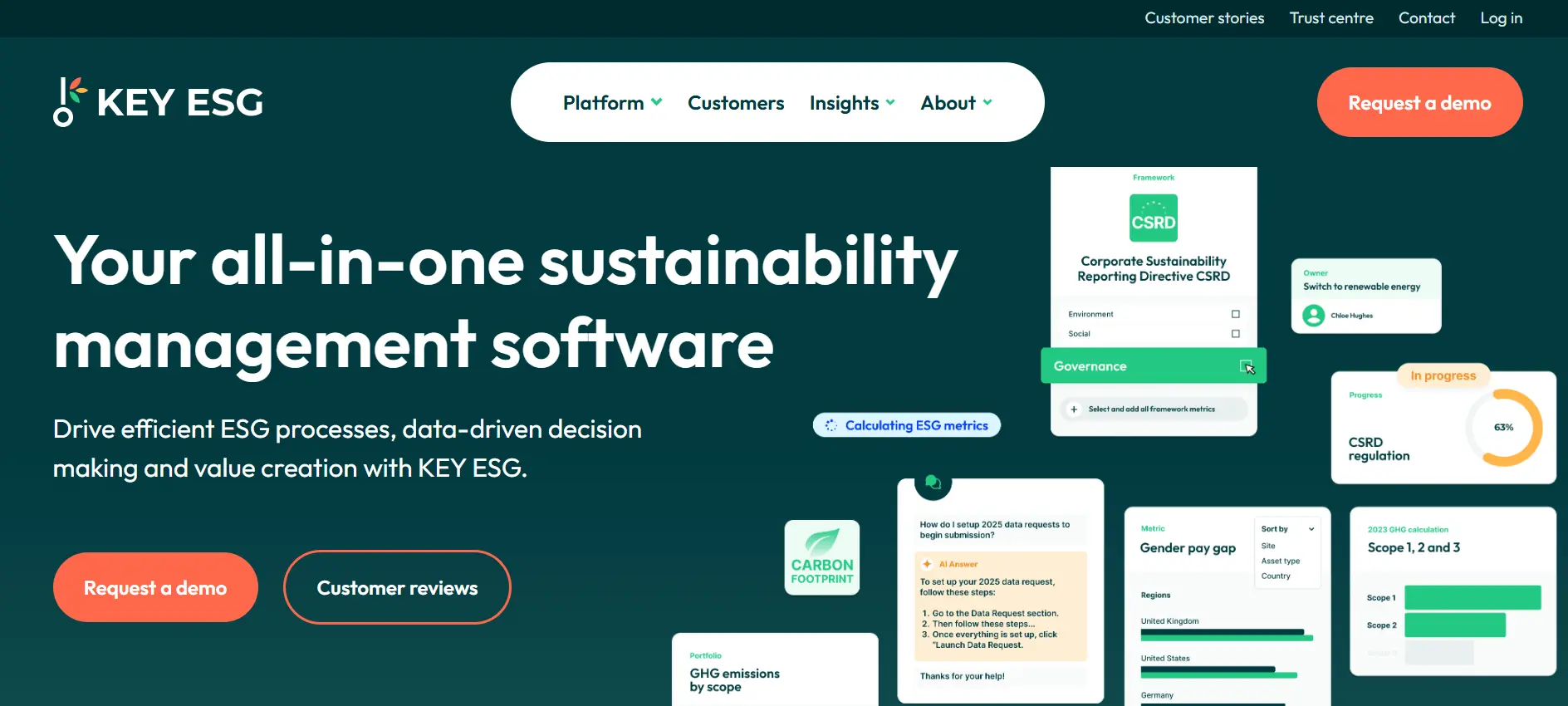
KEY ESG inverts this architecture. The Fund Manager Platform gives the GP centralized visibility, automated data requests, framework-mapped reporting, and LP communication tools. The Company Platform gives each portfolio company an entirely separate, intuitive data submission environment — purpose-built for a business user with limited ESG expertise who needs to provide accurate data without spending weeks understanding the system. The two platforms are connected. The portfolio company’s submission populates the fund manager’s dashboard. But the user experience is calibrated separately for each side of the relationship.
What the Fund Manager Platform provides:
- Real-time dashboard showing completion rates and data quality across all portfolio companies
- Automated data requests and reminders on a configurable schedule
- Portfolio-level aggregation with consistent methodology across all entities
- Framework outputs: SFDR PAI, EDCI metrics, EU Taxonomy, CSRD, GRI, IFRS S1/S2
- LP reporting exports in standard formats
- Target-setting and action plan tracking across the portfolio
What the Company Platform provides:
- Step-by-step guided data submission with built-in validation
- Error and outlier flagging at point of entry
- Carbon accounting: Scope 1, 2, 3 with 70,000+ emission factors (DEFRA, US EPA, Climatiq)
- Consistent GHG methodology enforced across all portfolio companies
- Support in 13 languages for international portfolios
- 24/7 AI-assisted support with human expert backup
The SFDR and EDCI Dimension — Why PE Firms Evaluate KEY ESG Specifically
Two regulatory and industry frameworks have created specific ESG data collection requirements for European private equity that generic ESG platforms are not purpose-configured to handle. SFDR (Sustainable Finance Disclosure Regulation) requires Article 8 and Article 9 fund managers to disclose Principal Adverse Impact (PAI) indicators for their investments — a set of environmental and social metrics that must be collected at portfolio company level and aggregated at fund level. The 18 mandatory PAI indicators include GHG emissions intensity, energy consumption from non-renewable sources, biodiversity-sensitive site exposure, and several social metrics. Collecting these consistently across a diverse portfolio in a single submission cycle is the operational challenge KEY ESG’s portal architecture directly addresses.
EDCI (ESG Data Convergence Initiative) — launched by a coalition of major PE firms and LPs — standardizes the ESG metrics collected from portfolio companies across 12 core KPIs including GHG emissions, renewable energy, board diversity, work-related injuries, and net new hires. EDCI membership creates a commitment to annual data collection and submission. KEY ESG pre-maps EDCI metrics within the Company Platform, reducing the configuration burden for fund managers bringing new portfolio companies into the submission cycle. CSRD adds a third dimension for fund managers whose portfolio companies are in scope — particularly mid-large European companies who will face their first reporting obligation for FY2027 data under the revised threshold of Directive (EU) 2026/470 (>1,000 employees AND >€450M net turnover).
Carbon Accounting Methodology — Consistency as the Core Value
KEY ESG’s carbon accounting covers Scope 1, 2, and 3 across all 15 GHG Protocol categories using more than 70,000 emission factors sourced from DEFRA, US EPA, and Climatiq. The methodology is applied identically across every portfolio company in the platform — the same factors, the same boundary definitions, the same conversion methodology.
This consistency is the carbon accounting feature that matters most for fund managers, and it is the feature that distinguishes KEY ESG from asking each portfolio company to calculate its own carbon footprint independently using whatever methodology it has access to. When a PE fund aggregates Scope 1 emissions from 15 portfolio companies, the meaningfulness of the total depends on whether those 15 figures are methodologically comparable. If some companies used DEFRA factors, others used EPA factors, and two used country-specific grid emission factors from different vintage years, the aggregate is a statistical artifact rather than an analytically defensible number.
For fund managers preparing SFDR PAI disclosures or EDCI submissions where the reported figure will be compared to industry benchmarks, methodological consistency is not an implementation detail — it is the condition that makes the comparison valid. Against dedicated carbon accounting platforms, KEY ESG’s Scope 3 depth for individual companies is less than Watershed or Normative. The differentiation is not depth per entity but consistency across entities — which is the fund manager’s primary carbon data quality requirement.
Enterprise Groups — Beyond Private Equity
The dual-portal architecture serves enterprise groups beyond the PE fund structure: holding companies managing operating subsidiaries, conglomerates reporting ESG data across independent business units, and franchise or retail networks collecting sustainability data from franchisees. Any organization structure where ESG data must flow from multiple semi-autonomous entities to a central reporting function faces the same coordination problem that PE firms face with portfolio companies — and the same solution.
For enterprise groups with CSRD obligations at group level that cascade to subsidiaries, KEY ESG’s entity management and framework mapping provide a governance layer for multi-entity CSRD data collection that generic disclosure platforms require significant customization to replicate. The platform integrates with business intelligence tools for advanced analytics and supports API-based data exchange for organizations with existing data warehouse infrastructure.
KEY ESG vs. Workiva — Different Problems, Not Direct Competitors
The comparison between KEY ESG and Workiva for ESG reporting regularly comes up in evaluations, and it typically reflects a misframing of what each platform is designed to do. Workiva is a connected reporting governance platform: it manages disclosure workflow, version control, audit trail, and iXBRL tagging for regulated financial and sustainability filings. Its buyer is the CFO’s office at a large listed company where sustainability disclosure is integrated into the financial reporting governance structure.
KEY ESG is a multi-entity ESG data collection and management platform: its buyer is the ESG Director at a PE fund or enterprise group who needs to collect consistent data from entities that are not directly integrated into the fund manager’s own financial reporting infrastructure. The organizational relationship — GP to portfolio company, holding company to subsidiary — is the defining context. Workiva does not address this relationship natively. KEY ESG is built around it.
For organizations that need both — multi-entity data collection and regulated disclosure governance — the architecturally correct answer is KEY ESG for data collection upstream and Workiva (or Novisto) for disclosure governance downstream. Both platforms are compatible and serve sequential functions.
Who Should Not Buy KEY ESG
Three profiles are better served elsewhere. Single large enterprises filing CSRD independently without portfolio aggregation requirements — organizations with complex double materiality assessment documentation, full ESRS data point management across S and G standards, and iXBRL tagging for ESAP — will find Workiva or Novisto more fit-for-purpose for the disclosure governance function KEY ESG does not prioritize.
Fund managers whose primary carbon accounting obligation is PCAF-aligned financed emissions (Scope 3 Category 15) at the center of their Article 9 SFDR reporting should confirm KEY ESG’s current Category 15 automation capability before committing, and evaluate Persefoni for financial institution-specific financed emissions methodology if Category 15 is the dominant requirement.
Organizations with less than 5 entities and straightforward, single-framework reporting requirements may find KEY ESG’s multi-entity architecture more than their program complexity requires. Plan A or Greenly provide carbon accounting and ESG reporting at a scale and price point more appropriate for organizations without the portfolio coordination requirement that justifies KEY ESG’s architecture.
The Verdict
KEY ESG is the right platform for the PE fund manager who has accepted that a spreadsheet template sent to 20 portfolio companies is not an ESG program — it is the appearance of one. The dual-portal architecture, the consistent GHG methodology, and the multi-framework output to SFDR, EDCI, and EU Taxonomy simultaneously are purpose-built for the fund-portfolio data relationship that no enterprise ESG platform was designed to serve natively. For that buyer, KEY ESG is not competing with Workiva or IBM Envizi. It is filling a gap those platforms were not built to fill.