Reviewed by the AiGreenTools Editorial Team · Last Updated: June 2026
| Founded | 2004, Sydney, Australia — acquired by IBM January 2022 |
| Best for | Large enterprises with complex, multi-location energy and facilities data — especially IBM Maximo / TRIRIGA users |
| Carbon Scopes | Scope 1, Scope 2 (market-based and location-based), Scope 3 (all 15 categories) |
| Pricing | Custom / IBM enterprise licensing |
| AI Classification | AI Enhanced |
| Key Frameworks | GHG Protocol, CSRD/ESRS E1, ISSB/TCFD, GRI, SASB, CDP, SFDR, UN SDGs, ENERGY STAR, NABERS, GRESB |
| Maturity Stage | Stage 3–4 |
| Analyst Recognition | IDC MarketScape Leader — ESG Reporting and Compliance Management 2025 |
ESG Reporting Has a Data Problem. Most Software Platforms Skip to the Calculation Anyway.
The counterintuitive truth about large-scale ESG reporting is that the methodology problem is usually solved before the data problem is even acknowledged. Most enterprises have access to emission factor databases, GHG Protocol guidance, and carbon accounting expertise. What they cannot consistently produce is clean, normalized, complete energy and activity data from 200 buildings across 40 countries — data in different units, different currencies, different billing cycles, arriving in different formats from different utility providers on different schedules.
IBM itself experienced this problem. Its Global Real Estate team manages over 600 locations, 42 million square feet, and nearly 100 countries — receiving more than 6,500 utility bills annually. Before implementing Envizi, the team relied on multiple disparate tools and manual processes to extract and consolidate sustainability data from IBM TRIRIGA and IBM Maximo. IBM evaluated more than 35 sustainability reporting solutions before selecting Envizi for its automation capability, its integration with TRIRIGA and Maximo, and its ability to deliver dashboard-based insights at portfolio scale.
That reference deployment — the vendor’s own global real estate operation running on the same platform sold to customers — is either the most credible proof of concept in the enterprise ESG market or the clearest signal that IBM Envizi is purpose-built for organizations that look structurally like IBM: large, multi-site, facilities-intensive, and already operating in the IBM technology ecosystem. Both interpretations are accurate. The evaluation question is which one describes your organization.
What IBM Envizi Actually Does — and Why Data Architecture Is the Core Capability
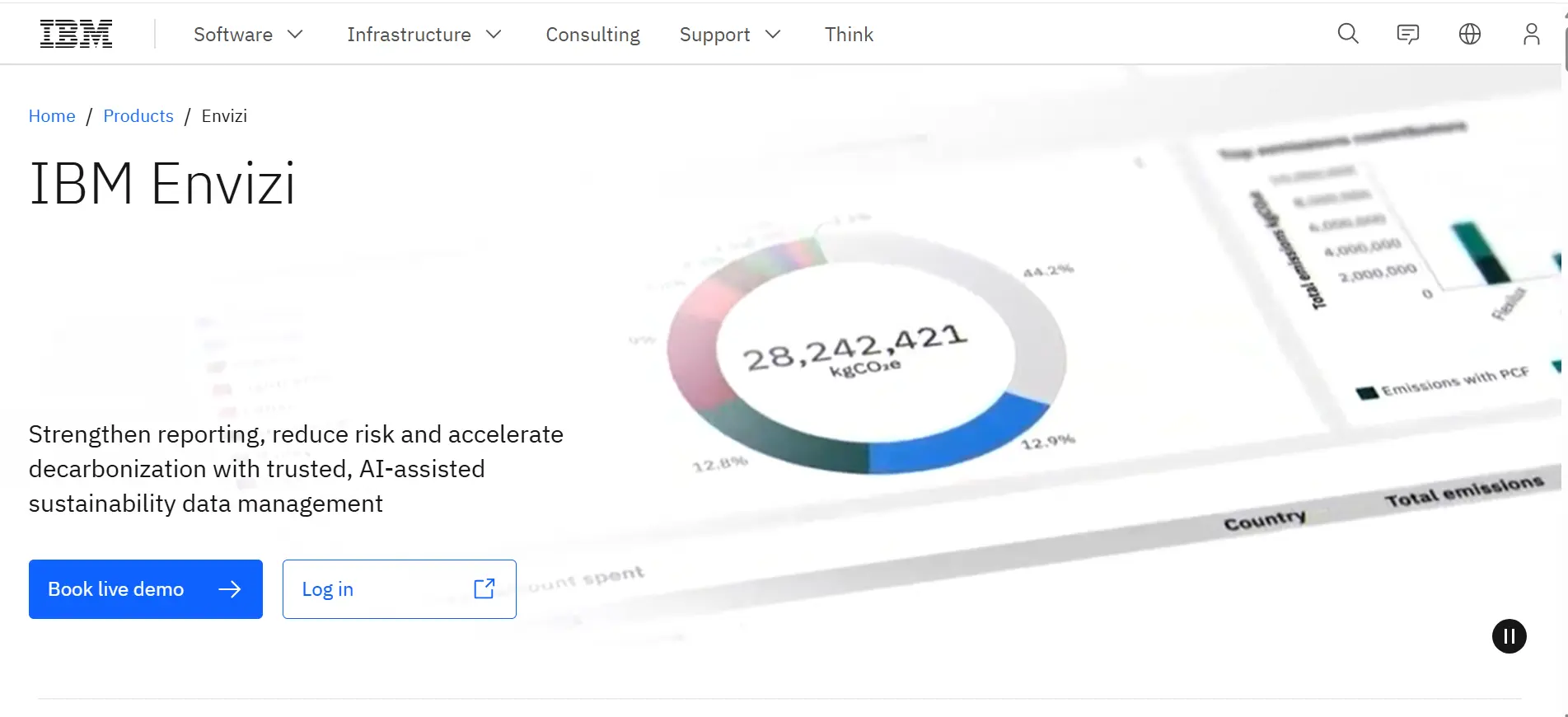
IBM Envizi ESG Suite is built on a single architectural premise: ESG reporting quality is determined by data quality, and data quality is determined by the automation and governance of data collection — not by the sophistication of the calculation engine that runs on top of it. The platform automates the capture and consolidation of more than 500 ESG data types from utility invoices, IBM Maximo asset management records, IBM TRIRIGA facilities management data, IoT sensors, supplier portals, and manual submission workflows into a single, auditable system of record.
The AI assistant embedded in the platform categorizes complex Scope 3 spend data — normalizing vendor names, classifying spend categories against GHG Protocol Scope 3 category definitions, and flagging data quality issues before they propagate into the GHG inventory. For Scope 3 Category 4 (upstream transportation and distribution), integration with IBM Sterling Supply Chain enables logistics emissions to flow from operational shipment records rather than from spend-based EEIO estimates — a meaningful improvement in primary data quality for organizations with significant freight emissions.
Key data inputs Envizi consolidates automatically:
- Utility invoices (electricity, gas, water, steam, district heating) — processed via file-loading connectors
- IBM Maximo asset records — energy consumption, maintenance events, equipment specifications
- IBM TRIRIGA facilities data — space utilization, occupancy, building classification
- Interval meter data — sub-hourly consumption for demand analysis and anomaly detection
- Supplier ESG data — via value chain surveys and portal submissions
- IoT sensor streams — for continuous environmental monitoring
Energy Analytics — The Capability Carbon Platforms Do Not Offer
Envizi’s energy management capability operates at two levels that matter distinctly to large real estate and industrial operators. At the portfolio level, building ratings and benchmarks integrate with ENERGY STAR Portfolio Manager, NABERS (National Australian Built Environment Rating System), and GRESB (Global Real Estate Sustainability Benchmark) to surface how each facility performs against sector and geography peers — identifying outliers whose energy intensity is materially above benchmark and quantifying the potential savings from addressing the gap.
At the facility level, interval meter analytics process sub-hourly energy consumption data to detect anomalies, identify demand charge triggers, and surface efficiency opportunities that monthly billing data obscures. A building consuming 15% more electricity than peers in the same climate zone on the same building type is visible in the benchmark. The specific shift schedule, HVAC setpoint, or equipment fault driving that excess is visible in the interval meter data. Both views require data automation at scale — which is the infrastructure Envizi provides before any calculation or report is produced.
Scope 2 emissions — both market-based (reflecting contractually procured energy products) and location-based (reflecting average grid emission intensity) — are supported in accordance with the GHG Protocol Scope 2 Guidance. Both must be disclosed separately under CSRD’s ESRS E1 requirements. Envizi’s market-based emissions report was enhanced in 2025 to include district heating, cooling, and steam alongside electricity — addressing a data gap that affected multi-facility operators with campus energy systems.
IBM Ecosystem Integration — Value for IBM Customers, Complexity for Everyone Else
The IBM Envizi integration architecture is the platform’s most differentiated capability — and its most context-dependent one. For organizations running IBM Maximo for asset management and IBM TRIRIGA for facilities management, the data flow from operational systems to ESG reporting is native. Maximo’s equipment records feed into energy intensity calculations per asset. TRIRIGA’s occupancy and space data feed into energy intensity calculations per square foot. These calculations update automatically as operational data changes — without manual export, transformation, or re-entry.
For organizations without IBM Maximo or TRIRIGA, the integration value diminishes significantly. The platform still provides file-loading connectors, API integrations, and survey-based data collection — capabilities common across enterprise ESG platforms. The architectural advantage of native IBM system integration becomes a library of point connectors that differ less materially from those offered by Sweep, Watershed, or Workiva.
This is the evaluation consideration that Envizi’s marketing materials understate: the platform’s reference deployment at IBM’s own global estate reflects an integration architecture that requires IBM TRIRIGA and IBM Maximo to replicate. Organizations evaluating Envizi based on IBM’s own case study should verify that their own technology stack matches the integration prerequisites that made IBM’s implementation function at that scale.
How Envizi Fits Into a Complete ESG Technology Stack
Envizi is designed as a data foundation layer — not a complete ESG disclosure platform. Understanding where it sits in the architecture prevents the common evaluation mistake of assessing it as a standalone solution when its intended role is as the data collection and quality layer that feeds downstream disclosure workflows.
What Envizi handles best:
- Automated utility data collection and normalization across large facility portfolios
- IBM Maximo and TRIRIGA data integration for energy and facilities
- Scope 1 and Scope 2 GHG calculation with full data lineage
- Scope 3 Category 1, 3, 4, 6, 7 estimation and supplier data collection
- Building performance benchmarking (ENERGY STAR, NABERS, GRESB)
- Interval meter analytics for energy efficiency identification
Where complementary platforms add value alongside Envizi:
- Full CSRD/ESRS disclosure governance: Workiva for iXBRL tagging, connected reporting, and assurance workflow
- Scope 3 supplier engagement depth: Watershed for AI-powered product footprinting and supplier decarbonization
- Verified carbon calculation: Normative for TÜV SÜD-verified methodology and named expert review
- PE portfolio-level ESG management: KEY ESG for multi-entity sustainability governance
Regulatory Framework Coverage
Envizi supports internal and external ESG reporting across CSRD/ESRS, GRI, SASB, SFDR, TCFD/ISSB, CDP, and UN SDGs through embedded framework question libraries that map collected data to disclosure requirements. For organizations with CSRD obligations under the revised post-Omnibus scope (Directive (EU) 2026/470 — thresholds: >1,000 employees AND >€450M net turnover), Envizi provides the data collection and calculation layer for ESRS E1 climate data points. Full CSRD disclosure governance — double materiality documentation, ESRS social and governance data points, iXBRL tagging for ESAP submission — requires a dedicated disclosure platform deployed alongside Envizi.
For real estate sector organizations subject to GRESB assessment, Envizi’s building benchmarks and energy performance data map directly to GRESB indicator requirements, reducing the manual data extraction effort that GRESB submissions typically require. For financial institutions with SFDR reporting obligations, Envizi’s environmental performance data feeds into Principal Adverse Impact (PAI) indicator calculations.
Who Should Not Buy IBM Envizi
Three organizational profiles are better served by alternative platforms. Organizations without IBM Maximo, TRIRIGA, or Sterling in their technology stack will find the platform’s primary integration advantage unavailable and should evaluate platforms where the data integration architecture is not IBM-dependent — Sweep, Watershed, or Normative provide comparable data management capabilities without requiring IBM ecosystem alignment.
Organizations whose primary ESG challenge is carbon accounting depth and decarbonization planning — particularly those needing Scope 3 Category 1 supplier engagement, product-level footprinting, or SBTi pathway modeling integrated with operational decisions — will find Watershed purpose-built for those requirements at greater depth than Envizi’s data foundation approach provides.
Mid-market organizations without significant physical infrastructure — companies without large facility portfolios, without utility bill management complexity, and without IBM enterprise relationships — face a cost-to-value mismatch with Envizi’s IBM enterprise pricing. Plan A or KEY ESG provide ESG data management at a scale and price point more appropriate for organizations below Envizi’s natural customer profile.
The Verdict
IBM Envizi is the right platform for organizations where the sustainability data problem is fundamentally a facilities and energy data problem — large, multi-site enterprises with complex utility infrastructure, significant real estate portfolios, and IBM technology ecosystems that can take advantage of native Maximo and TRIRIGA integration. For those organizations, Envizi’s automated data ingestion, energy analytics depth, and building benchmarking capability provide an ESG data foundation that enables downstream reporting with a quality and efficiency no alternative matches at equivalent scale. The IBM reference deployment is proof. The evaluation question is whether your organization looks enough like IBM to replicate it.