Risk Assessment

Origami risk

Large enterprises, public-sector bodies, healthcare systems, and P&C insurers / MGAs / TPAs / brokers that want to unify insurable risk (claims, policy, exposures) with operational risk (EHS, GRC) on one highly-configurable platform — with AI-driven Total Cost of Risk analytics as the unifying financial lens. Built for organizations with the budget and dedicated admin capacity to exploit deep configurability.

Try this tool
AiGreenTools Score
75 / 100
Rating G2 / Capterra
4.4
★★★★☆
out of 5 · G2 / Capterra
Pricing
enterprise

AiGreenTools Score breakdown

How is this score calculated?
Sustainability Impact 12 / 20
Features & Capabilities 18 / 20
Value for Money 15 / 20
Ease of Use 13 / 20
Trust & Maturity 17 / 20

Key Information

Year Founded
2009

Reviewed by the AiGreenTools Editorial Team · Last Updated: July 2026

Founded 2009 — by industry professionals seeking a single-version, cloud-based RMIS
Category Integrated risk — RMIS + EHS + GRC + healthcare risk + P&C insurance core
Best for Large enterprises, public sector, healthcare, P&C insurers/MGAs unifying insurable & operational risk
Origin RMIS-born — approaches integrated risk from the insurance/claims side, not from safety
Pricing Enterprise — custom quote, demo-first (no self-serve trial or public pricing)
AI Classification AI Enhanced — AI-driven analytics, TCOR modeling, intelligent automation
Recognition Verdantix Green Quadrant Leader 2025 (EHS) · cloud-native on AWS, single codebase
Maturity Stage Stage 4

Jump to:
The risk-silo problem ·
RMIS at the core ·
One platform: EHS, GRC & insurance ·
AI & Total Cost of Risk ·
vs. AuditBoard vs. Cority ·
Who should not buy

When Insurable Risk and Operational Risk Live in Different Systems, Nobody Sees the Total Cost

A large multi-site enterprise manages risk in fragments. Claims and insurance policies sit in one system — or a broker’s spreadsheet. Workplace safety incidents live in a separate EHS tool. Governance, compliance and audit live in a third. And the annual insurance values-collection is an email-and-spreadsheet scramble.

The result: nobody can see the Total Cost of Risk. Insurable risk (claims, premiums, losses) and operational risk (incidents, hazards, compliance failures) sit in disconnected systems that never talk. When a safety incident becomes a claim, the data is re-keyed. When the CFO asks “what is risk actually costing us, and where,” there’s no single answer. And the loss trends that would drive prevention stay invisible, because the incident data and the claims data never meet.

Origami Risk, founded in 2009 as a single-version cloud RMIS, was built to close exactly this gap — approaching integrated risk from the insurance side and connecting it to safety and compliance in one ecosystem.

Quick Answer: Origami Risk is an integrated, cloud-native risk platform that unifies insurable and non-insurable risk. Founded in 2009 as a single-version RMIS, it spans RMIS (claims, policy, exposures), EHS (incidents, OSHA, safety), GRC (governance, audit, business continuity), healthcare risk, and P&C insurance core systems — with AI-driven analytics and Total Cost of Risk (TCOR) modeling. Uniquely, it comes at integrated risk from the insurance/claims side rather than from safety, and is a 2025 Verdantix Green Quadrant Leader.

RMIS at the Core — The Insurance-Side Origin

Origami’s defining characteristic is where it started: a single-version, cloud-based Risk Management Information System. That insurance-and-claims origin is what makes it different from every EHS-native competitor in this directory.

The RMIS core connects:

  • Claims — intake, management, financials, loss trends
  • Policy — administration, exposures, certificates
  • Values collection — the annual insurance-renewal data-gathering, streamlined
  • Loss analytics — trends that inform prevention

💡 Why the insurance-side origin matters

Most EHS and GRC tools start with safety or compliance and never touch claims, policies or insurance exposures. Origami starts with the RMIS and connects outward. That means a safety incident can flow into the claims process without re-keying, and loss trends surface across the combined insurable-and-operational data — the foundation for a real Total Cost of Risk view that siloed systems structurally can’t produce.

Practical wins follow: Henry Schein simplified its annual values-collection across 400+ locations, improving data accuracy and insurer alignment; DHL uses Origami’s RMIS to streamline claims and uncover loss trends that promote safety best practices. Origami runs on AWS with every customer on the same single codebase — the basis, it says, for scalability, reliability and system integrity.

One Configurable Platform — EHS, GRC, Healthcare & Insurance Core

From that RMIS core, Origami expanded into a broad integrated-risk platform, all highly configurable on one cloud-native foundation.

Solution What it does
EHS Incident/injury capture, root cause, OSHA metrics, safety dashboards, Mitigation Action Planning (MAP), web + mobile
GRC Governance, risk, compliance, audit, KRIs/KPIs, Business Continuity Management
Healthcare Risk Patient safety + employee health, integrated reporting
Insurance Core (P&C) Policy administration, underwriting — Mission MGA reached $500M GWP on the platform

The common thread is deep configurability — role-based access, portals, dashboards, analytics and reporting tailored to each organization’s workflows. McCarthy Building automated its MAP program on the configurable platform; Boise Cascade unified safety across the enterprise; ABM Industries (100,000+ employees) uses it to drive consistency across 15+ industries. For the safety-management context, see our ISO 45001 guide, and for the corrective-action workflow that incidents feed, our CAPA Tracker.

AI-Driven Analytics and Total Cost of Risk (TCOR)

Origami’s analytics layer turns unified risk data into executive decisions — and it’s where the platform applies AI. The headline is Total Cost of Risk (TCOR): because Origami connects insurable and operational risk in one place, it can calculate, model and communicate the full cost of risk — claims, premiums, losses, retained risk and their operational drivers — with AI-driven insights and flexible modeling.

⚡ TCOR is the capability siloed systems can’t deliver

Total Cost of Risk requires insurable and operational data to sit together — you can’t compute it from a safety tool and a claims spreadsheet that never meet. Because Origami unifies them, its AI-driven TCOR modeling gives the CFO and risk leadership a clear view of what risk costs and where, informing both insurance-renewal strategy and operational prevention. It’s the financial lens that unifies the whole platform.

The analytics also deliver:

  • Intelligent automation — eliminating manual re-keying and reconciliation
  • Real-time KRI/KPI monitoring — for executive oversight and control
  • Role-based dashboards — EHS trends and hotspots; claims by allegation, medical-vs-indemnity, top categories; GRC compliance and audit status

Buncombe County (NC) equipped leadership with real-time reporting across 30 departments — the shift from scattered data to actionable, AI-informed insight aimed at reducing the total cost of risk.

Origami Risk vs. AuditBoard vs. Cority — Three Different Starting Points

Dimension Origami Risk AuditBoard Cority
Origin / core RMIS — insurance & claims side Internal audit & SOX EHS & occupational health
Unique strength Unifies insurable + operational risk; TCOR Audit-led connected-risk / GRC Deep EHS & occupational-health capability
Primary buyer Chief Risk Officer, Head of Claims/Insurance Chief Audit Executive, Head of Internal Audit Head of EHS / Occupational Health
Claims & policy Yes — RMIS & P&C insurance core No No
Best for Unifying claims, EHS & GRC with a TCOR lens Audit-first GRC programs EHS/occupational-health depth
AI classification AI Enhanced — analytics & TCOR AI Enhanced — connected-risk analytics AI Enhanced — EHS analytics

The three start from different places and meet in the middle at “integrated risk.” Origami is the one that owns the insurable side (claims, policy, exposures). For frontline mobile safety, see SafetyCulture; for connected EHS with embedded AI, Evotix; for QHSE with the quality dimension, SmartQHSE.

Who Should Not Choose Origami Risk?

Organizations wanting a simple, self-serve, single-purpose tool with transparent pricing and a free trial should look elsewhere — Origami is a configurable enterprise platform with custom-quote pricing and a demo-first sales process, calibrated to large organizations with dedicated admin capacity, not to quick, low-cost evaluation.

Buyers whose need is concentrated in one domain may prefer a specialist: SafetyCulture for frontline mobile safety adoption, Cority or Evotix for EHS/occupational-health depth, AuditBoard for internal-audit-and-SOX-first GRC. Origami’s advantage is integration across domains, not maximal depth in one.

Organizations needing supply-chain ESG due diligence or carbon accounting should use the appropriate specialist — IntegrityNext or EcoVadis for supplier ESG, Watershed for carbon. Origami is a risk, safety, insurance and compliance platform, not a carbon or supply-chain-ESG tool.

The Verdict on Origami Risk

Origami Risk is the right platform for large organizations whose real problem is fragmentation — insurable risk (claims, policy, exposures) siloed from operational risk (EHS, GRC) so that nobody can see the Total Cost of Risk. Its RMIS origin gives it something no EHS-native competitor has: it owns the insurance and claims side and connects it to safety and compliance in one configurable ecosystem, with AI-driven TCOR analytics as the unifying financial lens. The 2025 Verdantix Green Quadrant Leadership and a demanding reference base (Cheesecake Factory, ABM, DHL, Henry Schein, a $500M-GWP MGA) confirm the capability.

The honest caveats are complexity and commitment: Origami’s breadth and configurability bring a learning curve, a dependence on configuration expertise, an interface some find dated, and stability concerns in some reviews — plus opaque custom-quote pricing and a demo-only sales model with no self-serve trial. It rewards large organizations with the budget and admin capacity to exploit it, and over-serves those wanting a simple point tool. For the enterprise whose challenge is exactly the convergence of insurable and operational risk, Origami is a genuinely differentiated, analyst-validated choice.
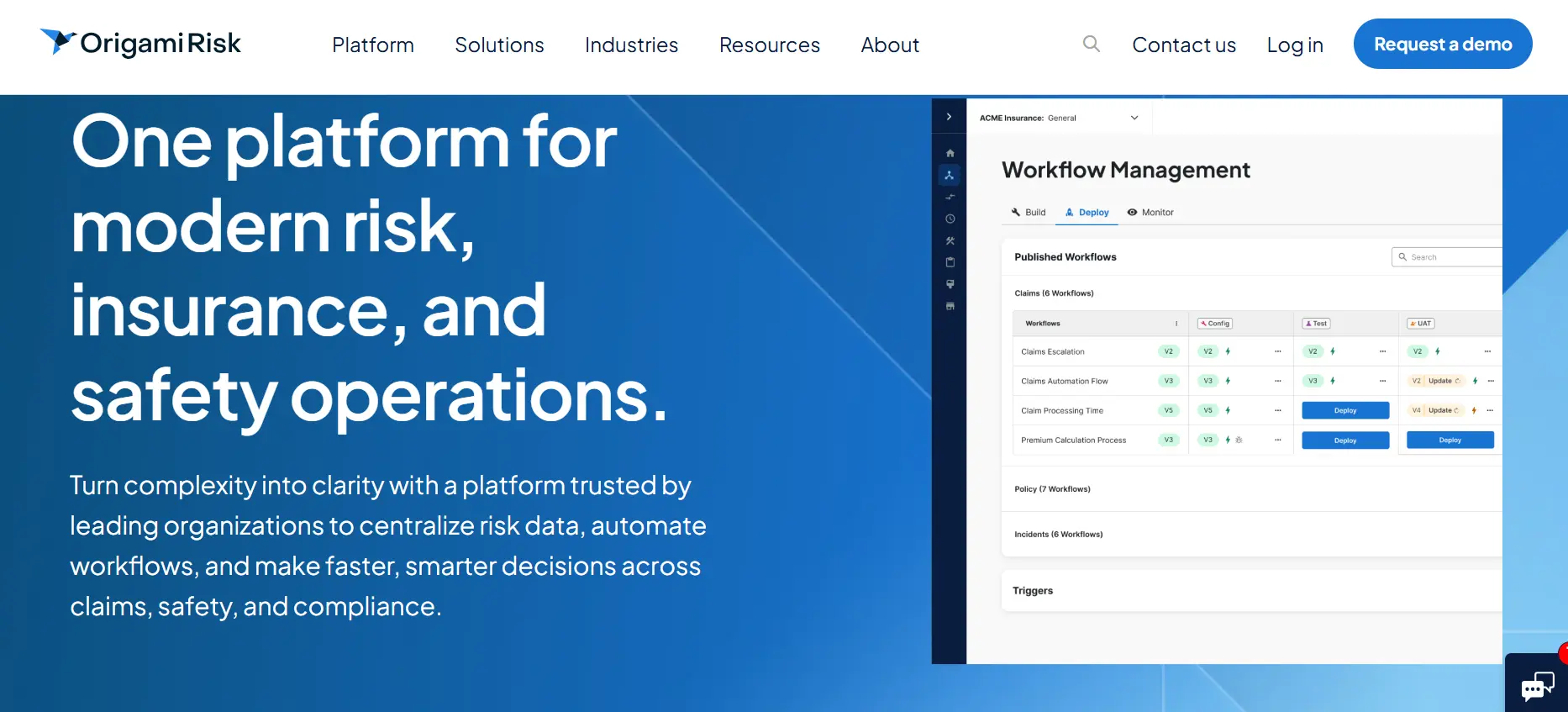
Origami risk screenshot

Key Features

  • RMIS at the Core — Unifying Insurable and Operational Risk Origami Risk's defining characteristic is its origin and its integration: it was built in 2009 as a single-version, cloud-based Risk Management Information System (RMIS), and it unifies insurable and non-insurable risk in one connected ecosystem — an approach that comes from the insurance and claims world rather than from safety, which distinguishes it from every EHS-native competitor. The RMIS core connects claims, policies, incidents, exposures and certificates, letting risk and insurance professionals consolidate data, automate critical workflows, and gain visibility into loss trends that inform proactive prevention. Because insurable risk (claims, premiums, losses) and operational risk (incidents, hazards, compliance) live on the same platform, a workplace safety incident can flow into the claims process without re-keying, and loss trends become visible across the combined data — closing the gap that defeats organizations whose risk lives in disconnected silos. The platform runs on AWS with every customer on the same single codebase, which Origami cites as the basis for its scalability, reliability, system integrity and flexibility. Practical RMIS wins include streamlining the annual insurance values- collection process (Henry Schein simplified this across 400+ locations, improving data accuracy and insurer alignment) and uncovering loss trends to promote safety best practices (DHL uses Origami's RMIS to streamline claims and surface loss trends).
  • One Configurable Platform — EHS, GRC, Healthcare and Insurance Core Systems From its RMIS core, Origami has expanded into a genuinely broad integrated-risk platform, all on one highly-configurable, cloud-native foundation. The EHS solution captures safety data and automates workflows through web and mobile tools, improves visibility into the root causes of incidents and injuries, tracks OSHA compliance metrics, and visualizes trends and hotspots on safety dashboards — McCarthy Building Companies used Origami's configurable platform to automate its Mitigation Action Planning (MAP) program, and Boise Cascade unified its safety processes across the enterprise. The GRC solution centralizes governance, risk and compliance, manages audit, tracks Key Risk Indicators (KRIs) and Key Performance Indicators (KPIs) for executive oversight, and includes Business Continuity Management for operational resilience and swift recovery after disruption. A dedicated Healthcare Risk Management solution improves patient safety and employee health through integrated reporting, and Origami's P&C insurance core systems support policy administration and underwriting for insurers and MGAs — Mission, a managing general agent, launched 60 lines and hit $500M in gross written premium on the platform through fast implementations and unified policy administration. The common thread is deep configurability: role-based access, portals, dashboards, analytics and reporting that organizations tailor to their own workflows across all these domains, from a single source of truth.
  • AI-Driven Analytics and Total Cost of Risk (TCOR) Origami's analytics layer is what turns unified risk data into executive decision- making, and it is where the platform applies AI. Its headline capability is Total Cost of Risk (TCOR) analysis: because Origami connects insurable and operational risk in one place, it can calculate, model and communicate the full cost of risk — claims, premiums, losses, retained risk and the operational drivers behind them — with AI-driven insights and flexible modeling that give leaders a clear, comprehensive view of what risk costs and where. This is a capability that siloed systems structurally cannot deliver, because TCOR requires the insurable and operational data to sit together. Beyond TCOR, the platform provides intelligent automation to eliminate manual work, AI-driven analytics to surface loss trends and risk hotspots, and real-time monitoring of KRIs and KPIs for executive oversight and control. Dashboards give role-based, real-time views: an EHS dashboard visualizing safety trends and hotspots, a claims dashboard showing claim counts, financials by allegation, medical-versus-indemnity splits and top allegation categories, and GRC dashboards tracking compliance and audit status. Buncombe County, North Carolina, for example, equipped leadership with real-time reporting to manage risk across 30 departments. The result is a shift from scattered data and manual processes to actionable, AI-informed insight aimed squarely at reducing the total cost of risk — the financial outcome that unifies the whole platform.

Pros & Cons

Strengths

  • The unification of insurable and operational risk is Origami's genuine, structural differentiator, and it comes from a place no EHS-native competitor does — the RMIS/insurance world. Because claims, policies and exposures live on the same platform as incidents, hazards and compliance, a safety incident can flow into a claim without re-keying, loss trends surface across the combined data to drive prevention, and the organization gains a single source of truth spanning risk that is usually fragmented across three or four systems. For a large enterprise whose risk and insurance functions have historically been siloed from safety and compliance, this connected ecosystem is a real architectural advantage, not a marketing claim.
  • The breadth and configurability make Origami a genuine platform rather than a point tool, and the analyst validation backs it up. Spanning RMIS, EHS, GRC, healthcare risk and P&C insurance core systems on one configurable, cloud-native foundation, Origami can consolidate an organization's entire risk landscape — and its 2025 Verdantix Green Quadrant Leader position (EHS) plus a substantial base of Gartner Peer Insights reviews signal recognized capability. The reference base is demanding and diverse: The Cheesecake Factory across 300+ locations, ABM Industries with 100,000+ employees, DHL, Moran Towing, Henry Schein across 400+ locations, McCarthy Building's MAP program, Buncombe County government, and the Mission MGA reaching $500M GWP — evidence the platform scales across construction, food service, logistics, healthcare, government and insurance.
  • The AI-driven Total Cost of Risk analytics deliver a capability siloed systems structurally cannot. TCOR requires insurable and operational risk data to sit together, and because Origami unifies them, it can calculate, model and communicate the full cost of risk with AI-driven insights — giving the CFO and risk leadership a clear, comprehensive view of what risk costs and where, which directly informs both insurance renewal strategy and operational prevention. Combined with intelligent automation that eliminates manual work, real-time KRI/KPI monitoring, and role-based dashboards for claims, safety and compliance, the analytics turn unified data into executive decision-making aimed at the financial outcome that matters most: reducing the total cost of risk.

Weaknesses

  • Origami's breadth and configurability come with real complexity, which is the most consistent theme in user feedback. Reviewers note a learning curve — particularly for new team members — and that tailoring the platform to specific needs can require configuration knowledge, with some pre built forms described as less straightforward than they could be and an interface that could use a refresh. The same flexibility that lets Origami span RMIS, EHS, GRC and insurance is what introduces this complexity: it is a powerful platform that rewards investment in setup and administration, not a lightweight tool that works out of the box. Some Gartner Peer Insights reviews also cite a volume of defects and recurring bugs affecting system stability and usability — buyers should probe stability and support responsiveness in reference checks and validate against their own workflows during evaluation.
  • The pricing and sales model are opaque and enterprise-oriented, which frustrates buyers wanting transparency and speed. Origami uses a custom quote pricing model with no public pricing, and a demo-first sales process with no self-serve free trial — you cannot spin up an account and test workflows without going through a formal demo or proof-of-concept cycle. Reviewers explicitly wish it were easier to try the platform hands-on. This makes Origami a poor fit for organizations wanting to evaluate quickly and cheaply, or for smaller buyers without the budget for an enterprise engagement; it is calibrated to large organizations prepared for a full enterprise evaluation and a custom commitment.
  • Origami is deliberately an integrated-risk platform, not a best-of-breed specialist in any single domain, so depth-seekers in one area may prefer a focused tool. An organization whose need is specifically frontline mobile safety adoption may prefer SafetyCulture; one wanting the deepest EHS or occupational-health capability may prefer Cority or Evotix; one needing internal-audit-and-SOX-first GRC may prefer AuditBoard; and one needing supply-chain ESG due diligence should look to IntegrityNext or EcoVadis. Origami's advantage is the integration of insurable and operational risk with TCOR analytics — not maximal depth in any single discipline — so buyers whose problem is concentrated in one domain should weigh a specialist, while those whose problem is exactly the fragmentation across domains are Origami's core buyer.

Frequently Asked Questions