Reviewed by the AiGreenTools Editorial Team · Last Updated: June 2026
| Founded | 2016 — San Francisco, CA + São Paulo, Brazil |
| Best for | Large enterprises with net-zero targets and decarbonization investment decisions — MACC + NPV/IRR from the GHG inventory platform as the requirement |
| Pricing | Custom / Enterprise |
| AI Classification | AI Enhanced (AI Emissions Match, AI Transition Plan tool — Verdantix top AI enhancement scores) |
| Key Frameworks | GHG Protocol, CSRD/ESRS E1, CBAM, SEC climate rules, IFRS/ISSB, CDP, SBTi, California SB 253/261 |
| Maturity Stage | Stage 4 |
| Certification | TÜV Rheinland (carbon methodology) — Verdantix Smart Innovator: Carbon Management Software 2025 |
| Modules | SINAI Measure / SINAI Reduce / SINAI Report / SINAI Engage |
Carbon Accounting Has a Problem That the Carbon Accounting Market Has Not Solved
The counterintuitive truth about enterprise decarbonization programs is that the bottleneck is not the measurement. Most large organizations running carbon programs for two or more years can produce a GHG inventory. What they cannot consistently produce is the answer to the question the GHG inventory is supposed to make answerable: which specific decarbonization project, in which business unit, in what sequence, produces the largest carbon reduction per dollar of capital committed?
The carbon accounting market built itself around the disclosure problem — get the number, structure the report, file the disclosure. The consequence is that most platforms optimize for the output document rather than the investment decision the document should enable. Measurement and financial planning became separate workflows managed by separate teams using separate tools that never reconcile when the CFO asks the investment committee question.
SINAI’s founding premise is that this separation is the problem. The data used to calculate the GHG inventory should be the same data used to model abatement scenarios, quantify financial returns, and build the capital allocation case for decarbonization investment. The MACC (Marginal Abatement Cost Curve) that emerges from SINAI’s analysis is not a separate consulting deliverable — it is generated from the same GHG inventory dataset in the same platform. Verdantix confirmed this positioning with top scores for MACC modeling and abatement opportunity identification across 22 evaluated vendors in its August 2025 Carbon Management Software assessment.
What Is SINAI and What Does Financial-Carbon Integration Actually Mean?
SINAI’s four operational modules:
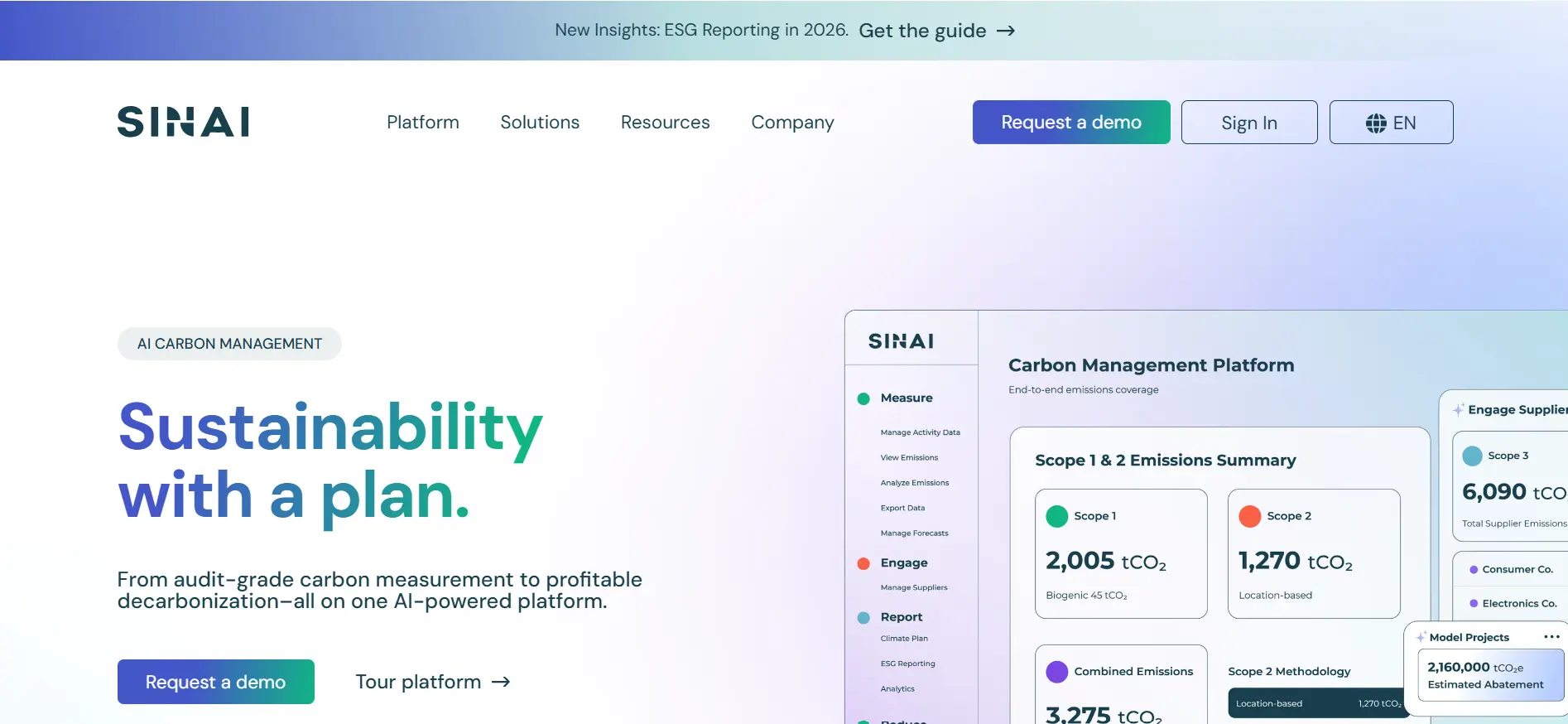
- SINAI Measure: Audit-grade Scope 1, 2, and 3 GHG accounting — TÜV Rheinland certified, 50,000+ factors, equipment-level hierarchy, AI Emissions Match, Utility Automation (Q1 2026)
- SINAI Reduce: MACC analysis with NPV/IRR financial modeling, decarbonization scenario planning, SBTi pathway tracking, project portfolio management, AI Transition Plan tool
- SINAI Report: Multi-framework disclosure — CSRD/ESRS E1, CBAM, SEC, IFRS/ISSB, CDP — with audit-ready evidence trails and ISAE 3000 assurance support
- SINAI Engage: Supplier Hub for Scope 3 Category 1 primary data collection — supplier engagement workflows, primary data substitution for EEIO estimates
What Is a Marginal Abatement Cost Curve — and Why Does Financial Integration Matter?
A standard MACC plots decarbonization initiatives by abatement potential (X-axis, tCO2e) and cost-effectiveness (Y-axis, $/tCO2). Projects below the X-axis reduce emissions and save money simultaneously. Projects above require net investment, and the curve shows how much per tonne of CO2 abated — enabling direct comparison against internal carbon prices or EU ETS market rates.
What SINAI adds is the financial depth that transforms the MACC from a sustainability visualization into a capital allocation tool:
SINAI’s financial modeling inputs per decarbonization project:
- Emissions reduction: tCO2e avoided per year (from SINAI Measure inventory)
- CAPEX: Initial capital investment required per project
- OPEX delta: Annual operating cost savings or additional costs
- Project lifetime: Years of emissions reduction contribution
- NPV: Net present value at organizational hurdle rate
- IRR: Internal rate of return for the investment
- Payback period: Years to full cost recovery
- Profitability index: NPV per unit of CAPEX invested
When a sustainability team presents this analysis to a CFO, it speaks the capital allocation language — not the ESG language. Projects with positive IRR above the hurdle rate are investment decisions, not sustainability projects. Projects below the hurdle rate can be evaluated against internal carbon prices to determine viability. The MACC portfolio view shows how the organization reaches its SBTi target through a sequenced investment plan with quantified financial returns — which is the transition plan disclosure that CSRD ESRS E1 now requires organizations to produce.
SINAI vs. Watershed vs. Normative — Three Platforms, Three Problems
| Dimension | SINAI Technologies | Watershed | Normative |
|---|---|---|---|
| Primary differentiation | MACC + financial-carbon integration (NPV/IRR) | Scope 3 depth + supplier engagement + clean power marketplace | TÜV SÜD-verified methodology + named GHGP advisor |
| Methodology verification | TÜV Rheinland certified | 100% audit pass rate — no TÜV verification | TÜV SÜD verified (ISO/IEC 25051 + GHG Protocol) |
| Decarbonization action layer | MACC + capital allocation sequencing by NPV/IRR | Operational decisions — supplier, logistics, clean power | SBTi submission support — methodology defensibility |
| Scope 3 supplier data | Supplier Hub — primary data collection | Product Footprints AI — product-level decomposition | Carbon Network — supplier primary data exchange |
| Industry strength | Energy, heavy industry, hard-to-abate — MACC-intensive | Consumer goods, logistics, multinationals — Scope 3 complex | Organizations approaching first SBTi or assurance |
| ESG breadth | Climate-first — Novisto integration for full ESRS | Climate-first — Workiva/Novisto for full ESRS | Climate-first — Novisto integration documented |
CBAM and CSRD — How SINAI Addresses Both Regulatory Obligations
SINAI and CBAM (Carbon Border Adjustment Mechanism)
CBAM entered its definitive phase on January 1, 2026. Organizations importing cement, iron, steel, aluminum, fertilizers, electricity, and hydrogen into the EU now face direct financial liability based on the carbon content embedded in those goods. SINAI’s CBAM compliance tools track embedded carbon content in covered imports and calculate the financial liability, then connect that liability directly to the MACC abatement scenarios for alternative sourcing decisions.
This CBAM-MACC integration is where SINAI’s financial-carbon architecture creates value that disclosure-only platforms cannot: the organization can compare the current CBAM cost of sourcing a covered material against the financial cost and emissions reduction of switching to a lower-carbon supplier — in the same analytical environment, with the same financial modeling parameters. The decarbonization decision becomes a procurement decision with quantified financial consequences on both sides of the choice.
SINAI and CSRD Transition Plan Disclosure
CSRD under Directive (EU) 2026/470 (thresholds: more than 1,000 employees AND more than €450M net turnover) requires not only GHG disclosure but transition plan disclosure — demonstrating a credible pathway to the organization’s climate targets. The transition plan must show what specific actions the organization will take, on what timeline, and with what capital commitment, to reach its net-zero or interim reduction targets.
SINAI’s MACC and financial modeling produce the quantified transition plan content that CSRD requires: specific decarbonization projects, their sequencing by cost-effectiveness, the capital investment required per project, and the emissions reduction pathway to the SBTi target. The AI Transition Plan tool (January 2026) uses AI to accelerate transition plan scenario development from existing inventory data. For CSRD post-Omnibus context, see our CSRD guide. For carbon accounting platform comparison across the market, see AI in carbon accounting 2026.
The SINAI-Novisto Integration — Carbon Depth + Full ESG Governance
SINAI’s climate-first architecture produces the limitation that all carbon-first platforms share: ESRS social and governance topics (ESRS S1 through S4, ESRS G1) are less comprehensively managed than in dedicated full-ESG platforms. The SINAI-Novisto partnership addresses this with a documented data integration: SINAI’s carbon accounting and decarbonization data flows into Novisto’s broader ESG data management platform without manual re-entry, maintaining data lineage across the two systems.
The combined architecture: SINAI for Scope 1, 2, and 3 GHG measurement, MACC-based decarbonization investment sequencing, and CSRD ESRS E1 climate disclosure; Novisto for full ESRS data governance across environmental, social, and governance topics, cross-functional contributor workflows, and assurance provider access. The investment is two platform contracts and an integration management overhead — the benefit is using each platform for what it does best rather than forcing a climate-first platform to manage human capital disclosures or a full-ESG platform to produce MACC financial modeling.
Who Should Not Choose SINAI?
Organizations at Stage 2–3 maturity building their first carbon footprint, without finance team engagement in sustainability investment decisions, and without a pipeline of decarbonization investment options to evaluate will not use the MACC capability that is SINAI’s primary differentiator. Greenly or Plan A provide carbon accounting at a more appropriate starting point for organizations that need the footprint before they need the investment analysis.
Financial institutions whose primary carbon accounting challenge is PCAF-aligned financed emissions — Scope 3 Category 15 for banks, asset managers, and insurers — should evaluate Persefoni, which was built specifically for portfolio-level financed emissions with the financial institution data model and regulatory documentation depth that investor-grade disclosure requires.
Organizations whose CSRD challenge spans the full ESRS set — requiring coordinated social and governance data collection alongside climate — should use SINAI for the climate layer and Novisto or Workiva for the broader ESG governance layer. Choosing SINAI as a standalone CSRD solution for organizations with material ESRS S and G topics will produce a gap at the first assurance engagement.
The Verdict on SINAI Technologies
SINAI is the right platform for the enterprise sustainability team that has accepted that measuring carbon is the prerequisite, not the program — and that the organization’s net-zero target requires a sequenced investment plan presented in financial terms, not a list of sustainability initiatives. The TÜV Rheinland certification, the Verdantix Smart Innovator recognition across MACC modeling and AI enhancement capabilities, the 50,000+ factor library at equipment granularity, and the MACC integrated with NPV/IRR financial modeling represent the most complete financial-carbon integration available in the carbon management market. The constraint is organizational readiness: the MACC is only as valuable as the organization’s capacity and governance structure to act on its recommendations. For organizations ready to act — SINAI has no peer for the financial-carbon decision layer.