Carbon Accounting

Salesforce net zero cloud

Medium-to-large enterprises already invested in Salesforce that want carbon accounting and ESG reporting (Scope 1, 2 and 3) managed on the same platform as their financial, supply-chain and operational data — with Einstein AI easing the reporting burden and built-in report builders for CSRD, GRI, SASB, CDP and California climate disclosure laws.

Try this tool
AiGreenTools Score
83 / 100
Rating G2 / Capterra
4.2
★★★★☆
out of 5 · G2 / Capterra
Pricing
enterprise

AiGreenTools Score breakdown

How is this score calculated?
Sustainability Impact 19 / 20
Features & Capabilities 17 / 20
Value for Money 14 / 20
Ease of Use 15 / 20
Trust & Maturity 18 / 20

Key Information

Carbon Scopes
Scope 1 (Direct emissions) Scope 2 (Indirect energy) Scope 3 (Value chain)
Year Founded
2019

Reviewed by the AiGreenTools Editorial Team · Last Updated: July 2026

Vendor Salesforce — launched as Sustainability Cloud 2019, rebranded Net Zero Cloud 2022
Category ESG & carbon accounting platform built on the Salesforce Platform
Best for Medium-to-large enterprises already invested in Salesforce
Emissions Scope 1, 2 & 3 (incl. supply chain) · waste · water · energy · fleet
Frameworks CSRD · GRI · SASB · CDP · California climate laws · GHG Protocol · SBTi goal-setting
Pricing Enterprise — permission-set licenses on the Salesforce Platform (premium)
AI Classification AI Enhanced — Einstein generative AI for reporting & carbon accounting
Maturity Stage Stage 4

Jump to:
The sustainability-data island problem ·
Built on the Salesforce Platform ·
Einstein AI & report builders ·
The “own first customer” origin ·
vs. Watershed vs. Persefoni ·
Who should not buy

A Salesforce-Native Enterprise Shouldn’t Run Its Carbon Data in Spreadsheets

A large enterprise runs its sales, service, supply-chain and customer data on Salesforce. Then CSRD, California climate disclosure, and investor ESG demands arrive — and its sustainability team is managing emissions in spreadsheets, disconnected from every other system. Activity data lives in the ERP and Salesforce supply-chain records; emissions calculations happen in Excel; the report is assembled by hand under deadline pressure.

The sustainability data is an island, divorced from the financial and operational data it actually relates to. Every reporting cycle is a manual fire drill, with no single source of truth, no audit trail, and no way to model a reduction scenario against real business data.

Salesforce built Net Zero Cloud on the premise that sustainability data shouldn’t be an island — it should live on the same trusted platform as the rest of the enterprise’s data. That platform-native architecture is the product’s defining idea.

Quick Answer: Salesforce Net Zero Cloud is an ESG and carbon accounting platform built on the Salesforce Platform. Its differentiator is architecture: it lets Salesforce-native enterprises layer Scope 1, 2 and 3 emissions data on top of the financial and supply-chain data already in their Salesforce ecosystem. Einstein generative AI eases ESG reporting, and framework report builders cover CSRD, GRI, SASB, CDP and California climate laws. Launched as Sustainability Cloud in 2019 and rebranded in 2022, it’s best for enterprises already on Salesforce.

Built on the Salesforce Platform — The Real Differentiator

Net Zero Cloud’s defining feature isn’t a specific emissions calculation — it’s where the platform lives. Built natively on the Salesforce Platform as a set of objects and an app enabled by permission-set licenses, it lets companies layer sustainability data on top of the financial, supply-chain and operational data already in their Salesforce ecosystem.

What it tracks:

  • Scope 1 — direct emissions
  • Scope 2 — purchased energy
  • Scope 3 — value chain, including supplier emissions and engagement
  • Plus — carbon conversions, waste, water, energy/resource and fleet tracking

💡 Why the “address” is the advantage: Because it uses Salesforce’s structured data model and workflow — not a generic reporting layer — emissions insights become part of broader operational reporting, sitting alongside real financial and supply-chain records. For a Salesforce-native enterprise this eliminates the integration project a standalone carbon tool needs. For a non-Salesforce company, this advantage largely disappears — which is why the buying decision is mostly “are we a Salesforce shop?”

Einstein AI and Framework Report Builders

ESG reporting is complex and time-consuming; Net Zero Cloud’s second strength is reducing that burden.

Einstein, Salesforce’s generative AI, is embedded to suggest report content and automate elements of carbon accounting, emissions tracking and metrics like building energy intensity — easing the manual effort that consumes ESG teams.

Framework report builders walk users through disclosure for both voluntary and mandatory regimes:

Framework Type
CSRD / ESRS Mandatory EU sustainability reporting
California climate laws SB253 / SB261 disclosure
GRI · SASB · CDP Voluntary / investor frameworks
GHG Protocol · SBTi Accounting standard & science-based targets

Add out-of-the-box SBTi goal setting with tracking, “what-if” reduction scenario modeling, automated data collection with stakeholder engagement and submission validation, and precise fleet-emissions calculation (including odometer-error correction) — a capable enterprise reporting toolkit for a tightening, multi-framework disclosure environment. For the CSRD picture specifically, see our CSRD guide.

The “Own First Customer” Origin

Net Zero Cloud carries the credibility of Salesforce’s decade-long sustainability commitment. Salesforce launched Sustainability Cloud in 2019 as an in-house tool for its own carbon accounting — the same “own first customer” origin as its earliest clouds — iterated through limited-access versions, then broadened it into a full ESG solution and rebranded it Net Zero Cloud in 2022. The product was battle-tested on Salesforce’s own net-zero journey before general availability.

It’s designed for every stage of the sustainability journey — from a first carbon footprint, through reduction strategy, to investor-grade reporting — and is especially relevant for high-emitting industries: manufacturing, energy and utilities, retail and consumer goods, and travel, transport and hospitality. A mature partner ecosystem (PwC, Cherry Bekaert) supports implementation, carbon accounting audits and dashboards.

Net Zero Cloud vs. Watershed vs. Persefoni — Integration vs. Carbon Depth

Dimension Salesforce Net Zero Cloud Watershed Persefoni
Core strength Salesforce Platform integration + reporting Best-of-breed carbon science & Scope 3 depth Carbon accounting with financed-emissions (PCAF) depth
Best fit Enterprises already on Salesforce Enterprises wanting deepest carbon science Financial services & financed emissions
Data architecture Native on Salesforce, alongside business data Standalone, vendor-neutral, integrates broadly Standalone, finance-grade
AI Einstein generative AI for reporting AI-assisted carbon analytics AI-assisted accounting
Deciding question “Are we a Salesforce shop?” “Do we want the deepest carbon science?” “Do we need financed emissions?”
AI classification AI Enhanced AI Native AI Native

The decision is largely about your existing stack: for a Salesforce-native enterprise, Net Zero Cloud’s integration is decisive; for one seeking best-of-breed carbon science independent of its CRM, a specialist like Watershed, Persefoni, Normative or Sweep may go deeper. For physical climate risk (a different job entirely), see Jupiter Intelligence.

Who Should Not Choose Salesforce Net Zero Cloud?

Organizations not on Salesforce should think hard before adopting. The platform-integration advantage — the entire point of Net Zero Cloud — largely disappears if you’re not already in the ecosystem, and reviewers cite high price and Salesforce dependency as the main drawbacks. A standalone carbon specialist will be cheaper, more carbon-science-focused, and vendor-neutral.

Buyers seeking best-of-breed carbon science — deepest emission factors, most sophisticated Scope 3 supply-chain modeling, most advanced decarbonization analytics — may find Watershed, Persefoni, Normative or Sweep deeper in those dimensions. Net Zero Cloud’s strength is integration and reporting, not frontier carbon methodology.

SMEs and narrow-need buyers will find the enterprise pricing disproportionate, and those needing physical climate risk (Jupiter), supplier ESG due diligence (IntegrityNext), or renewable procurement (LevelTen) should use the appropriate specialist — Net Zero Cloud is a carbon accounting and ESG reporting platform, focused on that job.

The Verdict on Salesforce Net Zero Cloud

Salesforce Net Zero Cloud is the right ESG and carbon accounting platform for one clearly-defined buyer: the medium-to-large enterprise already invested in Salesforce that wants its sustainability data managed with the same rigor, workflow and integration as its financial and operational data. For that buyer, being built on the Salesforce Platform is a decisive, genuinely differentiated advantage — sustainability stops being a spreadsheet island and becomes part of the system that runs the business — and Einstein AI plus the framework report builders meaningfully ease a tightening multi-framework disclosure burden.

The honest caveat is that this strength is conditional: Net Zero Cloud’s value drops sharply for organizations not on Salesforce, where the high price and ecosystem dependency that reviewers flag become net negatives, and where a vendor-neutral carbon specialist would go deeper on carbon science for less commitment. The buying decision is, in the end, mostly “are we a Salesforce shop?” For those who are, Net Zero Cloud is a strong, well-supported, credibly-originated choice; for those who aren’t, a best-of-breed specialist usually makes more sense.
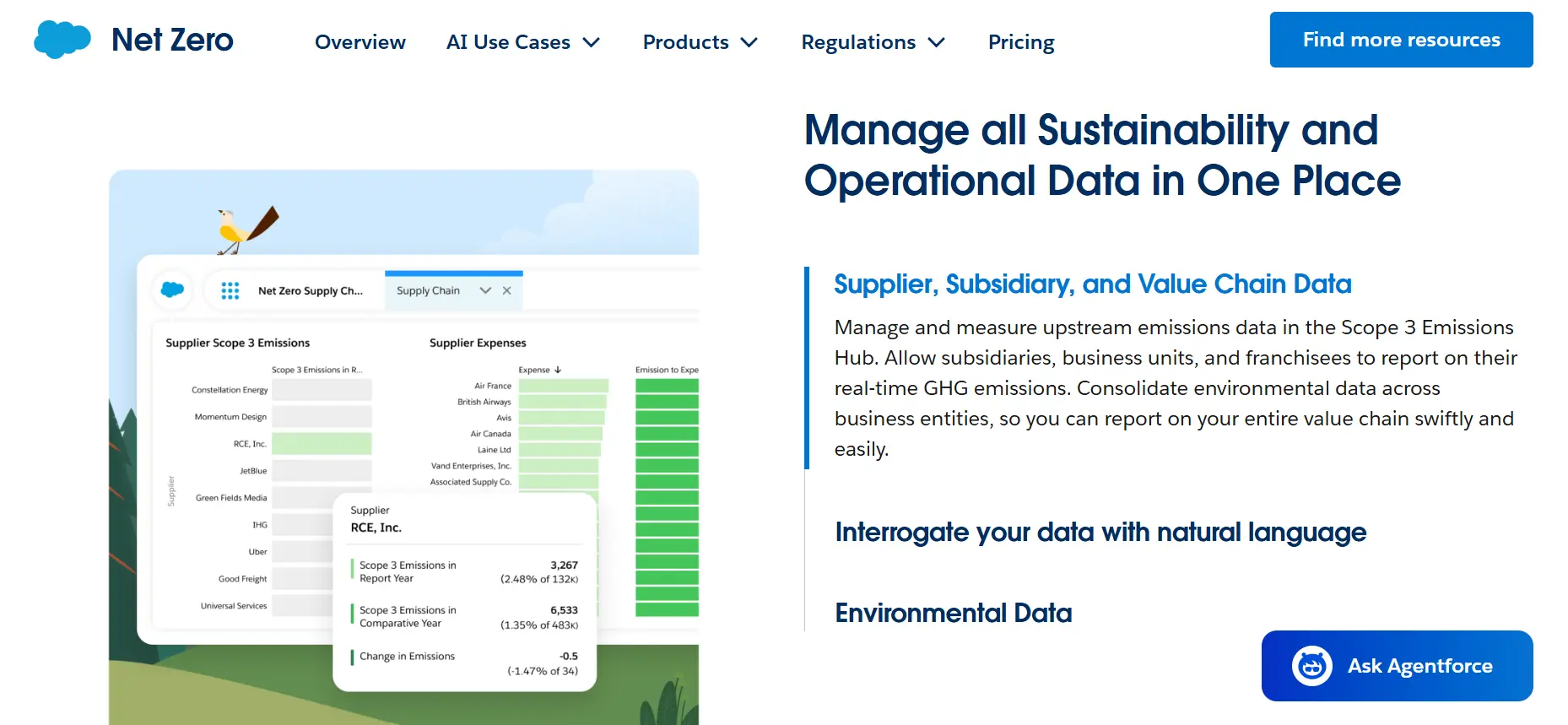
Salesforce net zero cloud screenshot

Key Features

  • Carbon Accounting Built on the Salesforce Platform — Data Where the Business Lives The defining feature of Net Zero Cloud is not a specific emissions calculation — it is where the platform lives. Built natively on the Salesforce Platform as a set of objects and an app enabled by permission-set licenses, Net Zero Cloud lets companies layer their sustainability data on top of the financial, supply-chain and operational data already in their Salesforce ecosystem. This is a genuine data-architecture advantage for Salesforce-native enterprises: instead of managing emissions in disconnected spreadsheets divorced from the systems that generate the underlying activity data, sustainability becomes part of the same structured data model, workflow engine and reporting infrastructure that runs the rest of the business. It tracks the full emissions picture — Scope 1 (direct), Scope 2 (purchased energy) and Scope 3 (value chain, including supplier emissions) — along with carbon conversions, waste, water and energy/resource tracking. Because it uses a structured data model and workflow capabilities rather than generic reporting, emissions insights become part of broader operational reporting, and the platform can layer sustainability metrics against real financial and supply-chain records. For an organization already committed to Salesforce, this integration is the reason to choose Net Zero Cloud over a standalone carbon tool; for one not on Salesforce, it is a far weaker draw.
  • Einstein AI and Framework Report Builders — Easing the Disclosure Burden ESG reporting is notoriously complex and time-consuming, and Net Zero Cloud's second major strength is reducing that burden through AI and structured report builders. Einstein, Salesforce's generative AI, is embedded to suggest report content and automate elements of carbon accounting, emissions tracking and metrics like building energy intensity — alleviating the manual effort that consumes ESG professionals and helping organizations of all sizes and industries get to compliance faster. On top of the AI, Net Zero Cloud provides framework-specific report builders that walk users through disclosure for both voluntary and mandatory frameworks: CSRD, GRI, SASB, CDP, and California's climate disclosure laws are supported, with more added as regulations emerge, and outputs align with the GHG Protocol. It also includes out-of-the-box goal setting for Science Based Targets (SBTi) with tracking toward them, and "what-if" scenario modeling to project outcomes and make confident carbon-reduction decisions. Automated data collection simplifies gathering information from multiple sources, with stakeholder engagement, task tracking and submission validation to ensure timely, accurate data. For transport-heavy organizations, it calculates precise fleet and ground-travel emissions, including correcting odometer errors — the kind of practical accuracy that matters for defensible reporting.
  • Enterprise Maturity, the Salesforce Origin Story, and the Partner Ecosystem Net Zero Cloud carries the credibility of Salesforce's decade-long sustainability commitment and its "own first customer" origin. Salesforce launched Sustainability Cloud in 2019 as an in-house solution for its own carbon accounting, iterated through limited-access versions, then broadened it into a full ESG solution and rebranded it Net Zero Cloud in 2022 — meaning the product was battle-tested on Salesforce's own net-zero journey before reaching general availability. It is designed for organizations at every stage of the sustainability journey, from calculating a corporate carbon footprint for the first time, through developing emission-reduction strategies, to reporting data to investors and stakeholders, and is particularly relevant for high-emitting industries such as manufacturing, energy and utilities, retail and consumer goods, and travel, transport and hospitality. A mature implementation-partner ecosystem supports deployment: PwC offers acceleration of sustainability reporting on Net Zero Cloud with robust carbon accounting audits, and firms like Cherry Bekaert provide carbon accounting, digital dashboards and tax-credit filing services around the platform. This combination of a proven origin, enterprise-grade platform infrastructure, and a professional-services ecosystem makes Net Zero Cloud a substantial enterprise ESG offering — provided the buyer is, or is willing to become, a Salesforce customer.

Pros & Cons

Strengths

  • The Salesforce Platform integration is a genuine, and genuinely differentiated, advantage for the large installed base of Salesforce customers. Because Net Zero Cloud is built natively on the platform, an enterprise can layer sustainability data on top of the financial, supply-chain and operational data it already runs in Salesforce — turning emissions from a disconnected spreadsheet island into part of the same structured data model, workflow and reporting infrastructure as the rest of the business. For a Salesforce-native organization, this eliminates the integration project a standalone carbon tool would require and lets sustainability insights sit alongside real business data, which is exactly what makes ESG reporting defensible and decisions grounded. No standalone carbon specialist can match this for a company already committed to Salesforce.
  • The AI-assisted reporting and framework coverage meaningfully reduce the ESG compliance burden. Einstein generative AI suggesting report content and automating elements of carbon accounting addresses the real pain of manual, time-consuming ESG reporting, and the framework specific report builders — CSRD, GRI, SASB, CDP, California climate disclosure laws, aligned to the GHG Protocol — turn data into disclosures with structured guidance rather than manual assembly. Out-of-the-box SBTi goal setting, "what-if" reduction scenario modeling, automated data collection with validation, and precise fleet-emissions calculation round out a capable enterprise reporting toolkit. For organizations facing tightening, multi-framework disclosure requirements, this reduces both effort and compliance risk.
  • The enterprise credibility, proven origin and partner ecosystem are strong. Built and battle-tested on Salesforce's own decade-long net-zero journey ("own first customer") before general availability, backed by Salesforce's enterprise platform infrastructure, and supported by a mature implementation ecosystem including PwC and Cherry Bekaert, Net Zero Cloud is a substantial, well-supported enterprise ESG platform. It suits organizations at any stage of the sustainability journey, from first footprint to investor-grade reporting, and is especially relevant for high-emitting industries like manufacturing, energy, retail and transport — with the reassurance of a vendor that has made sustainability a core corporate value for over a decade.

Weaknesses

  • Net Zero Cloud's dependency on the Salesforce ecosystem is simultaneously its biggest strength and its biggest limitation, and for non-Salesforce organizations it is a real drawback. Reviewers consistently cite high price and dependency on Salesforce infrastructure as the primary concerns. For an enterprise not already on Salesforce, adopting Net Zero Cloud effectively means buying into the Salesforce ecosystem to get a carbon tool — a far larger commitment than licensing a standalone specialist, and one where much of the platform-integration advantage (the whole point of Net Zero Cloud) doesn't apply. The value proposition is strongly conditional on being, or becoming, a Salesforce customer; buyers should be honest about which side of that line they're on before evaluating.
  • For buyers seeking best-of-breed carbon science, Net Zero Cloud is an ESG data and reporting platform rather than a carbon-science specialist. Organizations wanting the deepest emission-factor libraries, the most sophisticated supply-chain (Scope 3) carbon modeling, or the most advanced decarbonization analytics may find dedicated carbon platforms — Watershed, Persefoni, Normative, Sweep — deeper in those specific dimensions. Net Zero Cloud's strength is integrating sustainability data into the Salesforce ecosystem and easing multi-framework reporting, not pushing the frontier of carbon accounting methodology. Buyers whose primary need is carbon-science depth rather than ecosystem integration should compare against a specialist.
  • The premium pricing and enterprise orientation place Net Zero Cloud out of reach for smaller organizations and make it disproportionate for narrow needs. As an enterprise platform licensed via the Salesforce model, it is calibrated to medium-to-large organizations with the budget and the platform commitment to justify it. SMEs that simply need to calculate and report a carbon footprint will find it expensive and heavier than necessary, and organizations whose need is specifically physical climate risk (Jupiter, ClimateAI), supplier ESG due diligence (IntegrityNext, EcoVadis), or renewable procurement (LevelTen) should use the appropriate specialist rather than expecting Net Zero Cloud to cover those adjacent domains — it is a carbon accounting and ESG reporting platform, focused on that job.

Frequently Asked Questions