EHS

Novara Flex

Mid-market operators in hazardous, field-intensive industries with large contractor populations and mobile workforces — construction, manufacturing, oil and gas, utilities, mining — that need contractor risk management, training certification tracking and offline-capable field capture in one configurable platform, and that can accept a vendor entity in its first year.

Try this tool
AiGreenTools Score
70 / 100
Rating G2 / Capterra
4.6
★★★★½
out of 5 · G2 / Capterra
Pricing
enterprise

AiGreenTools Score breakdown

How is this score calculated?
Sustainability Impact 11 / 20
Features & Capabilities 17 / 20
Value for Money 14 / 20
Ease of Use 15 / 20
Trust & Maturity 13 / 20

Key Information

Year Founded
2026

Reviewed by the AiGreenTools Editorial Team · Last Updated: September 2026

Product Novara Flex — formerly KPA Flex, formerly KPA EHS Software
Vendor Novara — independent company since January 2026, new CEO
Product lineage ⚠ KPA, founded 1986 · renamed KPA Flex Oct 2023 · Novara Flex Jan 2026
Category Mid-market field-operations EHS
Best for Contractor-heavy, mobile workforces in hazardous industries
Modules Incidents · inspections & audits · corrective actions · training & certifications · equipment · leading indicators · contractor risk · sustainability
Languages 100+ via automatic translation
Data access ⭐ Free token-based HTTPS API, JSON/CSV, public documentation
AI Classification AI Enhanced — Flex AI, announced as a priority after the separation
Pricing Sales-led quote — not published, no trial found

In January 2026, the Company That Made This Software Split in Two

Most vendor histories in enterprise software run one direction: a smaller company is absorbed into a larger one. In this EHS cluster that pattern is almost universal. ProcessMAP was acquired by Ideagen. Quentic was absorbed into AMCS, to the point that Verdantix now lists it as “AMCS (formerly Quentic)”. IndustrySafe became Vector EHS inside Vector Solutions.

Novara went the other way. In January 2026, KPA — a compliance business founded in 1986, serving more than 15,000 client locations with roughly 150 in-house consultants — separated into two independent companies. KPA retained the automotive compliance business. A new company, Novara, took the industrial EHS software operation, under a new chief executive. The platform that had been called KPA Flex since October 2023 became Novara Flex.

That makes this the only platform in the comparison whose forty-year track record and whose corporate age point in opposite directions — a product with four decades of lineage, sold by a company eight months old. Everything worth knowing about Novara Flex sits somewhere on that tension.

Quick Answer: Novara Flex is a configurable, mobile-first EHS platform for hazardous and field-intensive industries, covering incidents, inspections, corrective actions, training and certifications, equipment, leading indicators, contractor risk and sustainability. Its distinguishing capability is contractor risk management in the core module set — absent entirely from Quentic and EHS Insight — alongside 100+ language automatic translation and a free data API. Its distinguishing risk is that the vendor became an independent company only in January 2026, when KPA separated its automotive and industrial businesses.

The Contractor Gap Two of Its Rivals Leave Completely Open

The most consequential item in Novara Flex’s module list is not the longest one. It is contractor risk management, and it matters because of what the alternatives do not have.

Platform Contractor prequalification How it got there
Novara Flex In the core module set Built — consultancy heritage
Quentic Absent —
EHS Insight Absent —
Ideagen EHS Present Acquired Beakon, February 2025

For a specialty contractor rotating through eighty subcontractor firms a year, or a manufacturer whose site population is half contract labour, this is frequently the exposure that dominates the risk register rather than a peripheral concern.

💡 The mechanism that makes it useful, not just present. Contractor records link to certification tracking inside the same platform. That converts a lapsed subcontractor certification from a document nobody re-filed into a visible compliance state with an owner and a date. The demonstration question that tests it: ask to see, live, which subcontractor firms currently hold valid certifications for the work they are performing on a named site — and whether an expiry three weeks out generates an alert to a person, or simply changes a field.

Two adjacent capabilities compound the fit for field operations. Automatic translation across more than 100 languages addresses a workforce that does not all read English — the exact structural inverse of Vector EHS, which operates in English only. And access to more than 70 million safety data sheets removes chemical-document assembly from the site supervisor’s week.

A Free API — the Smallest Clause With the Largest Long-Term Effect

Novara publishes a token-based API over HTTPS returning JSON and CSV, with public documentation, and states explicitly that there is no cost simply to access your own data.

That sentence deserves more weight than it usually receives. In enterprise EHS software, data egress is routinely a paid add-on, a separately quoted integration project, or an implicit lock-in mechanism where the practical cost of leaving equals the cost of extracting three years of incident history. A free, documented API means the reporting layer your business already runs can consume EHS data without a line item — and it means an exit is technically survivable.

⚠️ “Free API” and “supported integration” are two different promises. Establish what happens when the API changes: whether versioning is guaranteed, how much notice you get, and what support exists if a scheduled pull breaks at month-end. A free API with no support commitment is a materially different product from a free API with one — and after a corporate separation, engineering support commitments are exactly the thing worth getting in writing.

Flex AI — and Why the Announcement Date Is the Interesting Part

Flex AI is described as embedded directly in the platform and specifically trained on EHS and sustainability content, positioned against generic assistants that require exporting data and translating results back into a workflow. That framing is reasonable and matches where the market is going: Verdantix describes EHS software as being redefined by AI features.

The timing carries information the feature description does not. Novara announced AI capability as a near-term development priority following the January 2026 separation. The roadmap being sold was therefore written by a company less than a year old, to be delivered by engineering resources whose post-separation allocation is not visible from outside.

This is not a reason to discount the capability — it is a reason to evaluate it as a commitment rather than a delivered feature. Before taking the roadmap at face value, ask three things:

  • What is in general availability today, versus on the roadmap?
  • What proportion of customers run it in production?
  • How many engineers are assigned to it? — treat a vague answer as an answer.

Why AiGreenTools classifies this AI Enhanced, not AI Native

The classification follows architecture, not marketing emphasis. Flex AI is described as embedded directly in Flex — added to an existing platform rather than being the platform. Remove it and Novara Flex remains a complete EHS management system: incidents, inspections, corrective actions, certifications and contractor records all function. That is the definition of AI Enhanced, and it is the same verdict this assessment reaches for every platform in this cluster.

Why This Profile Publishes Fewer Numbers Than Others You Will Read

A G2 rating of 4.6 out of 5 across 75 reviews circulates for Novara Flex, together with a specific pattern of criticism: limited customization, limited field options, limited functionality, complex workflow.

🔍 Every one of those figures traces to a competitor’s blog. EHS Insight publishes a head-to-head comparison article against Novara Flex, and it is the origin of each instance of these numbers we traced. AiGreenTools does not repeat a vendor’s competitive marketing about a rival as fact — which means we are also declining to publish the criticism, convenient though it would be. If that pattern holds at source it would be worth taking seriously, precisely because it contradicts the platform’s own configurability positioning. Read G2 directly and form your own view; it takes ten minutes and it is the only way to know.

Novara Flex vs. EHS Insight vs. Ideagen EHS

Dimension Novara Flex EHS Insight Ideagen EHS
Contractor management ⭐ In the core module set Absent Acquired 2025
Vendor entity age ⚠ 8 months (Jan 2026) Since 2009 Since 1993
Product lineage Back to 1986 via KPA Unbroken since 2009 ProcessMAP, since 2000
Published price No ⭐ Yes, from $4,600/yr No
Data API ⭐ Free, documented Not established Not established
Deciding question “Is contractor risk our dominant exposure?” “Can I get a number before a meeting?” “Do quality and safety argue over the same CAPA?”
AiGreenTools Score 70 75 73

The EHS software category separates on buyer shape more than on feature count, and our best EHS software ranking covers the wider field. SafetyCulture is the closest competitor for frontline inspection adoption at scale. EcoOnline competes on chemical and SDS depth.

What Implementation Actually Requires

Novara Flex is a configurable platform, which means the implementation cost is a configuration decision rather than a licence one. The consultancy heritage shows here: the product assumes someone will define what an inspection looks like, what a certification requires and how a corrective action escalates.

💡 The precondition specific to contractor management. A contractor compliance module reproduces whatever prequalification standard you give it. If your organization has never written down what a subcontractor must hold before working on a site — which certifications, which insurance, which training, valid for how long — the platform will faithfully track an undefined standard. That definition is a procurement and legal exercise, and it belongs before the software project. Buying the module first produces a very organised record of a rule nobody agreed on.

Who Should Not Buy Novara Flex

Organizations whose procurement weighs corporate stability heavily. The vendor entity is eight months old. If your process requires audited accounts, multi-year corporate history or evidence of financial continuity from the contracting entity, this is a real obstacle in 2026 — one that will fade with time, but has not yet.

European multi-country operators. Novara Flex is built around OSHA-shaped compliance and an American field-operations buyer. It carries no national legal register construct. Quentic is built for that buyer.

Enterprises consolidating quality and safety governance on one spine. That is Ideagen EHS‘s structural argument, backed by Verdantix Leader placements across both categories.

Buyers who need a published price to secure internal approval. There is no published tier and no trial. EHS Insight serves the same mid-market and publishes a starting figure.

The Verdict on Novara Flex

Novara Flex is the right answer to a question the rest of this cluster answers badly or not at all: what does an EHS platform look like when the dominant exposure is a contractor population and the workforce is in a field with no signal. Contractor risk management in the core module set, certification tracking linked to it, 100+ language translation, offline capture and a free data API add up to a coherent product for that buyer — and the consultancy heritage that shaped it is visible in the design rather than claimed in the marketing.

The reservation is not about the product. It is that the company selling it became independent in January 2026, under a new chief executive, with an AI roadmap announced after the split and no external visibility into how engineering, support and investor backing were divided. Forty years of lineage is real, and it belongs to a corporate entity that no longer sells you this software.

For a contractor-heavy field operation, Novara Flex should be on the shortlist and may well win it. Just price the vendor question into the contract — term length, support commitments, data export guarantees — rather than assuming the track record transfers with the name.

Assessment date: 29 August 2026. This assessment would change if Novara publishes its post-separation engineering headcount, ownership structure and support continuity commitments, which would directly raise the Trust score; if the G2 rating and its cons pattern are confirmed at source rather than through a competitor’s comparison content; or if Flex AI reaches documented general availability with production-adoption data, converting a roadmap commitment into a delivered capability.
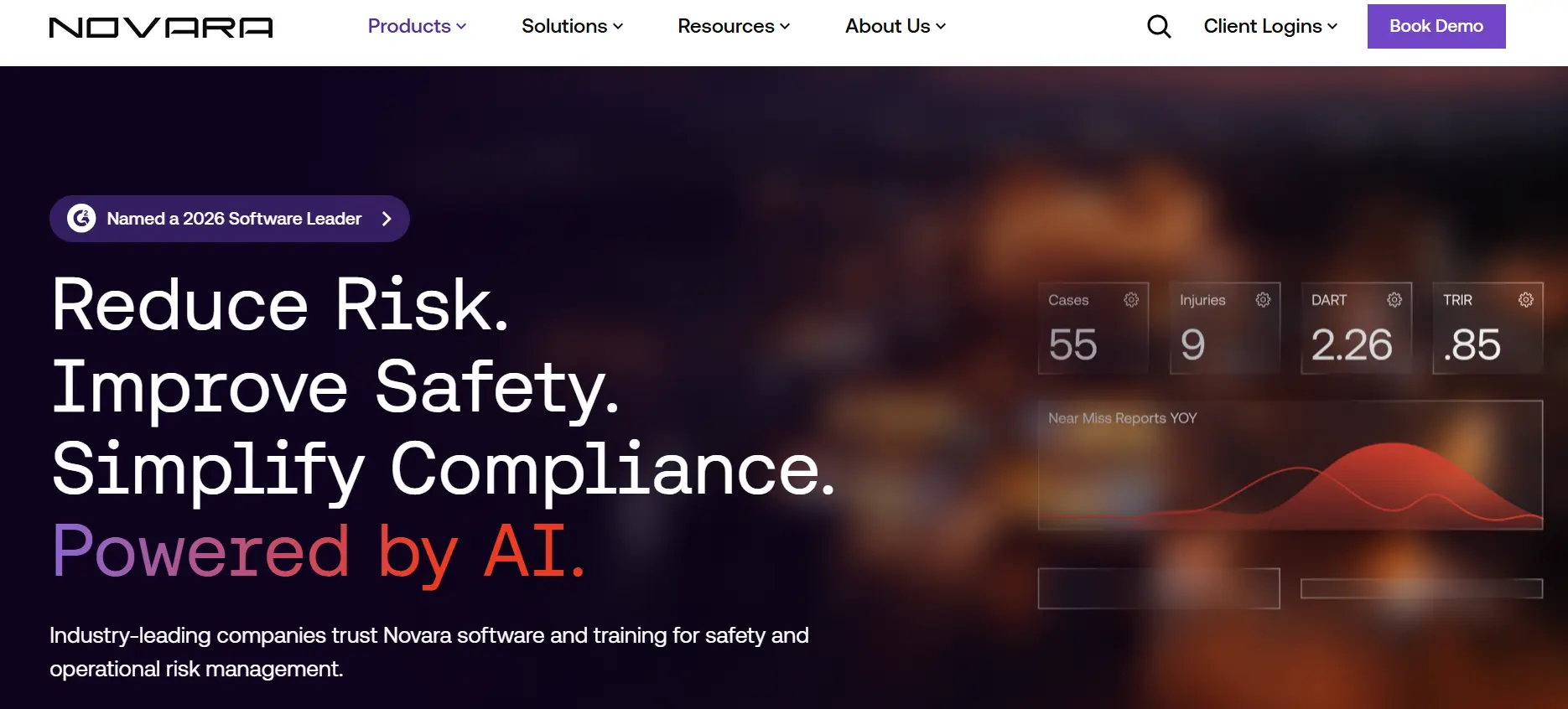
Novara Flex screenshot

Key Features

  • ✓ Contractor Risk Management in the Core Module Set — the Gap Its Rivals Leave Open The most consequential thing about Novara Flex's module list is not its length but one specific inclusion. Contractor risk management is part of the core platform, alongside incidents, inspections and audits, corrective actions, training and certifications, equipment and leading-indicator reporting. Neither Quentic nor EHS Insight offers contractor prequalification at all, and Ideagen had to buy the capability outright in February 2025. For a specialty contractor rotating through eighty subcontractor firms a year, or a manufacturer whose site population is half contract labour, this is not a nice-to-have — it is frequently the exposure that dominates the risk register, and the reason a general contractor's prequalification questionnaire arrives with a deadline. The mechanism that makes it work is the link between certification tracking and the contractor record: a subcontractor whose certification lapses becomes visible as a compliance state rather than as a document someone failed to re-file. Two adjacent capabilities compound it. Automatic translation across more than 100 languages addresses a field workforce that does not all read English — the exact inverse of Vector EHS, which operates in English only — and access to more than 70 million safety data sheets removes the chemical-document assembly work that otherwise falls on a site supervisor.
  • ✓ A Free Data API — a Small Clause With Real Commercial Weight Novara publishes a token-based API over HTTPS returning JSON and CSV, with public documentation, and states explicitly that there is no cost simply to access your own data. That sentence deserves more attention than it usually gets. In enterprise EHS software, data egress is frequently either a paid add-on, an integration project quoted separately, or an implicit lock-in mechanism where the practical cost of leaving is the cost of extracting three years of incident history. A free, documented API changes the shape of the relationship: it means the reporting layer your business already uses — Power BI, a data warehouse, an existing operations dashboard — can consume EHS data without a line item, and it means an exit is technically survivable. For a mid-market buyer who has been burned by a previous platform, this is often worth more than a feature. The caveat is that "free API" and "supported integration" are different promises. Establish what happens when the API changes, whether versioning is guaranteed, and what support exists if a pull breaks at month-end — because a free API with no support commitment is a different product from a free API with one.
  • ✓ Flex AI — Announced After the Separation, Which Is the Detail That Matters Flex AI is described as embedded directly in the platform and specifically trained on EHS and sustainability content, positioned against generic assistants that require exporting data and translating results back into the workflow. That framing is reasonable and matches the direction of the market: Verdantix describes EHS software as being redefined by AI features. But the timing carries information that a feature description does not. Novara announced AI capability as a near-term development priority FOLLOWING the January 2026 separation from KPA — meaning the roadmap being sold was written by a company that has existed for less than a year, to be delivered by engineering resources whose post-separation allocation is not externally visible. This is not a reason to discount the capability. It is a reason to evaluate it as a commitment rather than as a delivered feature: ask what is in general availability today versus on the roadmap, ask for a demonstration on your own incident data rather than a curated set, and ask how many engineers work on it. The AiGreenTools classification is AI Enhanced rather than AI Native for the ordinary architectural reason — remove Flex AI and Flex remains a complete EHS management system, which is the definition.

Pros & Cons

Strengths

  • Contractor risk management sits in the core module set, closing a gap two of its three closest competitors leave entirely open. Quentic and EHS Insight offer no contractor prequalification at all; Ideagen acquired the capability in February 2025 rather than building it. For a construction, manufacturing or energy operator whose site population is substantially contract labour, contractor compliance is frequently the dominant exposure rather than a peripheral one, and having it linked to certification tracking inside the same platform turns a lapsed certification into a visible compliance state rather than a document nobody re-filed.
  • The platform is built for people who work outdoors, not at desks. Mobile-first design, offline-capable field capture, equipment records and inspection workflows reflect a product whose origin is on-site compliance auditing rather than enterprise reporting. Automatic translation across more than 100 languages is the structural counterpart: it addresses a field workforce that does not all read English, which is the exact limitation that disqualifies Vector EHS for the same buyer. Access to more than 70 million safety data sheets removes chemical document assembly from the site supervisor's workload.
  • The free data API is a genuine commercial advantage, not a specification. Novara publishes a token-based HTTPS API returning JSON and CSV with public documentation, and states there is no cost simply to access your own data. In a category where data egress is routinely a paid add-on or a quoted integration project, this lowers both the cost of connecting EHS data to an existing reporting layer and the practical cost of one day leaving. For a mid-market buyer who has previously been locked into a platform by extraction cost, this is worth more than most feature comparisons.
  • Forty years of domain lineage sit behind the product, and it shows in the shape of it. KPA was founded in 1986 and built its position on on-site EHS audits and loss-control consultancy with roughly 150 in-house compliance consultants, serving more than 15,000 client locations. The training library and the SDS database are that consultancy practice productised. A platform designed around what a compliance consultant actually does on a site visit — inspect, document, certify, correct — behaves differently from one designed around what a corporate reporting function wants to see, and for a field-operations buyer the first is the right design.
  • The separation gives the product an undivided owner for the first time. Until January 2026 the software competed for investment inside a business that also served automotive dealerships — a genuinely different market with different requirements. Novara now exists to do one thing. Focus is not automatically an advantage, but a vendor whose entire commercial future depends on a single product line has an alignment with its EHS customers that a diversified parent structurally cannot match.

Weaknesses

  • The vendor entity is eight months old, and no amount of product lineage changes that. Novara became an independent company in January 2026, when KPA separated its automotive compliance business from its industrial EHS software operations, under a new chief executive. A separation of this kind redistributes engineering staff, support organisations, investor backing and roadmap authority — and none of those outcomes is externally visible yet. The forty-year track record belongs, strictly speaking, to a different corporate entity than the one on your contract. A buyer signing a multi-year agreement should ask directly how many engineers and support staff transferred, who the chief executive is, whether existing support contracts carried across unchanged, and which investors back the new company. Vague answers to any of those are themselves informative.
  • The AI roadmap was written by a company that did not exist a year ago. Flex AI is presented as embedded and EHS-trained, but AI capability was announced as a near-term development priority following the separation. That sequencing means the buyer is evaluating a commitment rather than a track record. Establish what is in general availability today, what proportion of customers run it in production, and how many engineers are assigned to it — questions that are reasonable for any AI claim and necessary for one made by an eight-month-old vendor.
  • The sustainability module is a third party's product. ESG and sustainability capability launched in October 2023 powered by Brightest, an external sustainability and impact management platform, rather than built in-house. This is a legitimate way to reach capability quickly and it is not concealed, but it carries the ordinary consequences of a partnership: the roadmap for that module is not fully Novara's, the commercial relationship could change, and the integration depth is a question rather than an assumption. Any buyer weighting ESG reporting in the decision should establish what happens to that module if the partnership ends.
  • Vendor pages contradict each other on the training library, which is a small signal worth noticing. One Novara page states more than 1,000 courses, another more than 1,500 interactive multilingual courses. The discrepancy is almost certainly a matter of different update dates rather than a contradiction of substance, but it means a buyer cannot cite a course count from public sources with confidence — and in a period immediately following a corporate separation, inconsistent public collateral is exactly the kind of thing that warrants a written confirmation rather than a screenshot.
  • Independent review evidence exists but cannot currently be read at source. A G2 rating of 4.6 out of 5 across 75 reviews circulates for Novara Flex, together with a specific pattern of criticism citing limited customization, limited field options, limited functionality and complex workflow. Every instance of those figures traced during this assessment originates from a competitor's comparison blog rather than from G2 directly. AiGreenTools does not repeat a vendor's competitive marketing about a rival as fact, so none of it is published here — including the criticism, which would be convenient to repeat and is equally unverified. Read G2 directly. The pattern, if it holds at source, would be worth taking seriously precisely because it contradicts the platform's own configurability positioning.
  • No published pricing and no trial. The route to a number is a sales-led quote. This is category-normal, and it is a real disadvantage against EHS Insight, which publishes a starting figure and offers a trial to the same mid-market buyer. An organization that must produce a cost figure before securing internal approval will find that conversation easier to start elsewhere.

Frequently Asked Questions