Reviewed by the AiGreenTools Editorial Team · Last Updated: October 2026
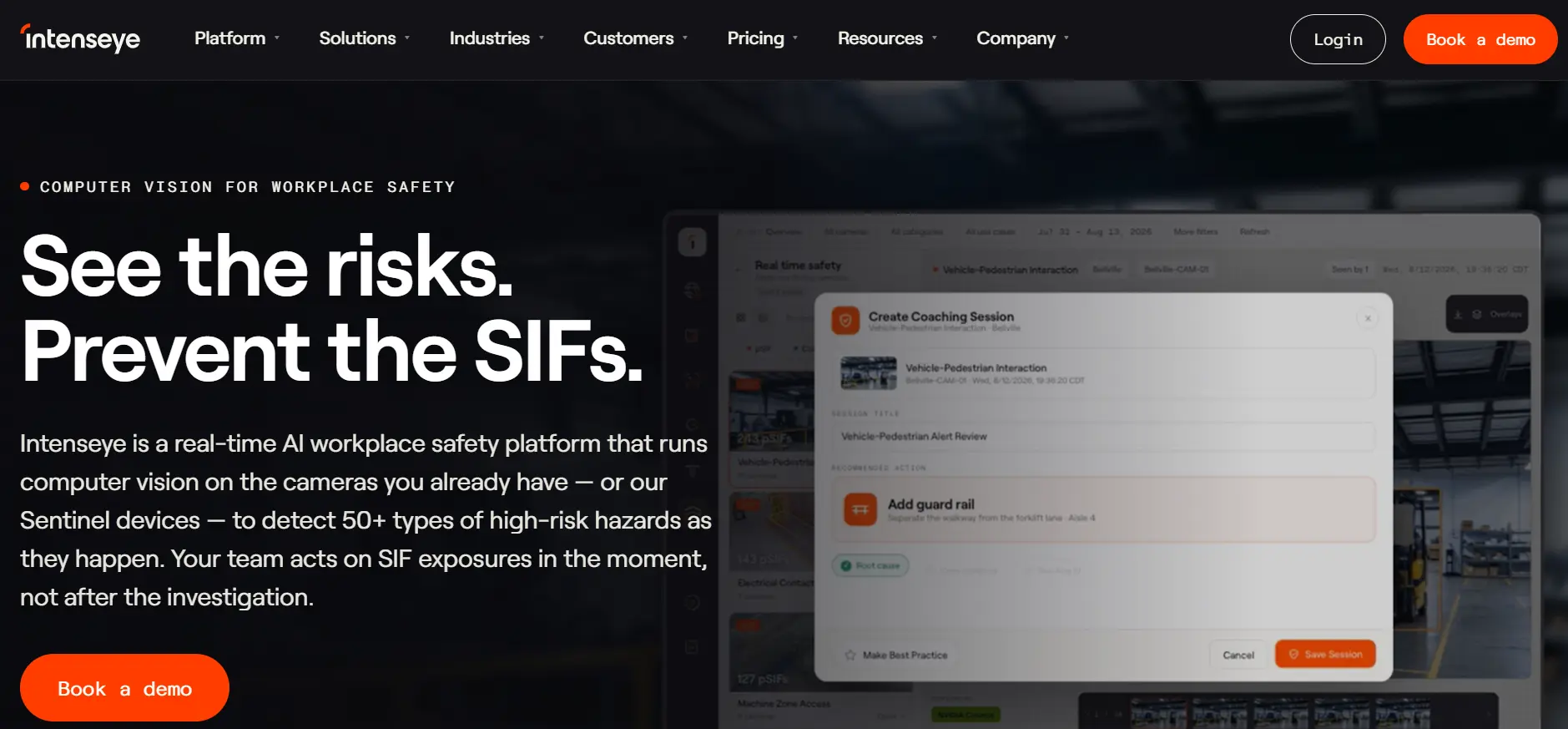
| Product | Intenseye — computer vision workplace safety platform |
| Vendor | Intenseye Inc. — founded 2018 Istanbul, HQ New York |
| Founders | Sercan Esen (CEO) · Serhat Cillidag (CTO) |
| Category | ⚠ Leading-indicator detection layer — NOT an EHS system of record |
| Best for | Multi-site operators with an existing camera estate and an existing EHS platform |
| Hardware | ⭐ None required — runs on existing network cameras · optional Sentinel edge hardware (US, since Nov 2025) |
| Deployment | Cloud · private cloud · hybrid on-premise |
| Privacy | ⭐ Irreversible anonymisation — PII stripped from all captured video |
| AI Classification | AI NATIVE |
| Funding | More than $90M · $64M Series B led by Lightspeed, Feb 2024 |
| Reach | 45+ countries · 400+ facilities (vendor) · customers include Swire Coca-Cola, Henkel, Huhtamaki, Coats |
| Pricing | Enterprise quote — not published, no trial found |
You Are Probably Comparing This Against the Wrong Products
A safety director evaluating software in 2026 builds a shortlist, and Intenseye tends to arrive on it beside Quentic, Ideagen EHS and EHS Insight. Those three are systems of record: they hold incidents, audits, corrective actions and the evidence a regulator asks for.
Intenseye is not one of those. It has no incident investigation workflow, no audit scheduling, no OSHA recordkeeping and no corrective action engine. Placing it on the same shortlist and asking which wins produces a meaningless answer, because they do different jobs — and the mistake is expensive in a specific way: an organization that replaces its EHS platform with a detection layer has bought a very good sensor and lost its filing cabinet.
The correct question is not whether Intenseye beats an EHS platform. It is whether your organization has run out of things to learn from the incidents it already records — because that is the point at which a continuous detection layer starts to pay for itself, and before which it mostly generates alerts nobody has time to action.
The Problem It Solves Is Sampling, Not Recording
A food manufacturer runs eleven plants and a mature safety programme. Incidents are recorded, audits happen monthly, corrective actions close. The recordable rate has been flat for three years.
Everyone involved knows why, and nobody can act on it. The audits sample. A safety officer walks a line for ninety minutes on a Tuesday and observes what happens during those ninety minutes. What happens on the other shifts is not in any system — not because it was recorded badly, but because nobody was standing there.
💡 The mechanism, stated precisely. Intenseye does not record incidents better than your existing system. It converts a claim into a count. “We think forklift speed is a problem in the despatch aisle” becomes a number of occurrences per shift per zone, observed continuously rather than sampled. That is the entire value proposition, and it is either transformative or irrelevant depending on one thing: whether your safety programme is currently limited by a shortage of data about what precedes incidents, or by a shortage of capacity to act on what it already knows.
Why Intenseye Is Classified AI Native — and Why the Label Matters
AiGreenTools classifies AI on architecture rather than on marketing. The test is simple: remove the AI and see what is left.
| Tool | Remove the AI and you have… | Classification |
|---|---|---|
| Ideagen EHS | A complete enterprise EHS platform, minus Mazlan | ✨ AI Enhanced |
| Quentic | A complete modular EHS platform, minus SDS machine learning | ✨ AI Enhanced |
| Novara Flex | A complete EHS platform, minus Flex AI (announced after the January 2026 separation) | ✨ AI Enhanced |
| EHS Insight | A complete EHS platform — its AI is an addition, not the core | ✨ AI Enhanced |
| Vector EHS | A complete EHS platform — its AI is an addition, not the core | ✨ AI Enhanced |
| Intenseye | Nothing. There is no product. | 🤖 AI Native |
| Protex AI | Nothing — the same test applies | 🤖 AI Native |
Intenseye is classified as AI Native under the AiGreenTools architecture test, as is Protex AI. It is worth being precise about what the AI Native label does and does not imply. It does not mean Intenseye is more advanced, or better, or a safer purchase. It means the AI is the architecture rather than a layer on top of one — which has a direct practical consequence: there is no non-AI fallback. If the detection quality is poor in your environment, there is no underlying system that still works.
Anonymisation as Architecture, Not Compliance
Intenseye strips personally identifiable information from all captured video through measures it describes as irreversible, guaranteeing worker anonymity. The vendor claims to be the only computer vision workplace safety provider embedding a full suite of such measures as standard — a claim worth attributing rather than repeating as established fact.
What is more useful than the claim is the reasoning behind the design. Chief executive Sercan Esen frames privacy-by-design in terms of workers’ psychological safety alongside their physical safety. That is not a compliance posture; it is an acknowledgement that a system watching people continuously cannot be deployed unless the people being watched can be told, credibly, what it cannot do.
⚠️ The anonymisation is a capability limit as well as a protection, and both halves matter. Because individuals cannot be identified, the system cannot be repurposed for individual discipline — which removes the objection most likely to end this project in a consultation meeting, and which a safety leader should state plainly rather than defensively. The same property means the output is rates, zones and trends, never individual case files. An organization hoping for the latter will be disappointed, and should be.
The Conversation That Actually Decides This Project
Nothing in an evaluation checklist captures the hardest part of deploying this product, so it belongs in its own section.
Installing continuous algorithmic observation of a workforce is an industrial-relations decision before it is a software decision. In jurisdictions with statutory employee representation — Germany, France, the Netherlands, the Nordic countries — consultation on monitoring technology is frequently a formal requirement and occasionally an effective veto. The anonymisation is genuine and well engineered, and it does not settle the question by itself.
⚠️ Sequence the works council conversation before the IT conversation, not after. The common failure pattern is a safety team that completes a technical evaluation, secures budget, agrees a deployment plan with IT, and only then discovers that employee representatives have a formal position on camera-based monitoring. At that point the project has cost money and acquired advocates, which makes the consultation adversarial rather than collaborative. Run it first, with the anonymisation architecture as the opening subject rather than a defensive answer. If the answer is no, you have lost a meeting instead of a quarter.
Where Intenseye Sits Against the Platforms of Record
| Dimension | Intenseye | Ideagen EHS | Quentic |
|---|---|---|---|
| What it is | Detection layer | System of record | System of record |
| Data type | ⭐ Leading indicators, continuous | Lagging + process | Lagging + process |
| AI classification | 🤖 AI Native | ✨ AI Enhanced | ✨ AI Enhanced |
| Incident workflow / CAPA | Absent by design | Present | Present |
| Hardware required | ⭐ None — existing cameras | Wearables available (Reactec) | None |
| Replaces the other? | No — complements it | Yes | Yes |
| Deciding question | “Have we run out of things to learn from recorded incidents?” | “Do quality and safety argue over the same CAPA?” | “Is our complexity geographic and legal?” |
| AiGreenTools Score | 65 ⚠ see caveat | 73 | 76 |
The EHS software category mixes systems of record with point solutions, and our best EHS software ranking covers the wider field. SafetyCulture is the closest comparison for frontline observation, but it captures what people report rather than what cameras see — a different mechanism for a related problem.
🔢 Read this score differently from the others on this page. Intenseye scores 65 against a framework built to assess EHS management platforms, and it is deliberately not one. Its Features sub-score is depressed because it lacks modules it was never designed to have — incident workflow, audits, recordkeeping — not because it executes poorly. Judged as a detection layer it has no direct equivalent in this comparison set. The total is the least useful number on this page; the sub-scores and the category line are what matter.
What Implementation Actually Requires
The technical deployment is unusually light: integration with cameras already installed, with optional Sentinel edge hardware in the United States since November 2025, and a choice of cloud, private cloud or hybrid on-premise hosting. A pilot can be genuinely small — one plant, existing cameras, no equipment procurement.
The organisational deployment is where the effort sits, and G2 reviewers describe it precisely: configuring AI safety rules to match real-world behaviours is challenging at first in dynamic, high-traffic environments, and initial alert volumes may be higher until thresholds and parameters are aligned with actual site operations.
💡 Two preconditions, and the second is the one projects fail on. First, audit your camera coverage against your actual risk zones — most industrial CCTV was specified for security and asset protection, not for observing work, so the cameras frequently do not point where the hazards are. Second, and more decisive: decide who owns alert triage before go-live. A system that sees everything will initially report everything, and an alert nobody actions is worse than no alert, because it teaches the team that the system can be ignored. Name the owner, agree the daily time budget, and set the escalation path in week one rather than month three.
Who Should Not Buy Intenseye
Any organization looking for an EHS system of record. This is first because it is the most common and most expensive misunderstanding. There is no incident investigation, no audit scheduling, no OSHA recordkeeping, no CAPA engine. Buy Quentic, Ideagen EHS or EHS Insight for that, and consider Intenseye afterwards.
Organizations without a meaningful camera estate, or whose cameras do not cover the zones where unsafe acts occur. The economics rest entirely on infrastructure that already exists, and most industrial CCTV was installed to watch assets rather than work.
Single-site or smaller operators, where the deployment economics and the triage burden do not amortise across enough sites or enough safety headcount to justify the investment.
Organizations whose safety programme is limited by capacity rather than by information. If your team already knows what its top three hazards are and cannot get to them, more detection makes the backlog worse rather than better. This product pays back when the constraint is knowledge, not when it is bandwidth.
Workforces or jurisdictions where continuous monitoring is contested regardless of anonymisation. The privacy architecture is genuine, and it does not override an employee representation body that has taken a position. Find that out first.
The Verdict on Intenseye
Intenseye does something the EHS platforms in this comparison do not: it removes sampling from safety observation. For a large multi-site operator whose recordable rate has plateaued despite a functioning EHS programme, it is a direct way to add continuous computer-vision-based safety observations to what audits already capture — and the fact that it runs on cameras already installed, needs no hardware to start, and blurs faces irreversibly makes it deployable in places a sensor programme would not be. The Lightspeed-led Series B provides evidence of substantial investor backing.
The reservations are structural rather than qualitative. It is not a system of record and must not be bought as one. Its own G2 reviewers say integration with existing EHS platforms needs to be stronger, which is customers describing the seam between detection and action. Alert volume is a genuine early burden inherent to the architecture. And the decisive obstacle is not in any evaluation checklist at all: deploying continuous algorithmic observation of workers is an industrial-relations project first, and safety teams that discover this late lose quarters rather than meetings.
The score of 65 measures a detection layer against a framework built for management platforms, and understates it accordingly. The honest summary is narrower and more useful than a number: if your safety programme is limited by not knowing what precedes your incidents, it is a direct way to add continuous computer-vision-based safety observations. If it is limited by anything else, buy something else first.
Assessment date: 03 October 2026. This assessment would change if native, bidirectional integrations with major EHS platforms of record are delivered and documented, closing the seam its own reviewers identify; if a numeric G2 rating and review count become readable at source, allowing the review evidence to be quantified rather than characterised; or if Intenseye adds incident workflow and corrective action management, which would move it from a detection layer to a platform and require a different comparison entirely.