Reviewed by the AiGreenTools Editorial Team · Last Updated: July 2026
| Founded | 2021–2022, Amsterdam, Netherlands (as Greencast.io; rebranded Coolset March 2023) |
| Best for | European mid-market companies facing several sustainability regulations with a small internal team |
| Regulations covered | CSRD / ESRS, VSME, EU Taxonomy, EUDR, CBAM, PPWR, EcoVadis |
| Carbon scopes | Scope 1, 2 and 3 |
| Pricing model | Custom quote — not publicly published |
| AI Classification | AI Enhanced |
| Certifications | ISO 27001, SOC 2 Type II, methodology certified by TÜV Rheinland |
| Maturity Stage | Stage 2–3 |
| Team size | ~18 employees (April 2026) |
Buy the Expertise, or Build It?
There is a decision every mid-market sustainability lead eventually faces, usually in the second year. The first regulatory report was produced with a consultant. It cost somewhere between twenty and eighty thousand euros, it arrived late, and it was correct. Now the second cycle is approaching, the consultant has sent a renewal proposal, and the question that has been avoidable until now is no longer avoidable: does this company keep buying the answer every year, or does it build the ability to produce the answer itself?
Most sustainability software is sold without engaging that question, because most sustainability software is sold to organisations that already employ specialists. The mid-market does not. A European company of eight hundred people typically has one person on sustainability, frequently part-time, often inherited from finance or operations. For that person, a platform designed for a sustainability department is as unusable as a spreadsheet is inadequate.
Coolset was built directly on that gap. Founded in Amsterdam as Greencast.io and rebranded in March 2023, it targets companies that intend to own their regulatory compliance internally, and it structures the software so that the regulatory expertise sits in the workflow rather than in the user. The customer testimony the company puts forward is unusually direct about this: buyers describe choosing it specifically because it was not another consulting service, and because they preferred to figure things out themselves rather than fully outsource.
Five Regulations, One Team, One Calendar
The mid-market compliance problem is routinely described as a CSRD problem. In practice, for a European company that imports anything, it is an accumulation problem — and the accumulation is what breaks a team of one.
Consider a Dutch furniture manufacturer with six hundred employees. It imports timber, which places it in scope of the EU Deforestation Regulation and its due-diligence statement requirements. It imports aluminium fittings, which brings the Carbon Border Adjustment Mechanism into play. Its packaging falls under the Packaging and Packaging Waste Regulation. Three of its largest customers require an EcoVadis scorecard as a condition of supply. And depending on where it sits against the revised thresholds, it either files a full CSRD sustainability statement or adopts the VSME voluntary standard to satisfy the same customers and its bank.
Each of those obligations has its own deadline, its own format, and its own evidence requirement. What they share — and this is the architectural insight behind Coolset — is the underlying data. The supplier list behind the EUDR statement is largely the supplier list behind Scope 3 Category 1. The purchase records behind CBAM are the purchase records behind the carbon inventory. The material flows behind PPWR overlap with both. Treating these as five separate exercises, which is what five separate spreadsheets and one annual consultant enforce, means collecting the same data five times.
How the Platform Is Structured
Coolset organises its workflows around regulatory requirements rather than around a generic data model, which is a more consequential design decision than it first appears. A platform built data-model-first asks the user to structure their information correctly and then generates reports from it. A platform built regulation-first starts from the legal requirement and works backwards to the evidence needed — which is the right orientation when the user is a generalist who knows their business but not the reporting standard.
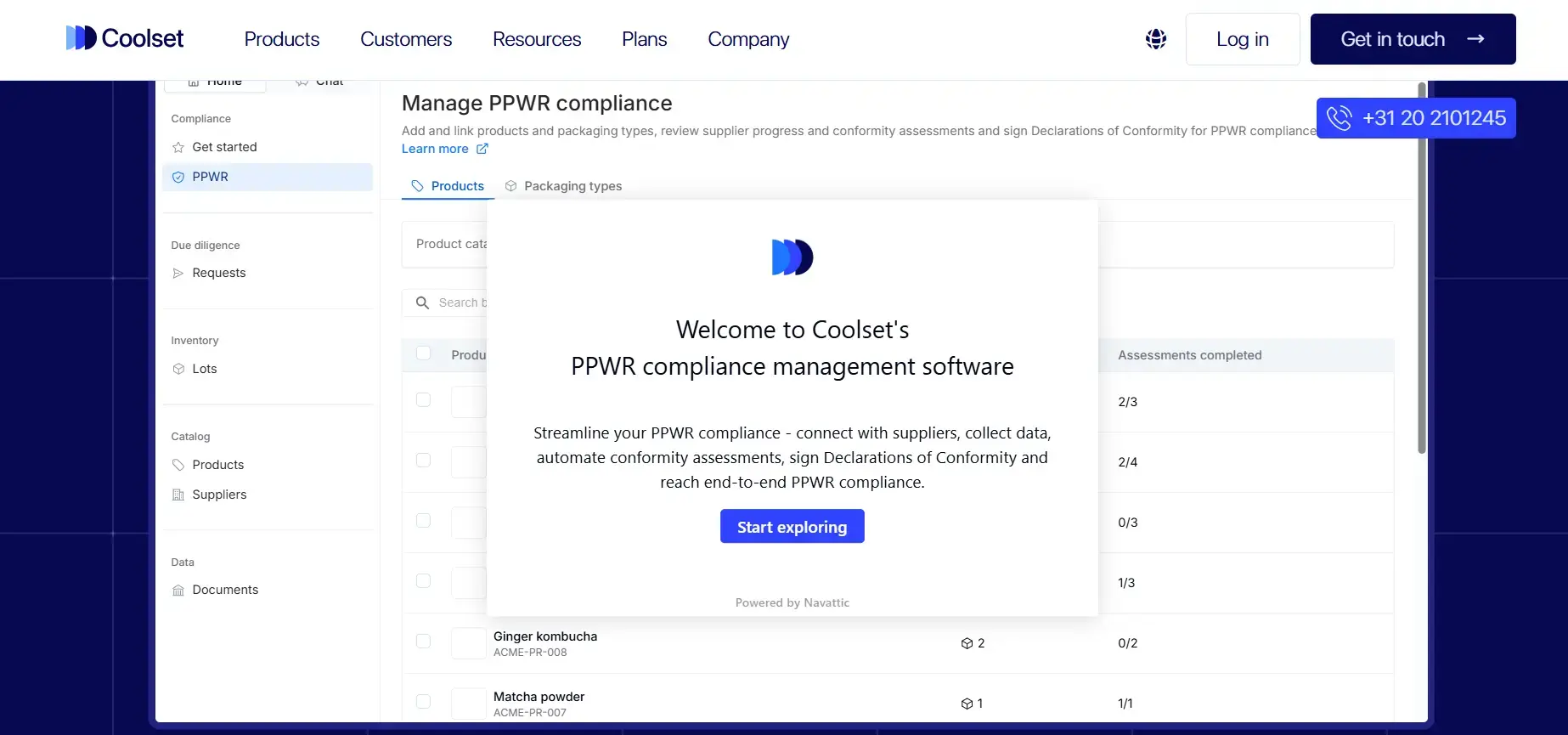
In practice this means guided templates that carry the regulatory logic, built-in rules that constrain what can be entered where, AI autofill to reduce manual data entry, and evidence linked directly to the disclosure it supports. Audit trails are produced as a by-product of the workflow rather than reconstructed afterwards, which matters more now than it did two years ago: assurance obligations have made traceability the constraint rather than calculation. Our guide to EU Taxonomy software sets out why evidence has displaced calculation as the binding requirement across this whole category.
The carbon module covers Scope 1, 2 and 3 measurement and reduction planning, with the methodology certified by TÜV Rheinland. For a young vendor this certification does specific work: it substitutes an independent assessment for the deployment history that a company founded in 2021 cannot yet offer, and it gives an auditor something concrete to examine when asking how the figures were derived.
The Question Every Buyer Must Now Ask First
In February 2026 the ground moved under this entire category. The Omnibus Directive narrowed mandatory CSRD reporting to EU entities above 1,000 employees and €450 million in net turnover, removing approximately 42,000 companies from scope. A significant share of the mid-market that CSRD-era platforms were built to serve is no longer legally required to report.
Any honest assessment of Coolset has to sit with that fact rather than around it. The platform’s original pitch — CSRD compliance for companies too small for enterprise suites — describes an obligation many of its natural buyers no longer have. A prospective customer should therefore begin not with a demo but with a scoping question: are we still within the reporting thresholds, and if we are not, what exactly are we buying this for?
There are good answers, and Coolset’s product scope suggests the company anticipated the risk. EUDR applies regardless of CSRD status. CBAM applies to importers of covered goods irrespective of size. EcoVadis requests come from customers, not regulators, and have if anything intensified. The VSME voluntary standard exists precisely for descoped companies that still need to answer their banks and buyers. What changed is not whether the platform is useful but which requirement justifies it — and a buyer who has not made that substitution consciously is buying against a rationale that expired.
Where Coolset Sits Against the Alternatives
Against Greenly, the closest comparison in accessibility terms, the distinction is centre of gravity. Greenly is a carbon accounting platform designed to get a first footprint produced quickly without a specialist. Coolset is a regulatory compliance platform with carbon accounting inside it. For a company whose sole requirement is a credible carbon number, Greenly’s focus is an advantage. For a company juggling EUDR, CBAM and EcoVadis alongside emissions, Coolset’s breadth is.
Against Plan A and Normative, both European and both serving overlapping segments, the difference is again scope rather than quality. Normative pairs measurement with named methodological advisors and a very large emission factor library; Plan A embeds SBTi-aligned decarbonisation planning. Both go deeper on the carbon discipline. Neither is structured primarily around the supply-chain regulations that increasingly dominate a European importer’s calendar.
Against Sweep, Persefoni or Workiva, there is no meaningful competition and buyers should not construct one. Those platforms serve multi-entity groups, financial institutions and companies facing reasonable assurance with a disclosure that must reconcile to the financial statements. A mid-market company evaluating Coolset against Workiva has almost certainly mis-scoped its own requirement in one direction or the other.
On supply chain specifically, EcoVadis and IntegrityNext operate at a different layer: EcoVadis is a rating network you join and are assessed by, IntegrityNext a due-diligence workflow across a large supplier base. Coolset helps you prepare for and respond to those systems rather than replacing them — a distinction worth clarifying in any demo where supply chain is the driving requirement.
Who Should Not Buy Coolset
Three profiles belong elsewhere. First: organisations wanting the work done for them. Coolset’s entire architecture assumes internal ownership, and its guided workflows are designed to make a non-specialist competent rather than to remove them from the process. A company that has decided it will never own this capability internally is better served by an advisory relationship, and will experience the platform as unfinished.
Second: enterprises with genuine consolidation complexity — dozens of legal entities, multi-currency financial reporting, group-level materiality assessments, or an audit committee expecting a sustainability statement that ties to the accounts line by line. That is enterprise reporting territory and the gap is structural rather than a matter of configuration.
Third: financial institutions. Financed emissions under PCAF is a specialist discipline with its own attribution methodologies and data-quality scoring, and it is not what this platform is built for. A bank or asset manager needs a purpose-built financed-emissions capability regardless of company size.
The Verdict
Coolset is a well-designed answer to a specific and under-served problem: the European mid-market company facing several sustainability regulations at once, with one person to handle them, that has decided to build the capability rather than rent it annually. The regulation-first architecture, the shared evidence base across obligations, and the TÜV Rheinland-certified methodology are real advantages at this tier, and the ISO 27001 and SOC 2 Type II certifications resolve the security review that would otherwise stall a small-vendor purchase.
Two conditions should govern the decision. Establish first which regulation actually justifies the purchase now that CSRD scope has narrowed — if the honest answer is EUDR, CBAM or customer EcoVadis pressure, the case is strong, and if the answer is a CSRD obligation you may no longer have, pause. Then conduct vendor due diligence proportionate to the company’s size: eighteen people and a modest funding total is not a reason to decline, but it is a reason to secure data export terms, roadmap commitments and continuity provisions in writing before signing. Both checks are ordinary procurement discipline. Neither is a criticism of the software, which does what it says it does.