
Computer Vision

Landing AI

Manufacturers, automotive, electronics, and pharma/medical-device makers that want their own quality and domain experts — not a data-science team — to build, train and deploy deep-learning visual inspection (defect detection) models that work on small datasets. Also document-heavy operations in finance, insurance, healthcare and legal needing agentic extraction of structured data from complex documents.

Try this tool
AiGreenTools Score
78 / 100
Rating G2 / Capterra
4.4
★★★★☆
out of 5 · G2 / Capterra
Pricing
freemium

AiGreenTools Score breakdown

How is this score calculated?
Sustainability Impact 11 / 20
Features & Capabilities 18 / 20
Value for Money 16 / 20
Ease of Use 17 / 20
Trust & Maturity 16 / 20

Key Information

Year Founded
2017

Reviewed by the AiGreenTools Editorial Team · Last Updated: July 2026

Founded 2017, San Francisco — Founder & CEO Andrew Ng (Google Brain, Coursera, Stanford)
Best for Manufacturers & industrial makers wanting domain experts (not data scientists) to build visual inspection AI; document-heavy regulated operations (ADE)
Flagship LandingLens — no-code/low-code data-centric computer vision platform
Products LandingLens · Visual Prompting · LandingEdge · Agentic Document Extraction (ADE)
Pricing Freemium — free Explore plan · pay-as-you-go · Enterprise custom
AI Classification AI Native — deep-learning CV, data-centric methodology, DPT-2 vision model, agentic extraction
Customers Foxconn · Stanley Black & Decker · Denso · OmniAb · global chip makers
Maturity Stage Stage 3–4

Jump to:
The data-centric idea ·
LandingLens & Visual Prompting ·
Agentic Document Extraction ·
The sustainability angle ·
vs. Cognex vs. general CV ·
Who should not buy

Most Factories Have the Expertise to Spot a Defect — Just Not the Data Science to Automate It

A manufacturer inspects quality manually: operators eyeball parts on the line, or a rule-based machine-vision system flags anomalies but can’t classify defect types well. Manual QC is slow, inconsistent, and misses subtle defects — and scaling it means hiring more inspectors. The obvious fix is deep-learning computer vision, but the conventional path demands a data-science team, millions of labeled images, and months of model engineering the plant simply doesn’t have.

Here’s the paradox: the factory already has people who know exactly what a defect looks like — its quality engineers. What it lacks is a way to turn that expertise into a working AI model without a machine-learning PhD.

Landing AI, founded in 2017 by Andrew Ng — founding lead of Google Brain and co-founder of Coursera — was built to close that gap. Its answer is “data-centric AI”: improve the AI by engineering the data, not the code, so the domain expert becomes the model builder.

Quick Answer: Landing AI is a data-centric computer vision company founded by Andrew Ng. Its flagship LandingLens is a no-code platform that lets domain experts — not data scientists — build, train and deploy deep-learning visual inspection models (defect detection, classification, segmentation), working even on the small datasets real factories have. It adds Visual Prompting for rapid model creation, LandingEdge for factory-edge deployment, and Agentic Document Extraction (ADE) for structured data from messy documents. Customers include Foxconn, Stanley Black & Decker and Denso.

LandingLens — Engineer the Data, Not the Code

LandingLens operationalizes Ng’s core thesis: AI performance now advances more by improving the dataset than by refining the model. In practice, that means the platform handles the full computer-vision workflow so a quality engineer can build the model.

The end-to-end workflow, no data-science team required:

  • Collect & label — with advanced labeling that auto-detects and corrects mislabeled images, plus collaborative consensus labeling
  • Train — a pretrained algorithm with automatic hyperparameter tuning that works on datasets of every size
  • Evaluate & deploy — to cloud, a Windows app, an API, or edge hardware
  • Refine — ongoing improvement of models and, especially, data

💡 Why “small datasets” is the killer feature

Big-tech AI assumes millions of labeled images. Real factories have a handful of examples of a rare defect. LandingLens is engineered for that reality — its pretrained algorithm and automatic tuning perform well on small datasets, so a plant can build a working inspection model from the data it actually has. This is the practical heart of “data-centric AI,” and it’s what lets projects reach production instead of stalling at proof-of-concept.

Visual Prompting takes it further. Inspired by ChatGPT-style text interfaces, it lets users create computer-vision projects in minutes by prompting on images rather than exhaustively labeling every feature — sufficient for over two-thirds of 40 tested use cases. Antibody-discovery firm OmniAb used it to analyze cells in honeycombs, replacing hours of hand-labeling hundreds of hexagonal shapes with high-quality results in a fraction of the time. For deployment, LandingEdge runs real-time inference on industrial edge hardware — a global chip maker processes hundreds of thousands of wafer images a day this way — with reported 80%+ reductions in manual QC.

Agentic Document Extraction — The Same Idea, Applied to Messy Documents

Landing AI applies its vision-first, data-centric approach to a second hard problem: extracting structured data from complex documents. Agentic Document Extraction (ADE) targets what general-purpose LLMs handle unreliably — stained invoices, margin signatures, forms full of stamps and checkboxes.

Instead of one giant model guessing through the noise, ADE uses a system of AI agents that break a document down and analyze it step by step, much like a human, powered by Landing AI’s proprietary DPT-2 vision model built to read tables, signatures, checkboxes and QR codes.

ADE capability Detail
Inputs PDF, images, spreadsheets, presentations — converted and parsed
Output Structured, machine-readable data with confidence scores & visual grounding
Tables Cross-page reconstruction merges tables spanning page breaks
Throughput Thousands of pages per minute
Delivery REST APIs · Python & TypeScript SDKs
Compliance SOC 2 Type II · GDPR · HIPAA · zero-data-retention option

With audit-ready traceability and regulated-industry compliance, ADE targets finance, healthcare, insurance and legal — Landing AI’s expansion from the factory floor to the back office, on the same principle: specialized, vision-first, data-centric AI beats a general model on the messy structured data enterprises actually have.

The Sustainability Angle — Quality as Waste Reduction

Landing AI is a computer-vision platform, not an ESG or carbon tool, so its sustainability contribution is indirect but real. Better, earlier, more consistent defect detection means less scrap and rework, higher first-pass yield, and fewer defective products escaping to customers — which directly reduces the material waste, wasted energy, and embodied emissions of producing goods that are later discarded or recalled. In resource-intensive manufacturing (electronics, automotive, batteries), yield improvement is a meaningful efficiency and waste-reduction lever.

This is a byproduct of quality, not a dedicated capability. For carbon accounting, see Watershed or our AI carbon accounting guide; for the quality-management workflow that inspection findings feed, see our CAPA Tracker.

Landing AI vs. Cognex vs. General-Purpose CV — Three Different Approaches

Dimension Landing AI (LandingLens) Cognex In-Sight General cloud CV (AWS/Azure)
Core approach Data-centric no-code software; domain experts build models Hardware-integrated smart cameras + embedded vision General-purpose CV APIs / ML services
Who builds it Quality / domain experts, no data-science team Vision engineers with Cognex hardware Data scientists / ML engineers
Data needs Works on small datasets by design Rule + AI hybrid on the camera Typically large datasets
Best fit Industrial inspection without an ML team; small data Turnkey smart-camera inspection on the line Broad, general vision use cases
Also does Agentic document extraction (ADE) ID/code reading, machine vision hardware Anything CV, less inspection-specialized
AI classification AI Native — data-centric CV AI Native — embedded vision Varies

The approaches are complementary as much as competing: Landing AI is the software-and-data-centric route to inspection AI when you lack a data-science team and have small datasets; Cognex In-Sight is the integrated smart-camera hardware route; a hyperscaler is the general-purpose route. For broader industrial-AI portfolios that include vision alongside predictive maintenance, see SparkCognition (Avathon) and Sight Machine.

Who Should Not Choose Landing AI?

Buyers wanting turnkey vision hardware — an integrated smart camera that inspects out of the box — should evaluate Cognex In-Sight or Keyence. Landing AI is a data-centric software platform; it works with cameras and edge hardware but is not itself a vision-sensor product.

Organizations needing general-purpose or consumer computer vision, low-latency consumer apps, or safety-critical real-time automotive perception should use general-purpose platforms (AWS, Azure, Databricks) or specialized automotive-perception vendors. Landing AI is explicitly optimized for industrial and enterprise inspection and document use cases, not those.

Buyers wanting a full asset-reliability or predictive-maintenance suite should look to Uptake, AspenTech APM, or Augury. Landing AI does visual inspection and document extraction — it does not predict equipment failure from sensor data.

The Verdict on Landing AI

Landing AI is the right choice for manufacturers and industrial makers who want their own quality and domain experts — not a data-science team they don’t have — to build and deploy deep-learning visual inspection, and who have the small, real-world datasets that defeat big-data approaches. The data-centric philosophy is not marketing: it is Andrew Ng’s influential thesis turned into a genuinely accessible product, with small-dataset capability, auto-correcting labeling and Visual Prompting that measurably lower the barrier, validated by customers like Foxconn, Denso and OmniAb and reported 80%+ manual-QC reductions.

The honest caveats are focus and integration: Landing AI is deliberately an industrial inspection and document-extraction specialist, not a general CV platform, and while building a model is no-code, wiring it into a physical production line remains an engineering project, with success still dependent on quality labeled examples. Its Agentic Document Extraction gives it a credible second market in regulated document-heavy industries. For the buyer whose problem is exactly “we need visual inspection AI but have no ML team and little data” — or “we need reliable structured data from messy documents” — Landing AI’s data-centric approach is a distinctive and compelling answer.
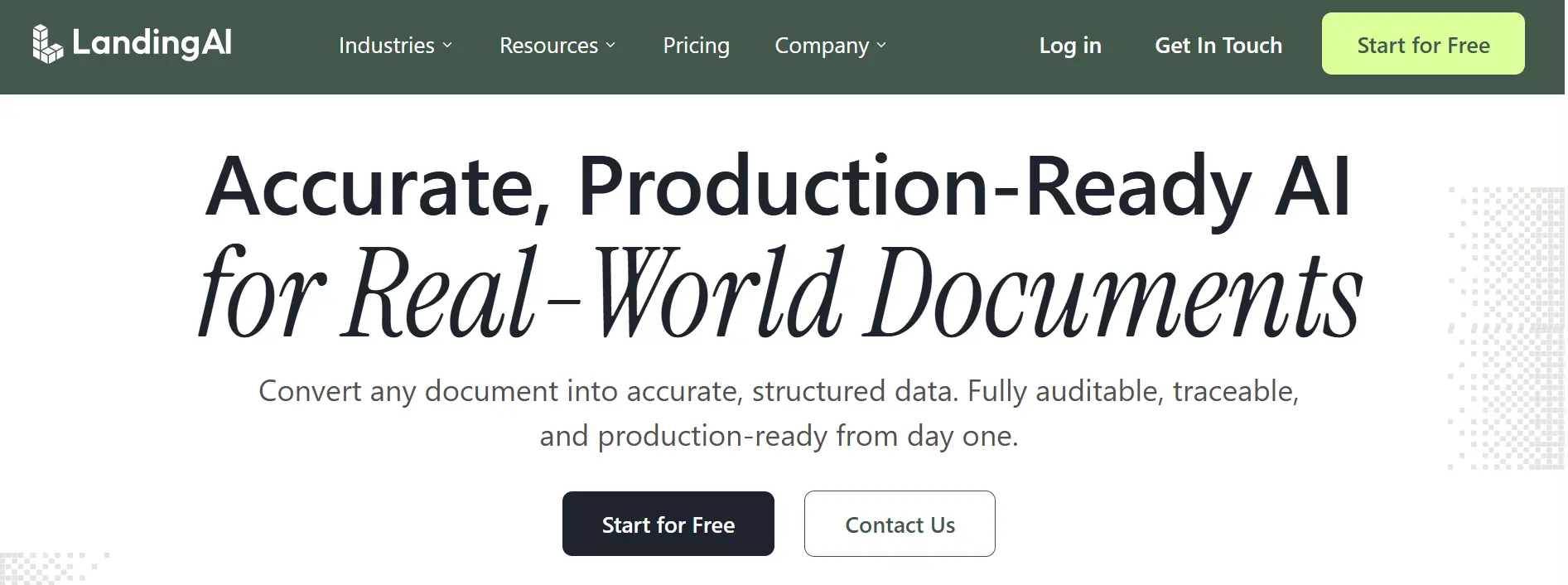

Landing AI screenshot

Key Features

  • LandingLens and Data-Centric AI — Domain Experts Build the Models LandingLens is Landing AI's flagship, and it operationalizes founder Andrew Ng's "data-centric AI" thesis: that AI performance now advances more by improving the dataset than by refining the model architecture. Practically, this means the platform lets users build, train and deploy deep-learning computer vision models — for defect detection, classification and segmentation — without deep machine- learning expertise or programming skill, so a factory's own quality and domain experts can create the AI rather than waiting on a scarce data-science team. It covers the full end-to-end MLOps workflow in one platform: collecting data, labeling, training, evaluation, deployment, and the ongoing refinement of models and especially data to improve results. Crucially, it is engineered to work on small datasets — the reality of most factories, where defects are rare and labeled images are scarce — using a pretrained algorithm with AI-based automatic hyperparameter tuning that performs well across datasets of every size, rather than requiring the millions of images that big-tech AI assumes. Its advanced labeling technology automatically detects and corrects mislabeled images to maintain data consistency, and supports collaborative labeling where multiple users reach labeling consensus — because in a data-centric approach, label quality is the product. This is why LandingLens can take a project from proof-of-concept to production where a code-centric approach stalls.
  • Visual Prompting, LandingEdge, and Deployment Flexibility Two capabilities extend LandingLens from model-building into rapid iteration and real-world deployment. Visual Prompting, inspired by generative-AI text interfaces like ChatGPT, lets users create and deploy computer vision projects in minutes by prompting on images rather than exhaustively hand-labeling every feature — a transformation for laborious annotation tasks. Landing AI's own analysis found Visual Prompting sufficient for over two-thirds of 40 tested use cases, and antibody-discovery firm OmniAb used it to analyze individual cells in honeycombs, a task that previously required hours of hand-labeling hundreds of hexagonal shapes, achieving high-quality results in a fraction of the time. For deployment, the platform is flexible: models can run in the cloud, be exported as a Windows application, called via programmatic API, or — through LandingEdge — deployed to industrial edge hardware for real-time inference in factory environments where low latency and local processing matter. A global chip maker, for example, ran LandingLens inference on hundreds of thousands of wafer images a day. This deployment range, from a few clicks to edge hardware on a high-speed line, is what lets the same platform serve a single production line or scale across global operations, and it integrates with third-party platforms including Snowflake, SAP, and ABB's robotics environment.
  • Agentic Document Extraction (ADE) — Structured Data From Messy Documents Beyond visual inspection, Landing AI applies its vision-first, data-centric approach to a different hard problem: extracting structured data from complex, messy documents. Agentic Document Extraction (ADE) targets the reality general-purpose LLMs struggle with — scanned invoices with stains, contracts with margin signatures, forms covered in stamps and checkboxes. Rather than using one giant model to guess through the noise, ADE uses a system of AI agents that break a document down and analyze it in steps, much as a human would, powered by Landing AI's proprietary DPT-2 vision model built to read tables, signatures, checkboxes and QR codes. It converts PDFs, spreadsheets, presentations and images into structured, machine-readable data with confidence scores, visual grounding, and audit-ready traceability — using cross-page table reconstruction to merge tables that span page breaks, and processing at thousands of pages per minute. Delivered as modular REST APIs with Python and TypeScript SDKs, ADE is built for regulated industries — finance, healthcare, insurance and legal — with SOC 2 Type II, GDPR and HIPAA compliance and a zero-data-retention option. It represents Landing AI's expansion from the factory floor to the back office, applying the same principle: specialized, vision-first, data-centric AI beats a general-purpose model on the messy, structured, real-world data that enterprises actually have.

Pros & Cons

Strengths

  • The data-centric, no-code approach is a genuine barrier-lowering advantage, and it addresses the single biggest reason industrial computer vision projects stall: the data-science bottleneck. By letting a factory's own quality and domain experts build, train and deploy deep-learning inspection models through data engineering — labeling, auto-mislabel correction, collaborative consensus, Visual Prompting — rather than model coding, LandingLens removes the need for a scarce ML team. Combined with genuine small-dataset capability (a pretrained algorithm with automatic hyperparameter tuning that works without the millions of images big-tech AI assumes), this is precisely matched to the reality of most manufacturers, where defects are rare and labeled data is scarce. The reported 80%+ reduction in manual QC with real-time defect detection is the kind of concrete outcome that justifies the investment.
  • The founder credibility and technical pedigree are exceptional and genuinely matter here. Andrew Ng — founding lead of Google Brain, co-founder of Coursera, and the most influential proponent of data-centric AI — gives Landing AI both a coherent, differentiated philosophy and deep technical leadership, not just a marketing story. The customer base reflects it: Foxconn, Stanley Black & Decker, Denso, a global chip maker running hundreds of thousands of wafer images a day, and antibody-discovery firm OmniAb, alongside partnerships with NVIDIA, SAP, Snowflake and ABB. Visual Prompting being sufficient for over two-thirds of tested use cases, and OmniAb's dramatic labeling-time reduction, are evidence the data-centric approach delivers in practice, not just in principle.
  • The Agentic Document Extraction expansion is a smart, credible application of the same core strength to a large adjacent market. ADE's vision-first, agentic approach to messy documents — where general LLMs struggle — with a proprietary DPT-2 vision model, confidence scores, visual grounding, audit-ready traceability, cross-page table reconstruction, and thousands-of-pages-per-minute throughput, addresses a real enterprise pain. Its regulated-industry readiness (SOC 2 Type II, GDPR, HIPAA, zero-data-retention) and developer-friendly delivery (REST APIs, Python and TypeScript SDKs) make it deployable in finance, healthcare, insurance and legal. This gives Landing AI a second growth vector beyond factory inspection, built on the same data-centric foundation.

Weaknesses

  • The narrow industrial focus that makes Landing AI strong for its target buyer limits it everywhere else. It is purpose-built for industrial visual inspection and document extraction, and reviewers consistently note this focus will limit its appeal beyond industrial computer vision. Organizations needing general-purpose computer vision, low-latency consumer vision applications, or safety-critical real-time automotive perception should look to general-purpose platforms (AWS, Azure, Databricks) or specialized automotive-perception vendors — Landing AI is explicitly not optimized for those. Buyers should be clear that they are buying an industrial inspection and document-extraction specialist, not a broad CV toolkit.
  • Visual inspection AI is only as good as its labeled defect examples, and the small-dataset capability reduces but does not remove this dependency. Rare defect types still require systematic data-collection effort to build quality training examples, and the data-centric philosophy — while it lowers the volume needed — places the burden squarely on label quality, which demands disciplined, consistent labeling by domain experts. Additionally, while model-building is genuinely no-code, deploying models to production-line edge hardware requires non-trivial integration with existing OT and IT manufacturing infrastructure, which extends time-to-value beyond the "few clicks" of model creation. The no-code promise is real for building the model; wiring it into a physical high-speed line is still an engineering project buyers should scope realistically.
  • Public transparency on pricing, SLAs and detailed case studies is limited, which complicates enterprise evaluation. While the free "Explore" plan (1,000 credits a month, non-commercial) and pay-as-you-go entry lower the barrier to experimentation, reviewers note limited public information on commercial pricing, rate limits, service-level agreements, and named customer outcomes with hard numbers. Enterprise buyers should expect to engage sales directly for production pricing and commitments, and should request detailed references and outcome data for their specific industry and use case rather than relying on the marquee logos — validating throughput, accuracy and integration effort against their own line or document workflow during a proof-of-concept before committing.

Frequently Asked Questions