Reviewed by the AiGreenTools Editorial Team · Last Updated: July 2026
| Founded | 2014, Chicago — Founder Brad Keywell (co-founder of Groupon, Lightbank) |
| Best for | Asset-heavy operators — power, mining, oil & gas, rail, steel, fleets — wanting predictive maintenance fast, without a data science team |
| Core moat | Asset Strategy Library — largest in market: ~800 equipment types · 58,000+ failure modes · 180,000+ reportable conditions |
| Pricing | Custom / Subscription — cloud-enabled, scales by assets/sites |
| AI Classification | AI Native — embedded ML, edge inference, curated failure-mode library, OT integration |
| Customers | Berkshire Hathaway Energy · BHP · US Army · Cintas |
| Maturity Stage | Stage 3–4 |
| 2026 development | Bosch announced planned acquisition — scaling AI predictive maintenance across mobility & fleets |
⚡ Ownership update — Bosch acquisition (2026)
Bosch announced its planned acquisition of Uptake in 2026, combining Uptake’s AI-driven predictive maintenance with Bosch’s global expertise in mobility, diagnostics and telematics. For fleet operators this means scaling vehicle-health solutions faster — earlier failure detection and more uptime. Heavy-industry buyers (power, mining, oil & gas) should confirm continued roadmap investment in their specific asset classes under Bosch’s mobility-oriented strategy before a long-term commitment.
Jump to:
The cold-start problem ·
The Asset Strategy Library ·
The APM platform ·
Reliability & sustainability ·
vs. GE Vernova vs. AspenTech APM ·
Who should not buy
Predictive Maintenance Has a Cold-Start Problem. Uptake’s Answer Is a Library, Not an Algorithm.
Every predictive maintenance business case runs into the same wall. Machine learning models need failure data to learn from — examples of equipment degrading and failing, labeled and clean. Most operators don’t have years of that data for every asset class they run. So the conventional path is: hire data scientists, instrument the assets, collect 12 to 18 months of failure history, then train models. That is a multi-year, expensive program that delivers no value while it’s being built — and the smaller the operator, the worse the ROI math.
Uptake, founded in Chicago in 2014, was built around a different bet: the barrier to industrial AI isn’t the algorithms, it’s the cold start. If the failure knowledge could be curated centrally, any new customer could inherit it immediately instead of rediscovering it asset by asset over years. That curated knowledge is the Asset Strategy Library — and it is Uptake’s real product.
The Asset Strategy Library — Why Breadth Beats Cold Starts
The Asset Strategy Library (ASL) is the market’s largest curated library of failure knowledge, expanded through Uptake’s acquisition of Asset Performance Technologies (maker of the Preventance APM and the original ASL).
| ASL dimension | Scale | What it means |
|---|---|---|
| Equipment types | ~800 | Coverage across mixed, multi-vendor fleets |
| Failure modes | 58,000+ | The specific ways each asset class fails — pre-encoded |
| Reportable conditions | 180,000+ | The signals and thresholds that precede failure |
Because the failure-mode understanding is already in the library, a new customer doesn’t train models from zero — they inherit decades of accumulated reliability knowledge on day one. That is what collapses time-to-value from years to weeks. The moat is the curated knowledge, not the math: any competent vendor can run an anomaly-detection algorithm, but few can hand a new customer a ready-made map of how 800 equipment types fail.
💡 Value in weeks, not years: The conventional predictive-maintenance build — hire data scientists, collect 12–18 months of failure data, train models — delivers nothing during the build. Uptake’s curated library means a new customer starts catching failures in weeks, because the failure modes for their equipment are already encoded. For operators without a data science team, this is the whole ballgame.
The APM Platform — Turning the Library Into Alerts
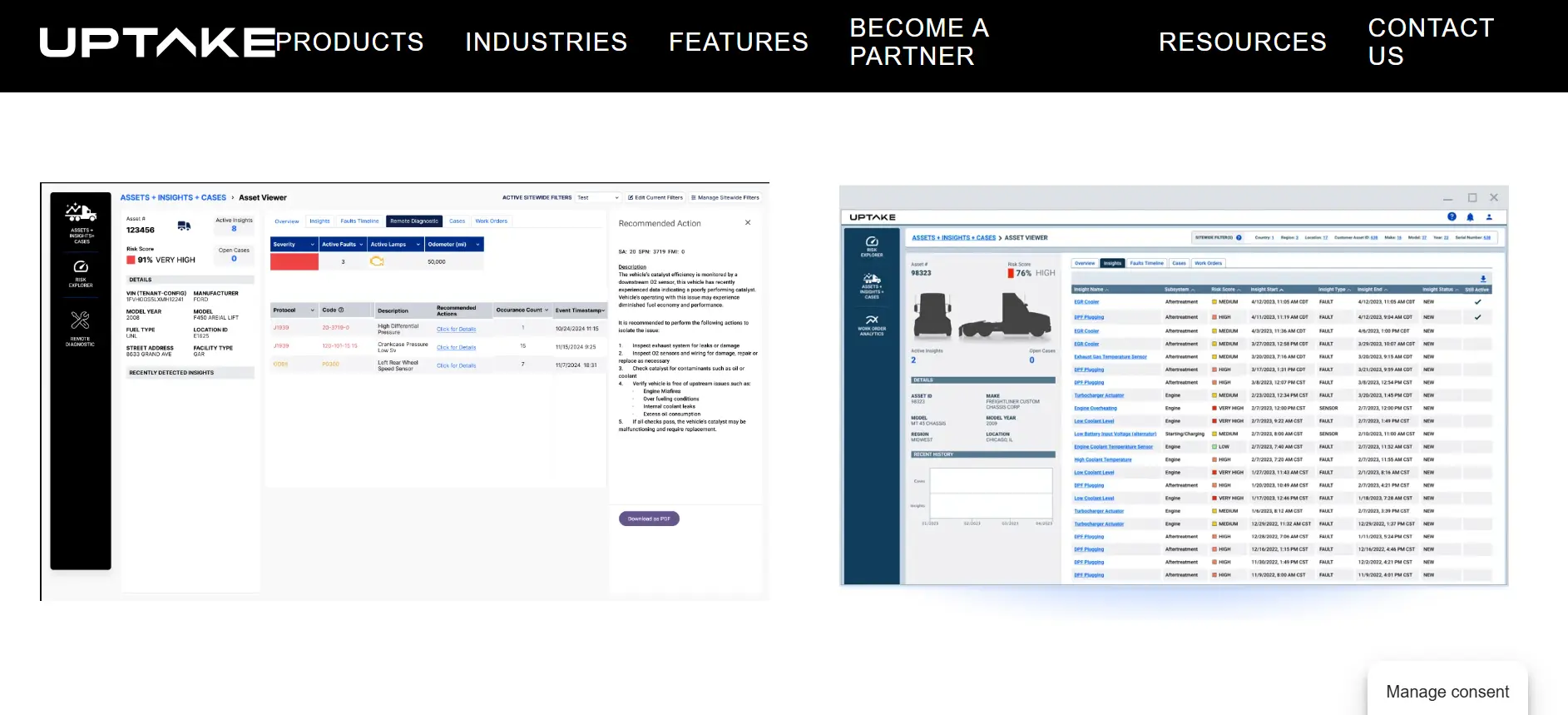
The Asset Strategy Library is the knowledge; the APM application is how that knowledge becomes operational. Embedded machine learning continuously compares live equipment condition data against the library’s failure modes, detecting degradation weeks before failure and shifting repairs from emergency shutdowns into planned windows.
What the platform delivers operationally:
- Fleet-wide standardization — one platform, one prioritized view across every asset, with alerts filterable by time, severity, location or affected system
- Edge inference — analysis close to the asset where bandwidth and connectivity are limited, common in remote industrial sites
- OT integration — connects to the sensors, historians and control systems that generate the condition data
- Mixed-fleet coverage — the library’s breadth spans equipment from many manufacturers, matching the reality of multi-vendor operators
Reliability and Sustainability — The Indirect Link
Uptake’s environmental contribution, like most APM platforms, is indirect but real. Equipment that runs reliably runs efficiently: catching degradation early prevents the energy waste of equipment operating in a degraded state, extends asset life (avoiding the embodied emissions of premature replacement), and eliminates the outsized emissions and resource cost of emergency repairs and unplanned shutdowns. Optimizing asset performance reduces energy consumption, material waste and emissions — which is increasingly recognized as aligning APM with ESG priorities.
This is a byproduct of reliability, not a dedicated sustainability capability. For carbon accounting and emissions disclosure, see Watershed and our AI in carbon accounting 2026 guide. For energy-plant-specific optimization, see Siemens Energy Omnivise and ABB Ability Genix.
Uptake vs. GE Vernova vs. AspenTech APM — Breadth vs. Depth
| Dimension | Uptake | GE Vernova APM | AspenTech APM |
|---|---|---|---|
| Core strength | Largest curated failure library — value in weeks | OEM-embedded depth for GE turbines/generators | Process-industry ML (Mtell) — failure prediction weeks ahead |
| Best fit | Mixed-vendor, multi-site, mid-market fleets | Power generation & heavy industry, GE-heavy fleets | Refining, chemicals, oil & gas process assets |
| Approach | Breadth-first — curated library across 800 equipment types | Depth-first — decades of GE OEM equipment knowledge | Depth-first — agent-based ML per process asset from historian data |
| Time-to-value | Weeks — library avoids cold start | Longer — enterprise deployment | Longer — historian integration & model training |
| AI classification | AI Native — embedded ML + curated library | AI Native — OEM analytics models | AI Native — agent-based ML |
| Best for | Operators without a data science team wanting fast value | GE-equipment-heavy power & industrial operators | Process industries with DCS historian depth |
For energy-plant control-system-native APM, compare Siemens Energy Omnivise (T3000 plants) and ABB Ability Genix (ABB automation estates). For rotating-machinery monitoring at the device level, see Augury and Tractian.
Who Should Not Choose Uptake?
Organizations whose reliability challenge is concentrated in one OEM’s equipment — a fleet dominated by GE turbines, or a plant running Siemens T3000 controls — will usually get more from the OEM-embedded depth of Siemens Energy Omnivise or GE Vernova APM than from Uptake’s cross-vendor breadth. Single-OEM embedded knowledge captures design and failure detail a broad library doesn’t match for that specific equipment.
Process industries needing historian-depth modeling — refineries, chemical plants, oil & gas processing where the reliability problem is complex process assets fed by DCS historian data — should evaluate AspenTech APM (Aspen Mtell), whose agent-based ML is purpose-built for that environment.
Heavy-industry buyers concerned about post-acquisition roadmap should confirm, during procurement, that their specific asset classes (power, mining, oil & gas, steel) remain a continued investment priority under Bosch’s mobility-oriented ownership before committing to a multi-year engagement. The Bosch acquisition is a scale positive, but its strategic center of gravity is fleets and mobility.
The Verdict on Uptake
Uptake is the right platform for asset-heavy operators who have accepted that the real barrier to predictive maintenance isn’t the algorithm — it’s the cold start, the years of failure data they don’t have and the data science team they don’t want to build. The Asset Strategy Library, the largest curated failure-mode library in the market, is a genuine answer to that problem: it lets a mixed-fleet, multi-site, mid-market operator inherit decades of reliability knowledge and start catching failures in weeks rather than years.
The honest context for 2026 is the Bosch acquisition. It brings scale and longevity — clearly positive for fleet and mobility customers, and reassuring on vendor viability — but its strategic emphasis is mobility, diagnostics and vehicle fleets. Heavy-industry buyers should confirm continued investment in their asset classes before a long-term commitment. For the operator who fits the profile — mixed fleet, no data science team, value needed fast — the library is the whole argument, and it is a strong one.