Reviewed by the AiGreenTools Editorial Team ·Last Updated: June 17, 2026
Quick Summary
| Founded | 1983 · Toronto, Canada |
| Best For | High-risk regulated industries · Manufacturing · Chemicals · Oil & Gas · Mining · Healthcare · Government |
| Carbon Scopes | Scope 1 · Scope 2 · Scope 3 |
| Pricing | Enterprise — custom quote · Modular |
| AI Classification | AI Enhanced |
| G2 Rating | 4.4 / 5 · Software Advice FrontRunners 2025 |
| Security | FedRAMP-authorized · SOC 2 compliant |
| User Base | 64% enterprise customers · Healthcare, automotive, energy |
Built for High-Risk Environments
There is a category of EHS programs where the stakes are high enough that the platform choice is not primarily about ease of use or mobile-first design — it is about regulatory credibility, data auditability, and the ability to handle occupational health complexity that simpler tools cannot address.
Cority was built for that category.
Founded in 1983 in Toronto and now operating as CorityOne, Cority has spent over four decades building EHS software for industries where incidents have serious consequences and regulatory oversight is intense: chemicals, oil and gas, mining, manufacturing, healthcare, and government. Its FedRAMP authorization — a US federal security certification that most EHS vendors do not hold — signals the level of data governance and compliance rigor the platform is designed around.
The platform is used by EHS professionals, safety managers, environmental compliance officers, industrial hygienists, occupational health specialists, sustainability directors, and risk management teams — a breadth of user types that reflects how comprehensively CorityOne covers the EHS+ function.
What CorityOne Covers
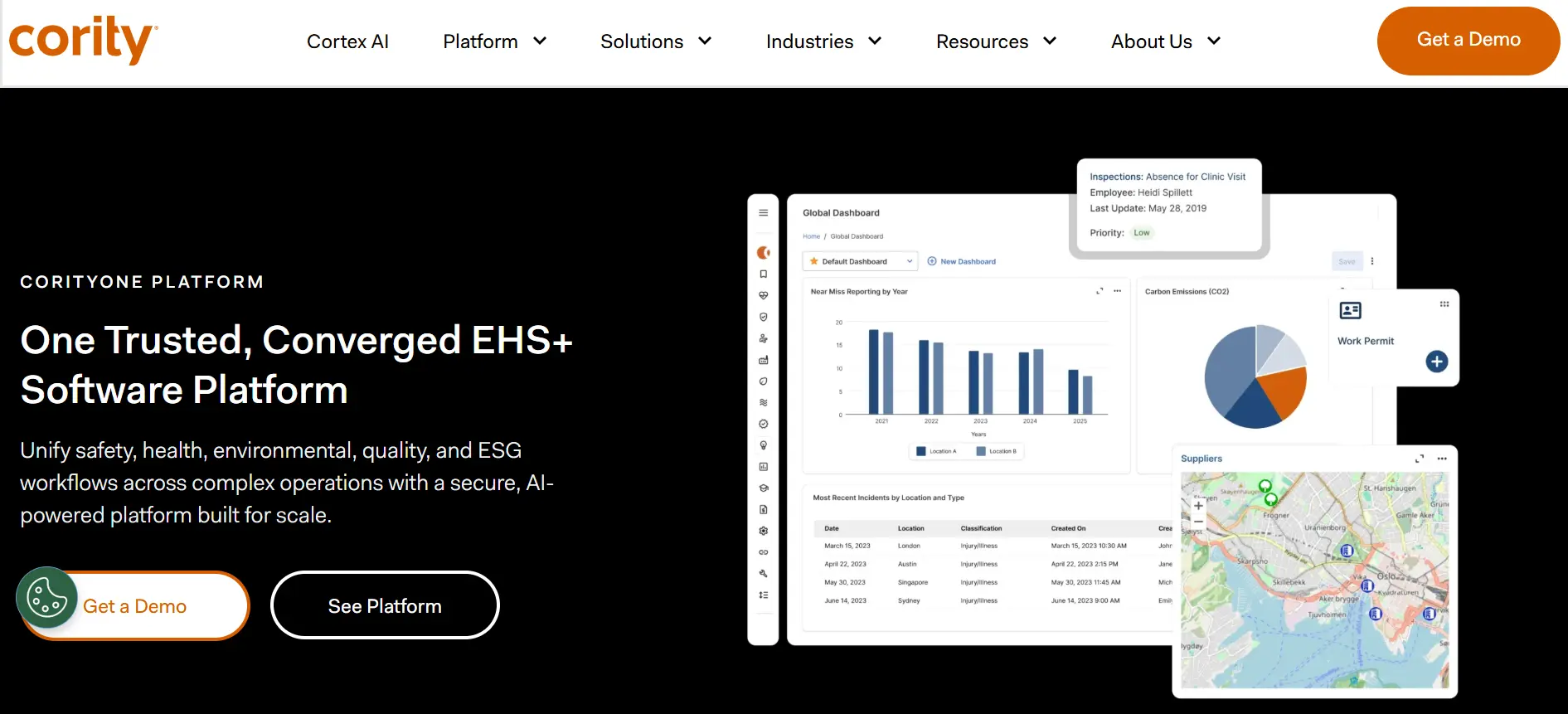
Cority’s platform philosophy is integration across the full EHS+ scope — safety, environmental compliance, occupational health, industrial hygiene, and sustainability as connected functions rather than separate modules with separate data silos.
Safety management. CorityOne covers incident management, audits, inspections, corrective actions, regulatory content libraries, risk assessment tools, and compliance dashboards. The safety module is designed for corporate EHS teams managing complex multi-site programs — not field supervisors needing a quick mobile checklist.
Occupational health and industrial hygiene. This is one of Cority’s strongest and most differentiated capability areas. The platform includes medical surveillance, exposure monitoring, respiratory protection management, and occupational health case management — capabilities that most EHS platforms treat as optional add-ons or exclude entirely. For healthcare systems, chemical manufacturers, and mining operations where occupational health is a core compliance obligation, this depth is a genuine differentiator.
Applied AI and ergonomics. Cority’s Applied AI technology includes AI motion capture for ergonomic assessment — analyzing worker movement patterns through video to identify ergonomic risk factors without manual observation. This real-time risk detection capability represents a meaningful advance over traditional ergonomic assessment methods and positions CorityOne alongside VelocityEHS as one of the few EHS platforms with production-grade AI ergonomics capability.
Environmental compliance. The environmental module covers air emissions tracking, water and waste management, environmental permit compliance, and chemical inventory management. For organizations managing multi-media environmental compliance across regulated facilities, the integrated approach reduces the data fragmentation that occurs when environmental and safety programs operate on separate systems.
Sustainability and ESG. CorityOne includes carbon tracking, sustainability metrics, and ESG reporting frameworks. This sustainability layer connects to the environmental data already collected within the platform — a structural advantage over ESG tools that require separate data collection for operational metrics. However, organizations with sophisticated CSRD, SFDR, or investor-grade ESG disclosure requirements will typically need a dedicated ESG platform alongside Cority for the reporting layer. Workiva is frequently evaluated for this complementary role.
myCority Mobile. The mobile component allows field users to complete tasks, inspections, and observations from any location. Mobile access is rated 4.3 on G2 — above average for enterprise EHS platforms — though the broader interface complexity still presents challenges for non-specialist users in the field.
FedRAMP Authorization — Why It Matters
FedRAMP — the Federal Risk and Authorization Management Program — is a US government security framework that sets stringent requirements for cloud software handling federal data. Very few EHS vendors hold FedRAMP authorization.
For government agencies, defense contractors, and regulated industries with elevated data security requirements, FedRAMP authorization is a procurement prerequisite rather than a differentiator — it determines whether a platform can be considered at all. For private sector organizations in chemicals, pharmaceuticals, or critical infrastructure, it signals a level of security governance that exceeds standard SOC 2 compliance.
This is one area where Cority’s positioning is genuinely distinct from most EHS competitors.
Pricing
Cority operates on a custom enterprise pricing model with no public standard tiers. Pricing is determined by organizational size, number of modules deployed, number of users, and implementation complexity.
User feedback and third-party analysis suggest that Cority sits at the higher end of enterprise EHS pricing — reflecting both its feature depth and the implementation investment required for full deployment. Implementation costs can be significant and typically involve Cority’s professional services team or certified implementation partners.
Pricing was not publicly available at the time of writing. Contact Cority directly for a scoped quote.
Strengths
- FedRAMP authorization provides a security and compliance standard that most EHS competitors do not meet
- Deep occupational health and industrial hygiene capabilities — medical surveillance, exposure monitoring, respiratory protection — that few platforms match
- AI motion capture ergonomics is a genuinely differentiated capability for industrial health programs
- Audit trail functionality is consistently rated among the platform’s strongest features by users and analysts
- 91% of reviewers who comment on support describe positive experiences — responsiveness and expertise are consistently praised
- Software Advice FrontRunners recognition for 2025 reflects strong peer validation across document and workflow management
Limitations
The interface is frequently described as heavy. Across G2, Capterra, and Software Advice reviews, the most consistent user feedback is that CorityOne feels complex in daily use — multiple modules behaving differently, requiring separate navigation logic, and too many clicks to complete routine tasks. This discourages adoption outside the core EHS team and creates resistance in frontline users.
Deployment is consultant-driven. Implementation is frequently described as complex and requiring significant external support. Organizations without dedicated IT resources and EHS technology expertise should budget for extended implementation timelines and professional services costs.
G2 score reflects mixed enterprise experience. A 3.8/5 rating on G2 CorityOne (47 reviews) — lower than competitors like VelocityEHS and SafetyCulture — reflects recurring themes of interface complexity, navigation difficulty, and support quality variance at scale. The 4.4/5 on Software Advice reflects a different review population with more positive overall experience.
Not suited for field-first deployments. Cority’s architecture is designed for corporate EHS administrators, not frontline supervisors or field workers who need simple, fast mobile tools. Organizations where field adoption is the primary challenge should evaluate SafetyCulture for that layer.
ESG reporting depth is limited. The sustainability module covers operational ESG data well, but does not replace a dedicated ESG reporting platform for organizations facing CSRD, ISSB, or investor-grade disclosure requirements.
Who Should Evaluate Cority
Cority earns its place on the shortlist for a specific and well-defined buyer profile: large enterprises in high-risk, highly regulated industries where occupational health depth, audit-ready data governance, and FedRAMP-level security are genuine requirements — not just desirable features.
For chemical manufacturers managing exposure monitoring programs, mining companies running medical surveillance across multiple jurisdictions, healthcare systems tracking occupational health cases at scale, or government agencies requiring FedRAMP-authorized software, Cority addresses requirements that most EHS platforms simply do not meet.
For organizations whose primary needs are frontline safety adoption, mobile inspection workflows, or lower-complexity compliance management, the platform’s depth and associated implementation cost may exceed what the use case justifies. VelocityEHS or Intelex serve those contexts with comparable enterprise credibility and somewhat lower implementation friction.
The AiGreenTools Score reflects the depth and quality of Cority as a software product — not an assessment of Cority’s own environmental performance as a company. Learn how we score tools.