Reviewed by the AiGreenTools Editorial Team ·Last Updated: June 17, 2026
Quick Summary
| Founded | 1997 · Chicago, Illinois, USA |
| Best For | Mid-market & enterprise · Manufacturing · Healthcare · Chemicals · Food & Beverage |
| Pricing | Enterprise — custom quote · Modular |
| AI Classification | AI Enhanced |
| G2 Recognition | #1 EHS Grid Leader · #6 globally in G2 2026 Best Software Awards (4,389 ERP solutions evaluated) |
| User Satisfaction | 99% of users rated 4 or 5 stars · G2 Fall 2025 |
| Scale | 10M+ workers protected worldwide |
The Numbers First
Some platforms earn their reputation through analyst endorsements. VelocityEHS earns its through user reviews — and the numbers are exceptional by any standard.
In March 2026, VelocityEHS was ranked #6 globally out of 4,389 ERP solutions in G2’s 2026 Best Software Awards — placing it in the top 50 products worldwide based entirely on verified customer reviews and publicly available market presence data. Only 0.63% of the more than 179,500 vendors listed on G2 earned a spot on this year’s list.
In the G2 Fall 2025 Grid Report for EHS, VelocityEHS earned the #1 ranking and highest Grid score across all vendors. Notably, 99% of users rated it 4 or 5 stars — one of the most consistent user satisfaction signals in the EHS software market.
These are not niche recognition signals. They reflect the experience of tens of thousands of EHS professionals using the platform daily across manufacturing plants, healthcare systems, chemical facilities, and food production sites. For EHS managers evaluating platforms, peer-validated performance at this scale is a meaningful data point.
What the Platform Covers
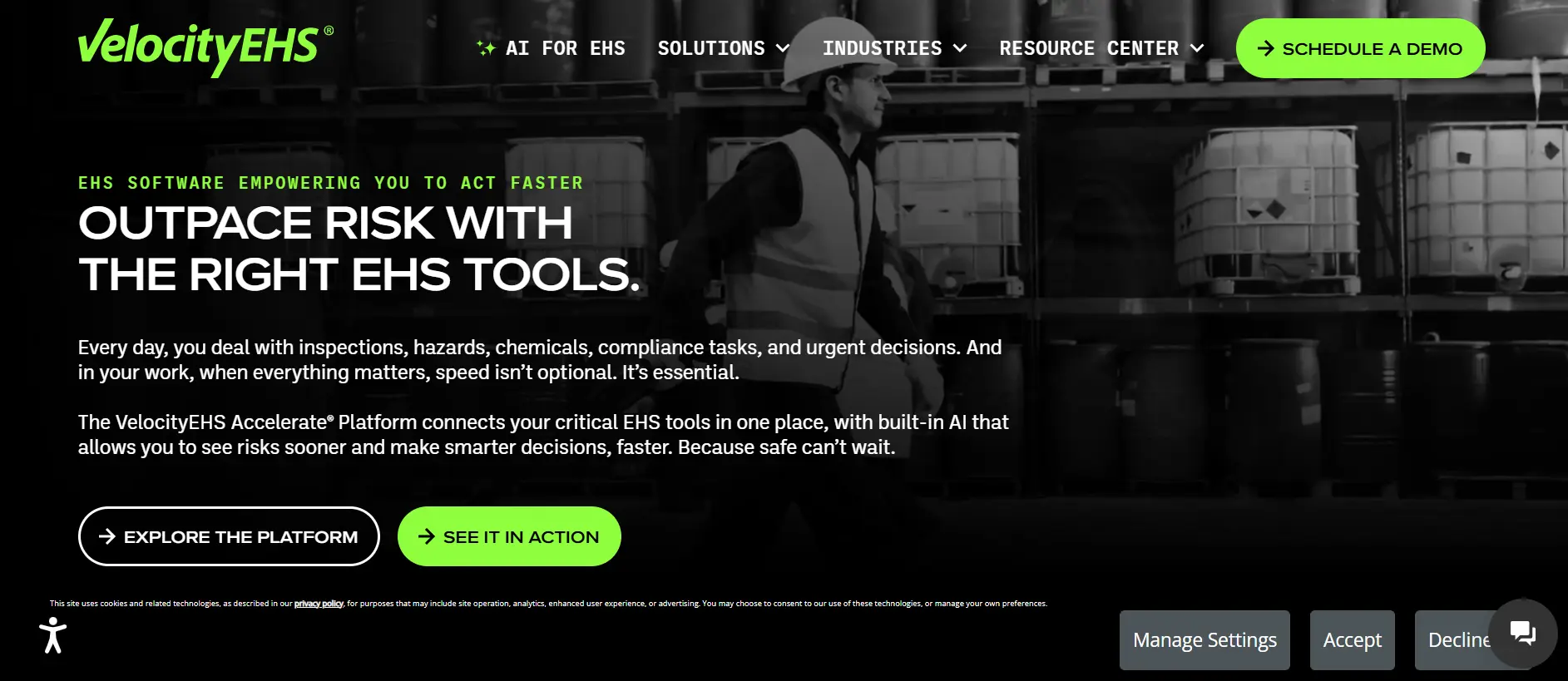
VelocityEHS operates as a modular SaaS platform — the Accelerate® Platform — built around the idea that EHS programs work best when safety, environment, quality, and sustainability data flow through a single system rather than disconnected tools.
Safety management. The core of the platform covers incident reporting and investigation, observation management, safety meetings, training and learning management, and compliance tracking. Users frequently highlight ease of use, helpful AI integration, efficient reporting, and the availability of support videos as primary benefits. Incident management received new AI-powered capabilities in 2025, enabling automated pattern detection and root cause suggestion across incident data.
Ergonomics. VelocityEHS’s ergonomics module is one of the most differentiated capabilities in the EHS market — offering video-based ergonomic assessment, job hazard analysis, risk verification, and management of change workflows. The platform employs board-certified ergonomists on staff, which gives its ergonomic tooling a level of domain depth that software-only vendors cannot easily replicate.
Chemical management. The chemical safety module — originally built on the MSDS Online foundation before the VelocityEHS rebrand — is one of the most established SDS management systems in the market, with some customers using it continuously since 2009. It covers SDS library management, hazard communication compliance, chemical inventory, and regulatory reporting across jurisdictions.
Operational risk. The risk module supports job safety analysis, risk assessment frameworks, risk verification, and management of change — enabling structured risk programs that connect to incident data and corrective action workflows.
Environmental compliance and ESG. Standalone modules for environmental compliance and sustainability extend the platform beyond traditional safety management. The ESG module supports data collection and reporting for organizations integrating EHS and sustainability programs, though this remains a less mature capability relative to the platform’s core safety strengths.
Contractor safety and permit to work. For organizations managing contractors and high-hazard work, VelocityEHS includes a dedicated contractor safety module and a permit-to-work system — capabilities that enterprise EHS platforms often handle through separate tools.
Human-Centered AI
VelocityEHS describes its AI approach as “human-centered” — and the distinction is deliberate. The platform employs Ph.D. AI/ML scientists alongside board-certified ergonomists and safety professionals, ensuring that AI outputs are validated by domain experts rather than applied directly from algorithmic outputs.
In practice, AI capabilities are embedded across several modules: automated incident pattern detection, AI-assisted ergonomic video assessment, predictive risk scoring, and natural language reporting tools. The platform supports 16 languages including English, French, German, Spanish, Japanese, and Chinese (Simplified) — meaningful for multinationals managing EHS programs across regions.
The platform is SOC 2 Type II attested and recognized as a Verdantix 2025 Green Quadrant Leader — analyst recognition that complements its user review performance.
Pricing
VelocityEHS does not publish standard pricing. The Accelerate® Platform is sold modularly — organizations select the specific solutions they need rather than purchasing a monolithic suite. This modular approach means entry costs vary significantly based on which modules are deployed, number of users, and organizational complexity.
The modular structure is an advantage for organizations with specific, well-defined EHS needs — they can start with incident management or chemical safety and expand over time. It can be a complexity factor for organizations seeking a single comprehensive quote upfront.
Pricing was not publicly available at the time of writing. Contact VelocityEHS directly for a scoped quote.
Where It Performs Best
Manufacturing and industrial environments. VelocityEHS users are predominantly Safety Managers and EHS Specialists across manufacturing and healthcare — the platform’s depth in chemical management, ergonomics, and operational risk reflects a design built around the realities of industrial EHS programs.
Organizations prioritizing user adoption. The platform’s #1 G2 rating for user satisfaction is not coincidental — it reflects consistent investment in usability and onboarding. For EHS managers whose challenge is getting frontline workers and supervisors to actually use a safety system, this metric matters more than feature depth alone.
Mid-market and enterprise. G2 data shows VelocityEHS serves 51% mid-market and 36% enterprise customers — a balance that reflects genuine product-market fit across both segments, unlike some EHS platforms that effectively serve only one.
Limitations
Support response time is a recurring concern. Multiple user reviews across Capterra and G2 note that support response times can be slow, which increases frustration when bugs affect system performance. For organizations that need rapid resolution of platform issues, this is worth factoring into evaluation.
Field customization has limits. Some users report that the out-of-the-box version restricts field-level edits, requiring vendor involvement for list data changes — adding cost and time that can become significant for organizations with frequently changing operational data.
ESG module is developing. The sustainability and ESG reporting module is functional but less mature than the platform’s core EHS capabilities. Organizations with sophisticated ESG disclosure requirements — CSRD, SFDR, or investor-grade reporting — will typically need a dedicated ESG platform alongside VelocityEHS. Sweep or Workiva are frequently evaluated for this complementary role.
Navigation complexity at scale. Users managing multiple modules report that navigation between sections can be time-consuming, and the interface’s depth can present a learning curve for organizations deploying the full Accelerate® Platform. G2 reviewers specifically note difficult navigation and confusing interface as recurring feedback themes, despite the platform’s overall high satisfaction scores.
How It Compares
For EHS managers building a shortlist, the choice between VelocityEHS and its nearest competitors typically comes down to program focus:
- vs SafetyCulture — SafetyCulture is stronger for mobile-first frontline inspection adoption. VelocityEHS offers significantly more depth in chemical management, ergonomics, and enterprise risk workflows.
- vs Intelex — Both are enterprise EHSQ platforms with comparable depth. VelocityEHS has a materially stronger user satisfaction record on G2. Intelex edges ahead on configurability without code.
- vs Cority — Cority combines EHS and ESG in a unified platform. VelocityEHS is stronger in ergonomics and chemical safety; Cority is stronger in integrated sustainability reporting.
For organizations where EHS program performance, user satisfaction, and chemical safety depth are the decisive criteria, VelocityEHS is one of the strongest options in the market in 2026.
The AiGreenTools Score reflects the depth and quality of VelocityEHS as a software product — not an assessment of VelocityEHS’s own environmental performance as a company. Learn how we score tools.