Reviewed by the AiGreenTools Editorial Team · Last Updated: June 2026
| Founded | 1993, Salt Lake City, Utah, USA |
| Best for | Enterprise pharmaceutical, biotech, and medical device — connected QMS, FDA 21 CFR Part 11, QMSR, ISO 13485 |
| Pricing | Custom enterprise — from ~$25,000/year |
| AI Classification | AI Enhanced (MasterControl AI — document summaries, CAPA acceleration, quality event auto-categorization) |
| Key Standards | FDA 21 CFR Part 11, 21 CFR 210/211/820, QMSR (ISO 13485 by reference, eff. Feb 2026), ISO 13485, GMP, GxP, GAMP 5/CSA, FedRAMP Moderate |
| Maturity Stage | Stage 3–4 |
| Recognition | #1 QMS Life Sciences — G2 (2026); 186% ROI, 74% faster product launches (documented outcomes) |
Why FDA Inspection Results Have a Financial Consequence That QMS Evaluations Underestimate
An FDA Form 483 observation is a finding. A Warning Letter following unresolved 483 observations is a regulatory action. A consent decree following a Warning Letter can require a company to halt manufacturing, implement a remediation plan under FDA supervision, and pay independent expert monitors for years. In pharmaceutical manufacturing, consent decrees have historically cost organizations hundreds of millions of dollars in direct remediation and lost production revenue.
The most common 483 observations cluster in three areas: document control failures (outdated procedures in use), training failures (employees following procedures they weren’t trained on the current version of), and CAPA failures (corrective actions opened, implemented, and never verified for effectiveness). These three failure categories share one root cause: the QMS treats documents, training, and CAPA as three separate records rather than three stages of a connected quality loop.
MasterControl was founded in 1993 on the observation that this disconnection was structural, not behavioral — and that a QMS that doesn’t natively connect document revisions to training requirements and training gaps to CAPA records is not managing quality. It is managing paperwork.
What Is MasterControl Qx — and How Does the Connected Architecture Work?
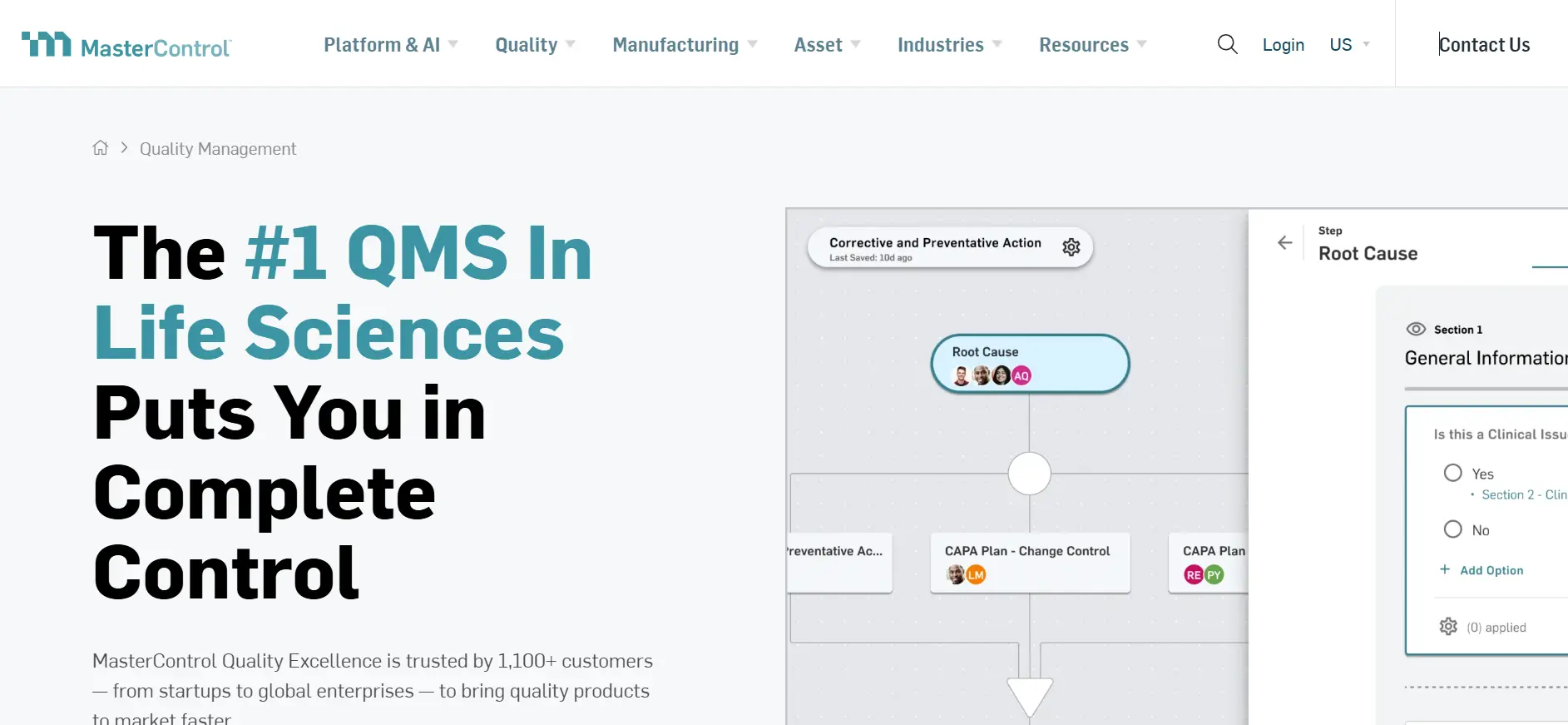
How the MasterControl quality loop works:
- Document Control: SOP revised and released with 21 CFR Part 11-compliant electronic signatures and controlled distribution
- Training Trigger: Document release automatically generates training assignments for every employee in the distribution list
- Quality Event: Deviation logged — linked to the relevant SOP and training records of involved personnel
- CAPA: Quality event initiates CAPA — linked to the deviation, the affected SOP, and any required document changes
- Effectiveness Verification: CAPA closure triggers effectiveness review at a defined interval — verified against the original deviation criteria
- Management Review: All records feed management review dashboards with full traceability to underlying quality events
MasterControl vs. ETQ Reliance vs. Qualio — Which QMS for Which Organization?
| Dimension | MasterControl | ETQ Reliance | Qualio |
|---|---|---|---|
| Primary industry | Life sciences (pharma, biotech, medtech) | Multi-industry (pharma, food, electronics, auto) | Life sciences startups and scale-ups |
| Architecture | Natively connected modules | No-code configurable — 40+ applications | Cloud-native, opinionated workflows |
| Validation tooling | Patented VxT — GAMP 5 delta automation | CSA-aligned documentation support | 99% of customers use pre-validation package |
| Deployment timeline | Months to a year (enterprise multi-site) | Months (complex configuration) | Weeks (pre-configured life sciences workflows) |
| FedRAMP | Moderate (Qx Gov) | Not authorized | Not authorized |
| Best for | Enterprise pharma / medtech, 500+ employees | Multi-industry manufacturers, flexible configuration | Life sciences startups, 10–500 employees |
How Does VxT Reduce the Software Validation Burden in GxP Environments?
Software validation in pharmaceutical and medical device environments is a regulatory obligation under 21 CFR Part 11 and FDA Computer Software Assurance (CSA) guidance (effective September 2025). The validation expectation: computerized systems used in GxP activities must be validated to demonstrate reliable, consistent performance — with documented IQ, OQ, and PQ protocols proportional to the risk the system poses to patient safety or product quality.
What MasterControl VxT delivers for GxP organizations:
- Pre-written IQ/OQ/PQ protocols: GAMP 5 and CSA-aligned validation packages provided for every MasterControl application module — not written from scratch by quality IT
- Delta validation on updates: When MasterControl releases software updates, VxT provides a validation package covering only changed functionality — eliminating full revalidation
- Risk classification: Functions are classified per CSA guidance — high validation effort for e-signatures and audit trails, reduced effort for lower-risk functions
- Embedded validation records: VxT validation packages maintained within MasterControl with 21 CFR Part 11-compliant signatures — validation evidence itself subject to the controls it validates
MasterControl and FDA QMSR — What Changed in February 2026
The FDA Quality Management System Regulation (QMSR), effective February 2, 2026, replaced 21 CFR Part 820 for medical device manufacturers by incorporating ISO 13485:2016 by reference. For MasterControl’s medical device customer base, this creates new compliance requirements in risk management (ISO 14971 alignment), design change control (ISO 13485 Clause 7.3), and supplier evaluation (Clause 7.4). MasterControl updated its modules for QMSR alignment before the effective date.
For the pharmaceutical customer base covered by 21 CFR Parts 210/211 rather than QMSR, the regulatory signal is equally relevant: FDA’s direction toward ISO-aligned quality systems reinforces MasterControl’s connected architecture as the platform designed for where the agency’s inspection expectations are heading. For EHS quality integration alongside QMS, see our profiles on Intelex and Cority. For ISO 45001 management system context, see our ISO 45001 guide.
Who Should Not Use MasterControl?
Multi-industry manufacturers needing QMS across pharmaceutical, automotive, food, and electronics should evaluate ETQ Reliance. MasterControl’s life sciences-native architecture and pre-configured workflows require additional effort to serve other industries effectively.
Growth-stage biotech and medical device startups under 200 employees, building their first QMS, and needing FDA readiness in 60–90 days should evaluate Qualio. Qualio deploys in weeks, is more user-friendly for small teams, and is more cost-proportionate for early-stage organizations.
Organizations prioritizing quality-team-independent configuration — where workflow and form modifications must be completed without IT or vendor involvement — should specifically test MasterControl’s configuration model against ETQ Reliance’s no-code drag-and-drop design before making a multi-year commitment in a validated environment where switching is operationally costly.
The Verdict on MasterControl
MasterControl is the right QMS for an enterprise pharmaceutical or medical device organization whose primary operational risk is the disconnected quality loop — where a document revision doesn’t automatically create a training obligation, a deviation doesn’t automatically initiate a CAPA, and an FDA inspector’s request for a connected record produces a retrieval exercise rather than a system report. For that organization, the connected architecture, patented VxT validation tooling, and 30 years of life sciences QMS heritage make MasterControl the platform that consistently produces the documented outcomes its case studies describe: 186% ROI, 74% faster product launches, fewer 483 observations. For organizations outside life sciences, or for life sciences organizations that need deployment speed and configuration simplicity over deep connectivity — the alternatives serve them better.