Reviewed by the AiGreenTools Editorial Team · Last Updated: June 2026
| Founded | 2019, São Paulo, Brazil |
| Best for | Mid-market manufacturers (50–2,000 employees) needing execution-first predictive maintenance with integrated CMMS, fast deployment |
| Industries | Automotive, Food & Beverage, Mining, Chemicals, Consumer Goods, Oil & Gas |
| Pricing | Hardware + software bundle — custom per deployment |
| AI Classification | AI Native |
| Key Metrics | IP69K + ATEX dual certification · 3-5 year battery · Sub-GHz 1km range · 500,000+ technician community (Brazil) |
| Maturity Stage | Stage 2–3 |
The Problem With Predictive Maintenance Programs Is Not the Technology — It Is the Gap Between the Alert and the Work Order
Most mid-market manufacturing facilities have investigated predictive maintenance software at some point and decided not to deploy it. The reasons are consistent: the implementation takes months, the sensors arrive weeks after the contract, the IT integration requires a project team, the reliability engineer who was supposed to interpret the alerts left the company, and the system that finally goes live sends alerts that the maintenance team does not know how to act on.
The alert-to-action gap is the failure mode that destroys predictive maintenance programs before they produce ROI. A bearing fault detected three weeks before failure is only valuable if the detection produces a work order, the work order reaches a technician, and the technician knows what repair to perform. If the alert sits in a monitoring dashboard that is disconnected from the CMMS, waiting for a reliability engineer to translate it into a maintenance instruction, the bearing fails before the translation happens.
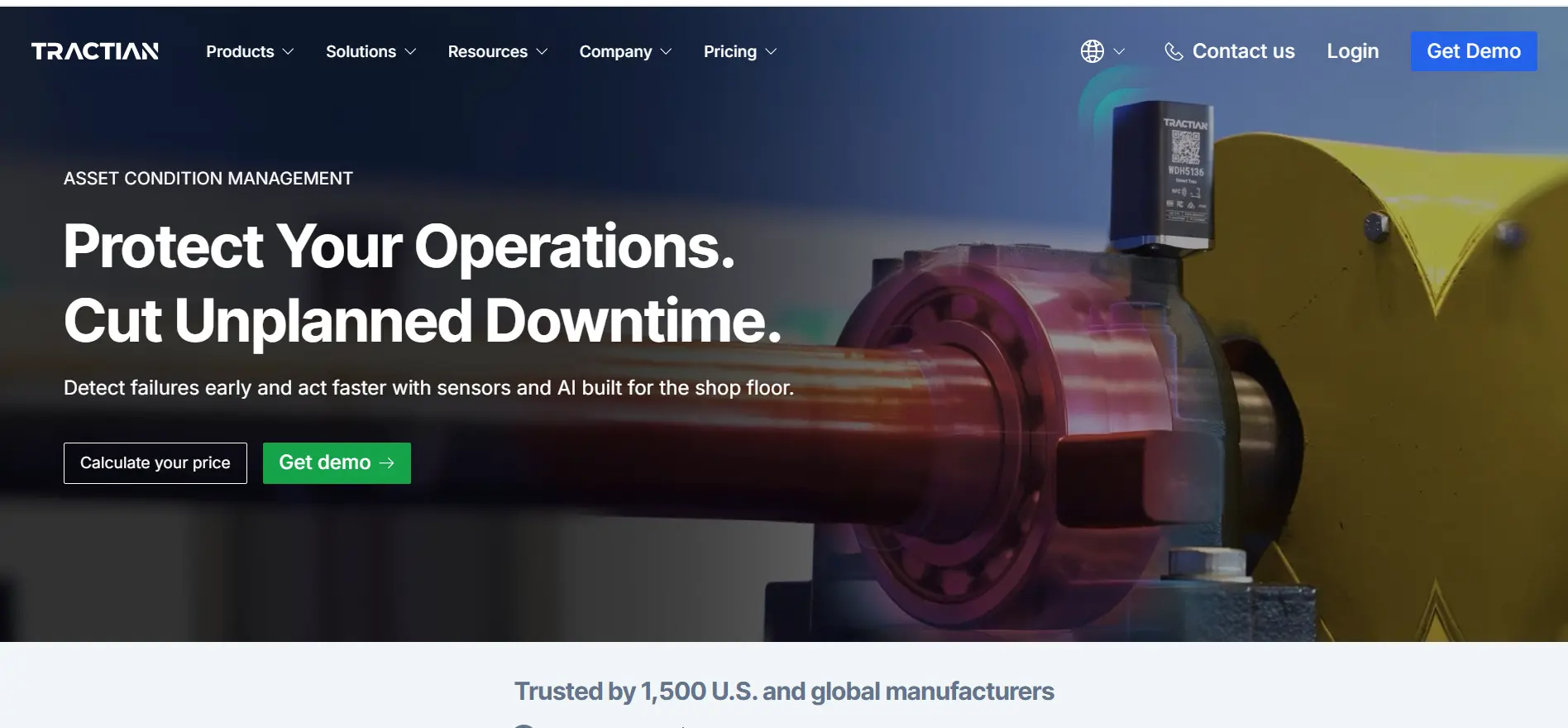
Tractian was founded in São Paulo in 2019 with a specific answer to this problem: build the sensor, the AI diagnostic engine, and the CMMS as a single system so that the fault detection automatically produces the work order, routes it to the technician, and confirms that the repair resolved the issue — without any manual translation step and without a reliability engineering team to operate it. That architecture, combined with Smart Trac sensors that attach magnetically in minutes, is why a mid-market food & beverage manufacturer can go from “no predictive maintenance program” to “first fault detected and work order generated” in less than a week.
How Does Tractian Work — From Sensor to Work Order?
Tractian’s sensor-to-work-order workflow:
- Installation: Smart Trac Ultra sensor magnetically mounted on motor, pump, fan, or compressor — no wiring, no drilling, minutes per asset
- Data capture: Triaxial vibration, temperature, and RPM measured every 5 minutes at full frequency range; transmitted via sub-GHz wireless to gateway
- AI analysis: Patented ML algorithms compare vibration signature against training library of millions of asset data points — classifying fault type, severity, and urgency
- Prescription: Technician receives specific fault (e.g., outer race bearing defect), severity (advisory), recommended action (replace bearing during next planned shutdown), and estimated timeline
- Work order: CMMS automatically generates work order with diagnostic details, parts list, and technician assignment — no manual creation required
- Verification: After repair, AI monitors vibration return to baseline — confirming repair effectiveness without manual protocol
Tractian vs. Augury — The Execution-First vs. Expert-Validated Comparison
The most common competitive evaluation in predictive maintenance pits Tractian against Augury. Both use vibration sensors and AI to detect rotating equipment faults. The architectural difference is in who validates the alert before it reaches the maintenance team.
| Dimension | Tractian | Augury |
|---|---|---|
| Alert validation | AI-only — alerts go directly to maintenance team | CAT III/IV analyst reviews every alert before delivery |
| CMMS | Native integrated — no external connection required | API integration to existing CMMS via AI Agents |
| Deployment timeline | Days — magnetic sensor installation, self-service | Enterprise rollout — weeks to months |
| Reliability team required | No — junior technicians operate the system | Augury’s analysts substitute for the internal team |
| Ultra-low RPM | Standard sensors; limited ultra-low coverage | Machine Health Ultra Low (1-150 RPM, ultrasonic) |
| Best for | Mid-market, fast deployment, integrated CMMS | Fortune 500, expert-validated diagnostics, heavy industry |
| Pricing | More accessible — hardware + software bundled | Higher — per-asset annual subscription, multi-year |
The selection rule: if the maintenance team can be trained to respond to AI-generated alerts and the organization needs speed and integrated CMMS native capability at mid-market pricing — Tractian. If the organization needs CAT III/IV-validated alerts, ultra-low-RPM coverage, and an expert-backed enterprise relationship model — Augury.
Industries Where Tractian Is Purpose-Built
Tractian’s sensor certifications and operational model serve three industrial sectors with specific requirements:
Industries where Tractian’s dual IP69K + ATEX certification matters most:
- Food & Beverage and Dairy: Production lines require daily high-pressure washdown protocols (IP69K) while refrigerant systems and some processing areas require ATEX rating — the Smart Trac Ultra handles both environments with a single sensor
- Chemicals and Pharmaceuticals: ATEX and IECEx certification for potentially explosive atmospheres alongside washdown capability for cleanroom-adjacent areas
- Mining and Minerals: Harsh environments, remote sites, large rotary equipment — Tractian’s 1km sub-GHz wireless range enables sparse gateway placement across large mining sites
- Oil & Gas (upstream and downstream): Class I/II Division I certification for US operations, ATEX for international sites, alongside pump and compressor monitoring capability
- Automotive: High-speed production lines with conveyors, robots, and CNC machines where unexpected failures halt entire sequences — continuous monitoring with automated work order generation is the operational requirement
Tractian’s CMMS — What It Covers and What Enterprise EAM It Does Not Replace
Tractian’s integrated CMMS covers the maintenance execution layer: work order management, technician assignment, mobile execution, spare parts consumption tracking, preventive maintenance scheduling, and KPI dashboards (OEE, MTTR, MTBF, planned vs. unplanned ratio). This coverage is sufficient for the majority of mid-market manufacturing maintenance operations.
What Tractian’s CMMS does not replace: enterprise EAM systems (SAP PM, IBM Maximo) that manage the full asset lifecycle — procurement, contract management, regulatory inspection compliance, spare parts warehousing with multi-site inventory visibility, and capital expenditure planning. For organizations already invested in enterprise EAM, Tractian functions most naturally as the condition monitoring and predictive maintenance layer that feeds work orders into the existing EAM through API integration — not as a standalone CMMS replacement.
For asset performance management at the enterprise scale — integrating condition monitoring with process historian data and risk-based inspection frameworks across heavy industrial assets — see our review of AspenTech APM. For the ISO 55001 asset management framework context, see our ISO 45001 implementation guide which covers the adjacent management system standards.
The Industrial Copilot Model — What Tractian Means by Augmented Reliability
Tractian’s 2026 positioning as an “Industrial Copilot” reflects a specific claim about what AI does for maintenance teams in the current labor market: it enables a junior technician to perform at the level of a 20-year vibration analysis veteran. When the AI diagnoses “outer race bearing defect on Pump 4, medium severity, recommend replacement during next planned shutdown” — the technician does not need to understand Fast Fourier Transform analysis, bearing defect frequencies, or vibration amplitude trending. They need to know how to replace a bearing. The expertise is in the diagnosis. The technician executes the prescription.
This augmented reliability model is operationally significant in an industrial labor market where experienced reliability engineers are scarce and expensive. Mid-market manufacturers that cannot justify a dedicated reliability engineering hire can deploy Tractian and achieve similar proactive maintenance outcomes — not because the AI replaces the expertise, but because it encodes the expertise into the output that reaches the technician.
Who Should Not Choose Tractian?
Fortune 500 manufacturers with complex, multi-continent reliability programs, large internal reliability teams, existing enterprise EAM infrastructure, and assets requiring ultra-low-RPM (1-150 RPM) monitoring should evaluate Augury for the expert-validated, enterprise relationship model that serves that profile. Augury’s CAT III/IV analyst validation and Baker Hughes partnership for heavy industry extend to asset types and validation standards that Tractian does not currently match.
Organizations with existing sensors and historian data who want AI analytics without additional hardware should evaluate sensor-agnostic platforms like AspenTech APM that can ingest existing SCADA, DCS, and OPC-UA data without proprietary hardware deployment.
Organizations requiring deep CMMS integration with existing SAP PM or IBM Maximo for unified maintenance management should map the Tractian-to-EAM integration architecture before committing, to confirm that the work order data flows without creating parallel maintenance records in disconnected systems.
The Verdict on Tractian
Tractian solves the most common reason mid-market predictive maintenance programs fail: not the algorithm, but the distance between the alert and the maintenance action. The hardware-to-CMMS integration in a single self-service platform eliminates that distance. Smart Trac sensors, AI diagnostics, and native work order generation operating as one system means that a bearing fault detected today is a scheduled repair by tomorrow — without a reliability engineer, without a system integration project, and without the months of procurement delay that traditionally separates the decision to invest in predictive maintenance from the first fault caught before it becomes a breakdown. For that specific problem, at mid-market scale, Tractian is the right tool.