[Last Updated: June 16, 2026]
Quick Summary
| Founded | 2019 · San Francisco, California, USA |
| Best For | Large enterprises · End-to-end climate programs · Multi-framework disclosure |
| Carbon Scopes | Scope 1 · Scope 2 · Scope 3 |
| Pricing | Custom / Enterprise — $37,000 to $264,000+ annually (third-party estimates) |
| AI Classification | AI Native |
| ESG Score | 8.4 / 10 · How we score |
| Valuation | $1.8 billion · $185M raised · Sequoia Capital, Kleiner Perkins, Greenoaks |
| Recognition | Verdantix 2026 Green Quadrant Leader · CDP Gold Accredited Provider |
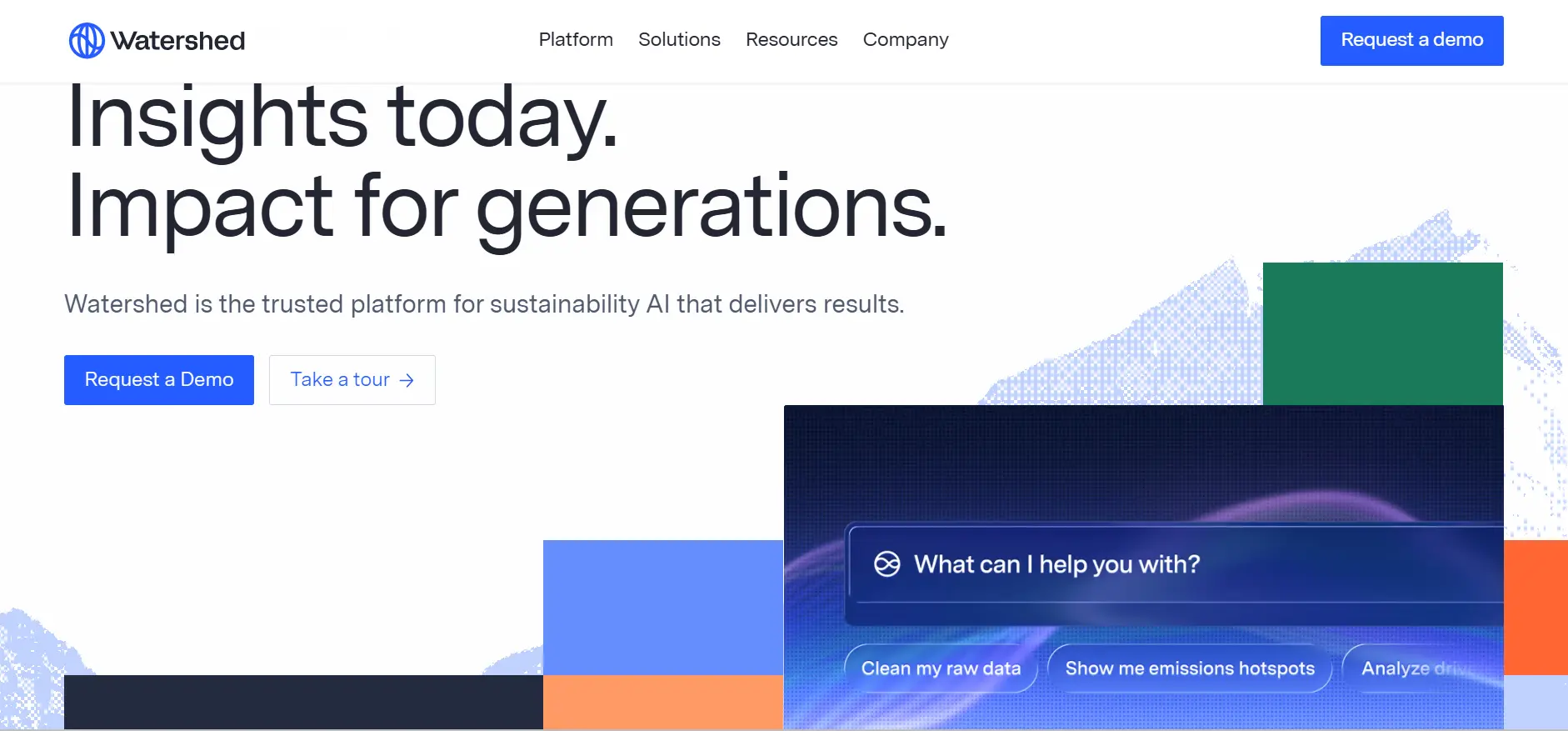
Most carbon platforms start with a question: how much are you emitting? Watershed starts with a different one: what are you going to do about it?
That distinction shapes everything about how the platform is built. Founded in 2019 in San Francisco by Avi Itskovich, Christian Anderson, and Taylor Francis, Watershed has grown into one of the most recognized names in enterprise climate software — valued at $1.8 billion after raising $185 million from Sequoia Capital, Kleiner Perkins, and Greenoaks. Its stated mission is to build “the climate economy,” and the platform reflects that ambition: measurement is the starting point, not the destination.
Watershed has been named a Leader in the Verdantix 2026 Green Quadrant for Enterprise Carbon Management Software, earning market-leading scores across data acquisition and quality control, carbon calculation methodologies, and net-zero strategy support. It is also a CDP-accredited global gold software solutions provider — one of a small number of platforms to hold that designation.
Current customers include Walmart, BlackRock, General Mills, Stripe, and Bain Capital — a client base that reflects the platform’s positioning at the intersection of corporate sustainability and financial services.
What Makes It Different
From measurement to action in one platform. Most enterprise carbon tools are strong at one end of the workflow — either measurement or reporting or strategy. Watershed is deliberately built to cover all three without requiring separate systems. Organizations can move from raw data ingestion to audit-ready disclosure to reduction pathway modeling to carbon market participation within the same platform.
CDP Gold accreditation. Watershed has been designated as an accredited global gold software solutions provider by CDP, the leading voluntary environmental disclosure system used by more than 18,000 companies. This is a meaningful third-party signal for organizations preparing CDP submissions — the platform’s outputs are pre-validated for CDP alignment.
Product Footprints and supply chain AI. In September 2025, Watershed launched Product Footprints — an AI-powered capability for supply chain decarbonization that enables organizations to calculate emissions at the product level and engage suppliers with granular data rather than category-level estimates. Watershed customers have funded more than $120 million in projects across decarbonization markets through the platform’s integrated carbon marketplace.
Expanding beyond carbon. Founded in 2019, Watershed initially focused on providing an enterprise sustainability platform to enable companies to measure, report, and reduce their greenhouse gas emissions, and over time expanded its capabilities to include areas such as waste, water, land-use change, and social and governance metrics. In March 2026, the company launched AI-powered sustainability reporting tools to manage ESG data across all metrics and reporting requirements — a significant expansion of scope that positions Watershed as a broader sustainability platform rather than a carbon-only tool.
Real-time emissions monitoring. Rather than annual reporting cycles, Watershed’s dashboard updates automatically with new data inputs, enabling line-by-line emissions analysis by scope, category, vendor, and location. Financial benchmarks against industry peers are embedded directly in the dashboard.
Who It Serves Best
Watershed’s architecture suits organizations that have moved past basic carbon inventory and are managing a genuine climate program — one that involves reduction commitments, supplier engagement, regulatory disclosure, and potentially carbon market participation.
It is a strong fit for:
- Large enterprises with complex Scope 3 footprints that need product-level emissions data and supplier engagement tools, not just category-level estimates
- Organizations with CDP disclosure obligations that benefit from the platform’s Gold accreditation and pre-validated reporting outputs
- Companies managing active decarbonization programs who need reduction modeling, target tracking, and access to high-integrity carbon removal projects in one system
- Multinational enterprises requiring multi-framework coverage across CSRD, TCFD, GHG Protocol, and California SB 253 simultaneously
It is less suited for organizations whose primary need is carbon accounting rigor for financial audit purposes. For that use case, Persefoni with its Footprint Ledger and PCAF alignment is more specifically engineered. Similarly, organizations focused primarily on multi-framework ESG data management — not just climate — may find Sweep offers broader coverage across ESRS and SFDR requirements.
Pricing
Watershed pricing is custom-quoted and not publicly disclosed. The platform operates on an annual subscription model. Third-party sources estimate annual costs ranging from approximately $37,000 to $264,000, depending on organizational complexity, number of entities, data integration requirements, and support levels included.
Additional costs may apply for third-party assurance preparation, extended training, and carbon marketplace transactions.
Pricing information was not officially confirmed by Watershed at the time of writing. Organizations should contact Watershed directly for a current quote tailored to their specific requirements.
Strengths and Challenges
What works well:
- End-to-end climate program management in a single platform — measurement, reduction, reporting, and carbon markets
- Verdantix 2026 Green Quadrant Leader with market-leading scores in data acquisition and net-zero strategy
- CDP Gold accreditation provides third-party validation for CDP filers
- Product Footprints capability brings product-level Scope 3 precision to supply chain decarbonization
- $185M in funding from top-tier climate tech investors signals long-term platform commitment
- Expansion into broader ESG metrics in 2026 increases platform relevance for CSRD compliance
Where to be cautious:
- Enterprise pricing starts well above mid-market budgets — third-party estimates suggest $37,000 minimum annually
- Implementation complexity for organizations without structured data systems
- Broader ESG reporting expansion is recent — organizations with mature ESRS or SFDR requirements should verify current capability depth
- The carbon marketplace, while differentiated, introduces a commercial dimension that sustainability teams should evaluate independently from the software decision
The Bigger Picture
Watershed is making a deliberate bet that the future of enterprise sustainability is not a compliance function but a value-generating one. Its mission framing — “the climate economy” — and its carbon marketplace reflect a platform built to help organizations not just measure and report, but actively participate in decarbonization markets.
For organizations that share that orientation, Watershed is one of the most coherent platforms available. The combination of Verdantix Leader recognition, CDP Gold accreditation, Fortune 500 clients, and a $1.8 billion valuation reflects genuine market validation — not just marketing.
The question for prospective buyers is simpler than it might appear: do you need a carbon accounting system, or do you need a climate program platform? The answer should drive the shortlist.
The AiGreenTools ESG Score of 8.4/10 reflects the depth and quality of Watershed as a software product — not an assessment of Watershed’s own environmental performance as a company. Learn how we score tools.